bloc 33rd Square Business Tools - smart drugs 33rd Square Business Tools: smart drugs - All Post
Showing posts with label smart drugs. Show all posts

Wednesday, January 25, 2017

The Cognitive Benefits of Smart Drugs


Smart Drugs  

In the last few years interest in smart drugs, or nootropics has skyrocketed. While they are not quite as powerful as the pills in the movie, Limitless, some nootropics can have a very beneficial impact on mental and physical functionality.


Cognition is a psychological phenomenon typically related to the brain’s ability to observe, learn and remember stuffs. A better cognition means a better memory, learning, attention, focus and reasoning, i.e. better intelligence, and hence it is obviously desirable to have optimum cognitive abilities. But the cognitive abilities of a particular brain primarily depend on genetics and other intangible factors. Fortunately, nowadays there are numerous ways to simply boost up the cognitive abilities without really caring about the factors. The most popular way is by the use of nootropics, also known as ‘smart drugs’. These Smart drugs have plenty of beneficial effects and are nowadays prescribed almost all over the world. The benefits, effects and types of smart drugs available in the market are discussed below:

Memory retention, learning, attention and focus

Smart drugs efficiently aid in bettering concentration, the most important tool for understanding and learning. Apart from concentration, nootropics amplify the storage capacity of the brain—improving memory. This is why students consume nootropics during exam seasons in many countries. With better concentration comes improved attention and focus. Many professional work-profiles demand high attention and focus and nootropics are a favorable choice for better performance. To boost up attention and focus while working on a project, or performing some other professional responsibilities, nootropics are suitable choices.


Protective nature of nootropics/ neuron-protection

Apart from the role as a cognitive booster, nootropics also serve for the brain tissue's health. Complex psychological issues, strenuous work-profile or even age wear out brain tissues at a rapid rate. This damage of brain tissues also affects cognition and gives rise to many severe brain diseases such as Alzheimer’s.

Related articles

Makes brain healthier

Smart Drugs efficiently protect the brain neuron from damaging and slow down the rate of age-related decay of the tissues. Many advanced nootropics are known to reverse the decay process to some extent even. By preventing the decay of brain tissues and neurons, nootropics keep the brain healthy and immune, which results in better cognition.


Types of smart drugs and effects

Coffee, the most common beverage consumed all over the world, can serve as a genuine, smart drug for you. Caffeine, as found out by researchers, has excellent cognitive booster properties. Apart from getting rid of drowsiness, a cup of coffee can effectively improve your concentration and learning.

Leafy vegetables, fish oils are a rich source of Omega-3 fatty acids and these acids are probably the best natural smart drugs available.

L-theanine alone has little impact on cognition, but if it is consumed with caffeine, then significant results are yielded.

Of all the synthetic smart drugs, the racetam family is well known. And amongst the racetam genre, piracetam is the most common as well as the oldest smart drug. Piracetam works wonder in increasing memory and are thus prescribed in many countries for the treatment of Parkinson’s, senile Dementia, etc.

Oxiracetam and Aniracetam are advanced classifications of racetam and are particularly beneficial for brain-trauma. Apart from that, both these racetams can be consumed as cognitive booster drug satisfactorily, as they stimulate parts of the brain responsible for memory and learning.

Modafinil is another important smart drug used popularly across many countries (in some countries, it requires a prescription) for enhanced focus, motivation and learning.


Side-effects and safety

Most of the smart drugs are mild cognitive enhancers and have practically no side-effects at all. However, over-consumption may give rise to a headache, high blood pressure, etc.

Lastly, if you want to have a boosted IQ, better learning and motivation, an ability to perform excellently in all tasks, remember things efficiently or simply to be more alert, proper dosage of quality smart drugs will elevate your cognition to a different level altogether.


By  Anna BreckenEmbed

Anna Brecken is a writer with extensive knowledge of nootropics. She also writes for several other supplement and brain enhancement websites.


Tuesday, October 6, 2015

How To Get More Out Of Your Brain


Smart Drugs  


Limitless is a new television program based on the movie about the powerful effects of nootropics, or smart drugs. We have asked Dan Fries of Corpina Nootropics for some essential information on this emerging class of drugs, and what you need to know.


The brain is a wonderfully complex collection of neurons and other cells that work towards giving you cognition. About the only time you find it stalling is when you actually need it most: during a big exam, an interview or while talking to an attractive member of the opposite sex.

The brain is a wonderful servant but a terrible master, so it’s important that we really master it to get what we want in life. Fortunately, there are supplements we can take to help tweak our brain so that it functions optimally, even under stress.

What I’m referring to, of course, are nootropics, which are otherwise known more commonly as smart drugs.

What Exactly Are Nootropics?

The term Nootropics gets thrown around a lot on the Internet these days. Indeed, a quick look at Google trends shows that more and more people are looking into nootropics:

Nootropics


Yet, despite their growing popularity, many people don’t know what a nootropic really is. By its definition, nootropics are drugs and supplements that increase the cognitive qualities of the brain: learning, memory and attention. They have been around for quite a while, but are finding more recognition now as people become more aware about the benefits of these drugs.

Scientific studies and individual reports are coming in thick and fast which show how nootropics help people without cognitive disabilities by boosting their memory, focus, confidence and other basic brain functions. They actually bring about beneficial chemical changes within the brain that produce measurably better results in real-world conditions.

How do Nootropics Work?

This is one of the most asked-about and misinterpreted part of nootropics since its discovery.

It is now known that many nootropics work by accelerating natural processes in the brain, akin to a supercharger in a car. But how they do this is invariably attributed to ‘pseudoscience’ by a lot of people.

Different nootropics work with different processes and stimulate different neurochemical triggers. Let’s have a look at the most common nootropic-affected pathways in the brain:

Boosting Acetylcholine levels within the brain

Related articles

An important factor that most nootropics rely on is to increase the amount of Acetylcholine in the body. Why is this important? Acetylcholine is one of the more critical neurotransmitter components present in the brain. It’s directly responsible for how quickly the brain can adapt to new stimulus, also known as neuroplasticity of the brain.

When talking about nootropics, the racetam family (Oxiracetam, Aniracetam, Piracetam) can help you get your ACh levels up to optimal levels. They stimulate the appropriate neural systems in the brain, triggering it to produce more ACh.

There are also exclusive ACh supplements in the market. The most famous of them being Alpha GPC as it is being used by a lot of people in conjunction with a racetam (which is called a stack) or alone without any additives.

Huperzine A can also help with ACh levels in that it acts as an acetylcholinesterase inhibitor, which promotes optimal ACh absorption in the brain. Since Huperzine also occurs naturally, it has found worldwide fame and has even been linked as an herbal treatment for people suffering from Alzheimer’s. Taking it on a regular basis can boost your memory.

You can find several sources of Acetylcholine in your daily diet, meaning meat, eggs, and fish. But like most vitamins, you’ll not get to the requisite amount from them alone. Pre-made nootropic stacks like Alpha Brain contain a good dose of ACh.

Regulating Glutamate uptake

Glutamate occurs naturally in the brain and plays an important role in neural signalling. As a result, glutamate encourages neuroplasticity and helps form new connections in response to different stimuli that the brain encounters. The direct result of this: big improvements in memory and learning. Glutamate ability to increase the rate at which you learn new information and recall that information later.

While this is quite beneficial to the body in high levels it can have counter-productive effects. In small doses, glutamate is found to have a lot of cognitive benefits for your brain as mentioned above.

There are a branch of nootropics called Ampakines which exclusively work with regulating glutamate levels in the brain. Ampakines stimulate AMPA and NDMA receptors in the brain and prevent negative effects of glutamate excess.

Racetams are the most-beneficial Ampakines that money can buy. Aniracetam and Piracetam contain requisite amounts of both ACh and Glutamate making them good all-round performers when it comes to brain benefits.

Increasing Blood & Oxygen Flow to the Brain

Every organ in our body requires oxygen to execute its primary functions. We evolved a useful protein to help oxygen move throughout the body: hemoglobin, which absorbs and releases oxygen.

The brain is an organ which consumes a high percentage of the oxygen in the blood stream, and for good reason. The brain co-ordinates thousands of different activities in the body each second and is responsible for almost all motor functions.

Most nootropics have shown increased blood flow to the brain. The family of racetams, Noopept and the like have found to increase cerebral blood circulation. But the highest circulation was achieved with doses of Vinpocetine, an herbal nootropic, which showed remarkable difference from the rest. It has also been found to have neuroprotective effects which means you’ll be at your best for a longer time.

Various Health Benefits of Consuming Nootropics

It is often thought that nootropics are a newfound cure for mental ailments but it couldn’t be farther from the truth. Nootropics have been used and prescribed by doctors for decades now. Though recently becoming more popular in the mainstream, they are by no means a new fad.

Nootropics have been used to treat people who are suffering from serious mental afflictions like ADHD, narcolepsy, Alzheimer’s disease, dementia, Parkinson’s disease, and Huntington’s disease. Their application and use is quite extensive.

Of late though, nootropics have caught the attention of normal people who seek to get an edge in life. By normal I mean, people who don’t suffer from any sort of mental problems and disease. They are discovering that different nootropics produce real benefits.

On sites like Reddit and Longecity, here are some of the more common benefits of nootropics:
  • Helps elevate mood and prevent depression
  • Increases confidence, especially during public speaking
  • Better sleep
  • Better coordinated when it comes to motor and mental skills
  • Decreases stress
  • More circulation and neuroprotective properties results in you being longer in ‘the zone’
  • Breezing through previously difficult tasks

You have to understand though not everyone who takes a specific nootropic will be able to experience all these benefits. There are varying doses and nootropics that will affect each person uniquely depending on their constitution and brain’s chemical makeup. What might have profound effects for one person will not be effective at all for another.

The best thing you can do is to talk to your doctor before starting a dose. This will ensure that you will have backup if at all things turn south, for example, if you accidentally overdose on a drug. Your doctor can recommend what could work for you and what you should keep away from.

Using Nootropic Stacks as Effectively as Possible

The process of stacking is combining nootropic substances into one ‘stack’ that you can consume and derive the benefits without experiencing any drastic, negative side effects. Stacking nootropics is both an objective and subjective science. Scientific because it has to be measured correctly and there is some trial and error involved, personal because a stack may not have the exact response from you as anyone else, so you need to work on it a bit.

There are pre-made stacks that are available on the market that can help you gain benefits of most commonly used nootropics easily. But after you become adept at it, you might want to craft your own stack, which is the way to go.

Frequently Asked Questions Regarding Nootropics

When it comes to something that affects the brain as powerfully as nootropics, people might want to get to know it better. Here are a few things that have been asked on the interwebs often.

When Will I Finally Start to See Results?

There really is no one answer to this question. Since it targets an organ which works and is made up drastically different from one person to the next, there are literally too many variables in the equation to solve. The closest answer anyone can give would be your doctor since he knows about your physiology in detail. So it would be wise to start with him first.

Are Smart Drugs Addicting?

Nootropics haven’t been found to be addicting at all if the right doses are followed. Since nootropic science has been developing at real quick pace, scientists have been able to eliminate most of the factors that cause addiction and dependency issues in the drug.

Do Brain Boosters Actually Work?

Well, there are scientific tests that prove they actually do work to increase concentration and focus across the board. In fact, if you actually wanted to try it out, more than a few sites offer trial packs for a very small amount or sometimes even free for you to try out.

Are Nootropics Right For Me?

This is something that can only be answered by your doctor. Assuming that you are not on medication of any kind or do not have allergies towards what is contained in these drugs then you are free to use them.

If I take it, how soon will I build tolerance towards it?

Tolerance is something that varies across different nootropic drugs. Something like Phenibut can develop tolerance levels quite quickly while racetams are slower. It also depends on the dosage of the drug in question.

Will it require me to change my lifestyle drastically?

Healthier changes like getting enough sleep and exercise actually help nootropics work better for you. These can help alter your metabolism to bring about better effects in conjunction with nootropics.

Selecting the Cognitive Product that is Best For You

You can find various resources on the internet about different nootropic drugs and their effects. This means that most of your research is already done for you. Take this with a pinch of salt however, as not everything you read on the internet is true. They can act as guides and the best research is usually done when you experiment with available nootropic drugs.

But always ensure that you start off with about fractions of the recommended dose and work your way up from there on. If you are not feeling the nootropic effects, you could up the dose as per your discretion.

For an in depth look at some of the best nootropics for memory, check out this post where some nootropics experts have shared their thoughts.

In Closing

I hope that this has been a guide for you about nootropic drugs and their general effects. I would like to end this with a strong suggestion that you always consult your doctor first before starting on your course of nootropics. Doctors can always give you the technical backup that is required before you intake any of these drugs.

Well, that it from my side! To summarize, start with using premade stacks if you’ve never had nootropics before. Then move on to personalized stacks which can target specific areas and give you great results.

The most important things when you take on nootropics are patience – wait for a bit and don’t up your dosage too fast and objectivity – you must be able to remain objective, not get too carried away by them. Now you can go be that popular person who is the life of all the parties and leaves work with a big smile and isn’t afraid to take on additional tasks! In short, a rock star!


By Dan FriesEmbed


Author Bio - Dan Fries is the founder of Corpina Nootropics, Dan's mission is to inform the world about nootropics and responsible nootropic use.

Tuesday, August 25, 2015

Smart Drug Modafinil Proven to Enhance Cognition


Cognitive Enhancement  


A new systematic review of the so-called smart drug, modafinil has been published online and shows that the drug does indeed imbue significant cognitive benefits to users, at least on a particular subset of tasks. Could this study lead the way to wider acceptance and use of the drug thought to be the inspiration for the movie, Limitless?


University of Oxford and Harvard Medical School researchers have reviewed nearly all available academic studies on cognitive enhancement with modafinil from January 1990 to December 2014. They found 24 studies dealing with different benefits associated with taking modafinil, including planning and decision making, flexibility, learning and memory, and creativity.

The study was published in the journal European Neuropsychopharmacology.

Modafinil, also marketed as Provigil, Modalert and Alertec, was developed to treat narcolepsy, but it is widely used off-licence as a ‘smart drug’ to promote cognitive enhancement, where qualities such as alertness and concentration are desired to assist someone with, for example, exam preparation.
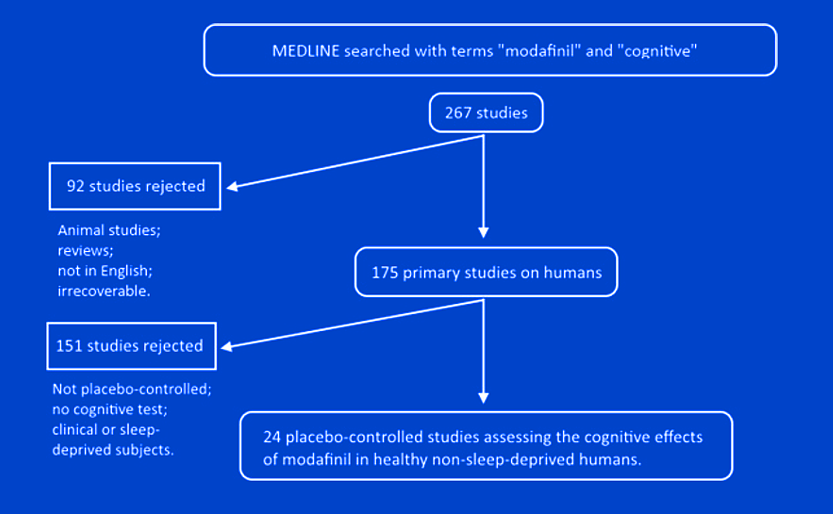
Former studies on sleep-deprived individuals have shown a strong positive effect of modafinil on these functions, but there has been less attention and scientific consensus on the drug’s overall effectiveness as a cognitive enhancer in people that are not sleep-deprived – presumably the majority of people taking it.

The researchers, Dr Ruairidh Battleday and Dr Anna-Katharine Brem, found that the performance-enhancing capacity of modafinil varied according to the task. What emerged was that the longer and more complex the task tested, the more consistently modafinil conferred cognitive benefits.

Modafinil was found to make no difference to working memory, or flexibility of thought, but did improve decision-making and planning.

Very encouragingly, the 70% of studies that looked at the effects of modafinil on mood and side effects showed very little overall effect, although a couple reported insomnia, headache, stomach ache or nausea (which were also reported in the placebo group).

provigil studies


"It appears that modafinil more reliably enhances cognition: in particular 'higher' brain functions that rely on contribution from multiple simple cognitive processes."


"This is the first overview of modafinil's actions in non-sleep-deprived individuals since 2008, and so we were able to include a lot of recent data." said Battleday. "Interestingly, we found that the type of test used to assess modafinil's cognitive benefits has changed over the last few decades. In the past, people were using very basic tests of cognition, developed for neurologically-impaired individuals. In contrast, more recent studies have, in general, used more complex tests: when these are used, it appears that modafinil more reliably enhances cognition: in particular 'higher' brain functions that rely on contribution from multiple simple cognitive processes."

Related articles

According to Brem, a researcher at both the University of Oxford and Harvard Medical School, "We ended up having two main conclusions: first, that, in the face of vanishingly few side effects in these controlled environments,  modafinil can be considered a cognitive enhancer; and, second that we need to figure out better ways of testing normal or even supra-normal cognition in a reliable manner. However, we would like to stress the point that with any method used to enhance cognition, ethical considerations always have to be taken into account: this is an important avenue for future work to explore."

Professor Guy Goodwin, President of the European College of Neuropsychopharmacology (ECNP) commented: "This overview suggests that, on current evidence, modafinil enhances cognition independent of its known effects in sleep disordered populations. Thus, the authors say that 'modafinil may well deserve the title of the first well-validated pharmaceutical nootropic agent'. In other words, it's the first real example of a 'smart drug', which can genuinely help, for example, with exam preparation. Previous ethical discussion of such agents has tended to assume extravagant effects before it was clear that there were any. If correct, the present update means the ethical debate is real: how should we classify, condone or condemn a drug that improves human performance in the absence of pre-existing cognitive impairment?

"As the authors point out, modafinil is not licenced for this use, and it will not be because it would be outside the current terms of reference of regulatory bodies. The non-medical use of mind altering drugs has hitherto broadly conflicted with the work ethic of many societies, has been very popular but leads to a range of demonstrable harms. Regulation has been and remains problematic. We cannot know either if demand for modafinil in the same societies will actually be significant, whether society will be more accepting and how regulation will then be framed.'


SOURCE  Oxford University


By 33rd SquareEmbed


Tuesday, July 29, 2014

Are We Asking The Right Questions About Smart Drugs?

 Smart Drugs  
Are we asking the right questions about smart drugs? Marek Kohn from Mosaic looks at the issue in depth.


"You know how they say that we can only access 20 per cent of our brain?” says the man who offers stressed-out, blank-screened ‘writer’ Eddie Morra a fateful pill in the 2011 film Limitless. “Well, what this does, it lets you access all of it.” Morra, played by Bradley Cooper, is instantly transformed into a superhuman by the fictitious drug NZT-48. Granted access to all cognitive areas, he learns to play the piano in three days, finishes writing his book in four, and swiftly makes himself a millionaire.

Limitless is what you get when you flatter yourself that your head houses the most complex known object in the universe, and run away with the notion that it must have powers to match. More down to earth is the idea that we always have untapped cognitive potential, but that life gets between us and the best we could possibly manage.

Most people’s best days still leave them wondering what might have been. Life is interference, acute and chronic: the broken night’s sleep, the replayed arguments with our nearest and dearest, the suspected slight from a colleague, the mortgage, middle age, the buzzing fly. This is what preoccupation means. Noise, alarms and gnawing unease all occupy the cortex and commandeer its resources, leaving the brain short of space for other demands.

Modafinil Provigil Alertec Modalert

Even small differences in cognitive performance can make a world of difference – between a good CV and an outstanding one, between a second-class degree and a first, and between a winner and an also-ran. According to widespread reports, some students recognize this by using drugs to enhance their performance, particularly ahead of exams or coursework deadlines. How many of them are doing so is unknown: it may be fewer than you would think from reading both mainstream media coverage and scientific journals, but it’s undoubtedly going on.

It’s also been suggested that some students are taking cognitive enhancement drugs on into their professional lives after they graduate – in a report in New York magazine, for example, which dubbed the wake-promoting agent Modafinil ‘the real Limitless drug’.

The drugs concerned are the ‘classic’ psychostimulants: amphetamines (often prescribed under the name Adderall) and methylphenidate (also known by its brand name Ritalin) – both extensively prescribed to children and young adults for the burgeoning diagnosis of attention deficit hyperactivity disorder (ADHD) – as well as modafinil, which is indicated for sleep disorders, including those produced by shift work.

None of these drugs are new. The performance-enhancing effects of amphetamine were reported as far back as the 1930s, among adolescent boys taking the Stanford achievement test. Even the youngest of these drugs, modafinil, was first synthesised in the 1970s, when the term ‘nootropics’ was coined to define a class of drugs that improves the mind. And yet cognitive enhancement drugs are usually depicted as a distinctly contemporary phenomenon, with the implication that more of them are down the road, offering new capacities and increasing ethical challenges.

Cognitive Enhancers Today

When scientists talk about cognitive enhancers today, they are often discussing drugs that mitigate the effects of the dementias and other cognitive disorders, whether they are new candidates or ones already in use such as donepezil and galantamine. Their aim is to recover function or reduce impairment, not improve on healthy levels – although, as populations age, dementias and other cognition disorders will climb healthcare priority lists, and the drugs developed to treat them may also turn out to aid cognition among healthy people, young and old.

By contrast, when futurists and ethicists talk about ‘smart drugs’ or cognitive enhancement, they tend to mean reaching levels of performance that were previously unattainable even under ideal conditions or acquiring new kinds of mental capability altogether.

Related articles
One scientist who is eager to peer at the horizon is Gary Lynch, a professor in the School of Medicine at the University of California, Irvine. What excites him is what he sees as “the ultimate description of enhancement”, the production of new capacities. “I’m interested in [the] capability to do things you can’t do now, thoughts that you can’t think, ideas that you can’t form.” He suggests extreme memory enhancement as an example of something you can’t do now: the concerted boosting of attention, learning and memory could enable you to repeat a conversation verbatim or do mental maths at a far higher level than normal.

Thoughts that can’t be thought and ideas that can’t be formed are, by nature, difficult – if not impossible – to imagine. “It’s at the fringe; it’s beyond current cognitive science,” Lynch admits. For the time being, we remain in the Amphetamine Age of cognitive pharmacology.

What Do Smart Drugs Actually Do?

Cognition is a suite of mental phenomena that includes memory, attention and executive functions. Executive functions are not clearly defined, but you know them when you see them. They occupy the higher levels of thought: reasoning, planning, directing attention to information that is relevant (and away from stimuli that aren’t), and thinking about what to do rather than acting on impulse or instinct. You activate executive functions when you tell yourself to count to ten instead of saying something you may regret. They are what we use to make our actions moral and what we think of when we think about what makes us human. Any candidate cognition drug would have to enhance executive functions to be considered truly ‘smart’.

These are quite abstract concepts, though. There is a large gap, a grey area in between these concepts and our knowledge of how the brain functions physiologically – and it’s in this grey area that cognitive enhancer development has to operate. Amy Arnsten, Professor of Neurobiology at Yale Medical School, is investigating how the cells in the brain work together to produce our higher cognition and executive function, which she describes as “being able to think about things that aren’t currently stimulating your senses, the fundamentals of abstraction. This involves mental representations of our goals for the future, even if it’s the future in just a few seconds.”

At the front of the brain is the prefrontal cortex. This is the zone that produces such representations, and it is the focus of Arnsten’s work. “The way the prefrontal cortex creates these representations is by having pyramidal cells – they’re actually shaped like little pyramids – exciting each other. They keep each other firing, even when there’s no information coming in from the environment to stimulate the circuits,” she explains.

Several chemical influences can completely disconnect those circuits so they’re no longer able to excite each other. “That’s what happens when we’re tired, when we’re stressed.” Drugs like caffeine and nicotine enhance the neurotransmitter acetylcholine, which helps restore function to the circuits. Hence people drink tea and coffee, or smoke cigarettes, “to try and put [the] prefrontal cortex into a more optimal state”.

"People think about smart drugs the way they think about steroids in athletics, but it’s not a proper analogy, because with steroids you’re creating more muscle. With smart drugs, all you’re doing is taking the brain that you have and putting it in its optimal chemical state. You’re not taking Homer Simpson and making him into Einstein."


In a broad sense, it’s enhancement; in a stricter one, it’s optimization. “I think people think about smart drugs the way they think about steroids in athletics,” Arnsten says, “but it’s not a proper analogy, because with steroids you’re creating more muscle. With smart drugs, all you’re doing is taking the brain that you have and putting it in its optimal chemical state. You’re not taking Homer Simpson and making him into Einstein.”

What’s more, the brain is complicated. In trying to upgrade it, you risk upsetting its intricate balance. “It’s not just about more, it’s about having to be exquisitely and exactly right. And that’s very hard to do.”

Scientists are frequently reminded of the difference between ‘more’ and ‘right’ when they administer cognitive enhancers. Methylphenidate improves working memory in rats performing tasks that involve the prefrontal cortex, but only in a narrow range of doses. The graphs rise, level off and drop, tracing a path from ‘not enough’ to ‘too much’ in the shape of an inverted ‘U’. Outside the lab, this point can be illustrated by comparing the effects of the first coffee of the day with those of the second or third.

A drug’s scope for enhancement may also be compromised by differences in optimal doses among the various circuits it affects. “What’s good for one system may be bad for another system,” says Trevor Robbins, Professor of Cognitive Neuroscience at the University of Cambridge. And it may be bad for the system as a whole.

“It’s clear from the experimental literature that you can affect memory with pharmacological agents, but the problem is keeping them safe,” Robbins observes, “because this inverted-U-shape issue does give you the problem of possible epilepsy, convulsions and so forth.”

Focusing Attention

The defining cognitive challenge of modern life is how to divide attention efficiently among multiple tasks and stimuli: not just how to concentrate, but how to compartmentalise. It’s about switching rapidly and smoothly between tasks, keeping the unresolved material from each to hand while the processor swivels round to the next. It’s the difference between the classical ideal of scholarship, of unqualified absorption in a single theme, and the reality of mental operations in a multiple-choice world where we are constantly beset by competing bids for our attention.

“Those two types of attention are really in opposition to each other,” says Barbara Sahakian, Professor of Clinical Neuropsychology at the University of Cambridge. The implication is that if you enhance focused attention, it will be at the expense of divided attention, and vice versa.

However, Martin Sarter, a professor at the University of Michigan, sees it differently. According to Sarter, “pretty much everybody” in the field agrees that we deal with multiple tasks by ‘time-sharing’, tackling “one task at a time and using more or less complicated scripts to flip between tasks. This comes down to working memory plus focused attention.”

"It’s clear from the experimental literature that you can affect memory with pharmacological agents, but the problem is keeping them safe."


Increasing focus, Sarter argues, increases the amount of work the brain gets done on a task before it switches to another, and thus reduces the amount of unfinished material from the task that has to be held in working memory until its turn comes round again. A drug that enhances focused attention will lower demands on both working memory and the control systems that monitor and manage the tasks in hand.

“That, we understand a bit,” says Sarter. “How to enhance working memory capacity or executive control independently, I don’t think we do understand, but that would be a neat trick.”

Enhancing Your Enjoyment of Using Your Brain

People have known for a long time that stimulants can make users warm to their tasks. In 1916, when a man named Horace Kingsley was arrested in a pub on England’s south coast for selling cocaine to soldiers, the authorities charged him with ‘selling a powder to members of His Majesty’s Forces, with intent to make them less capable of performing their duties’. On the contrary, he argued: “It makes you most keen on what you are doing.”

"I remember getting just completely absorbed in one book, and then another, and as I was writing I was making connections between them [and] actually enjoying the process of putting ideas together. I hadn’t had that before."


Although it doesn’t produce the buzz that hedonistic drug-takers pursue, modafinil may have other, more subtle attractions. Researchers at the University of Cambridge found it increased people’s enjoyment of the cognition tests they were set, without improving their general mood.

“Under placebo, there’s not much pleasure there at all, but under modafinil suddenly these tests seem very pleasurable,” remarks Sahakian. Performance in planning and working memory improved, too. Sahakian considers modafinil a true cognition enhancer, enabling young and healthy people to perform better on difficult tasks than when they are given a placebo.

Other scientists are sceptical about whether any of these drugs enhance cognition directly, rather than by improving the user’s state of mind. “I’m just not seeing the evidence that indicates these are clear cognition enhancers,” says Sarter, who thinks they may be achieving their effects by relieving tiredness and boredom. “What most of these are actually doing is enabling the person who’s taking them to focus,” says Steven Rose, emeritus professor of life sciences at the Open University. “It’s peripheral to the learning process itself.”

It may, however, be central to the person’s experience of what the learning experience feels like. Judging by accounts such as those gathered at an elite (unnamed) American university by researcher Scott Vrecko and published in 2013, the magic of cognitive enhancers lies in their ability to make study a pleasure. They overcome lethargy, reluctance and lack of confidence.

“I’ll get out my books, laptop, and stuff, but even that can be a challenge,” a student called Sarah told Vrecko. But when the Adderall takes effect, “all of a sudden I’ll just be like, ‘Oh wait. I can do this.’”

The doors of engagement open, as described by another student: “I remember getting just completely absorbed in one book, and then another, and as I was writing I was making connections between them [and] actually enjoying the process of putting ideas together. I hadn’t had that before.”

These students did not see their drug use as anything more than the removal of things that got between them and studying. They didn’t think drugs made them smarter. Yet even so, it would be unwise to assume that the effects were as impressive as their users thought they were.

As the psychologist Derek Russell Davis dryly observed back in 1947, “the subject who has taken amphetamine usually judges the effects more favorably than the experimenter”. By way of illustration, he recalled how “a research colleague, left to his own devices after a dose of amphetamine, spent a morning preparing with great thoroughness a grandiose research-plan, of which he would never find time to carry out even a quarter.”

One finding from a 2010 review of research that may come as a surprise to students who trust stimulants is that methylphenidate does not enhance attention and may even interfere with it. A recent study of Adderall at the University of Pennsylvania showed the drug failed to significantly affect cognition in healthy young adults – although those who took it mostly believed that it had.

In this kind of drug-taking, sensation isn’t the goal but the effect of pursuing other goals. Recognising it as a distinct form of drug use – for neither medication nor recreation, but for application – raises several questions: one is whether these drugs are effective over sustained periods (the 2010 review of work on modafinil and methylphenidate found only two studies for each drug that looked at the effects of repeated doses, and the longest of those lasted just six weeks), and another is what effects they might have on their users’ health. Sahakian emphasises the need for a long-term study “to determine whether these cognitive-enhancing drugs are safe for healthy people to use,” adding that “our brains are in development into late adolescence and even young adulthood, [so] these safety concerns are particularly great for young, healthy people.”

There May Be A Price

Drugs and catastrophe are seemingly never far apart, whether in laboratories, real life or Limitless. Downsides are all but unavoidable: if a drug enhances one particular cognitive function, the price may be paid by other functions. To enhance one dimension of cognition, you’ll need to appropriate resources that would otherwise be available for others.

“There are costs to narrowing your attention,” Sarter points out. “Not only all the stuff in the periphery that might be very significant that you might be missing, but internally – if you narrow your attentional field, it also narrows the range and scope of associations you could bring into your thought process.”

In many settings that could well prove costly – but in others, where you’re not being asked to think about the meaning of life, it could be beneficial. The inability to attend to one’s internal network of associations would be desirable in an air traffic controller, for example.

If paying Paul always requires robbing Peter, we can’t expect drugs to produce a general, cortex-wide expansion of cognition. But by allocating extra resources to one domain or the other, could you surpass the maximum levels you could previously have attained or even the highest levels attained by anyone?

“I think you can and you will,” says Sarter, “but you will do so with respect to very defined functions within very defined task contexts.”

For example, one of cognitive psychology’s most famous findings is that people can typically hold seven items of information in their working memory. Could a drug push the figure up to nine or ten? “Yes. If you’re asked to do nothing else, why not? That’s a fairly simple function.”

Beyond the Amphetamine Age

Scientists’ opinions differ on the prospects for progressing beyond the Amphetamine Age. Rose thinks that because most drugs work by affecting multiple brain processes, the idea of a pure ‘nootropic’ that very specifically affects coding is implausible and has “long gone by the board”. At the other end of the neuro-optimism scale, Lynch says “we are very close to being able to allow people to encode better”.

Lynch argues that recent advances in neuroscience have opened the way for the smart design of drugs, configured for specific biological targets in the brain. “Memory enhancement is not very far off,” he says, although the prospects for other kinds of mental enhancement are “very difficult to know… To me, there’s an inevitability to the thing, but a timeline is difficult.”

Lynch speaks after spending many years in an ultimately unsuccessful bid to develop a class of molecules called ampakines as a treatment for Alzheimer’s disease. “The ampakines have been around for quite a while,” he acknowledges. “They’ve gone into trials on ADHD; they’ve been in trials on memory. The problem has always been [that] there are side-effects.”

Echoing Robbins’s caveat about convulsions, Lynch draws a somewhat alarming lesson from his experience for researchers seeking new drugs to organise larger cognitive networks within the cortex: “The trick is not just to expand the networks, but to expand the networks without increasing the likelihood of seizures or some kind of psychosis. That may, in fact, be the most difficult part of the problem.”

Lynch points to nicotinic receptor agents – molecules that act on the neurotransmitter receptors affected by nicotine, without necessarily being related to nicotine itself – as ones to watch when looking out for potential new cognitive enhancers. So does Sarter, who also emphasises the importance of basing cognitive enhancer research on neurobiological knowledge. A class of agents known as α4β2* nicotinic receptor agonists seem to act on mechanisms that control attention, Sarter says, “and to do so in a very orderly fashion that maps them to the neurobiology.” Among the currently known candidates, he believes they come closest “to fulfilling the criteria for true cognition enhancers.”

He is downbeat, however, about the likelihood of the pharmaceutical industry turning them into products. Its interest in cognitive enhancers is shrinking, he says, “because these drugs are not working for the big indications, which is the market that drives these developments. Even adult ADHD has not been considered a sufficiently attractive large market.”

A substance called piracetam was once widely touted as a smart drug, as Rose recalled in a commentary piece published in 2002. Piracetam still has its enthusiasts, but its name is now mostly a reminder that candidate drugs come and go. “There have been a lot of clinical trials for a lot of substances that didn’t do anything,” observes Sarter.

Frustrated by the lack of results, pharmaceutical companies have been shutting down their psychiatric drug research programmes. Traditional methods, such as synthesising new molecules and seeing what effect they have on symptoms, seem to have run their course. A shift of strategy is looming, towards research that focuses on genes and brain circuitry rather than chemicals. The shift will prolong the wait for new blockbuster drugs further, as the new systems are developed, and offers no guarantees of results.

Lynch, Sarter and the pharmaceutical industry all agree that developing smarter drugs will require smarter science. A few new drugs (perhaps nicotinic receptor agonists, as Lynch and Sarter suggest) might emerge in the current system, but to find out what's possible beyond that will need a reinvented research programme. For real success, research needs to show what these drugs can do at the level of systems neuroscience and to establish systematic relationships between drug effects on circuits, receptors, behaviour and cognitive operations.

The Elusive Smart Drug

In the meantime, with no end to the Amphetamine Age in sight, smarter answers are needed for the unanswered questions about the drugs people already take in the hope of enhancing their cognitive powers – questions about whether they work, how they work, whether they work differently in people with different gene variants, the effects they have on the mind after their initial novelty has worn off, and the effects they may have on our health and wellbeing in the long term.

Despite decades of study, a full picture has yet to emerge of the cognitive effects of the classic psychostimulants and modafinil.


Despite decades of study, a full picture has yet to emerge of the cognitive effects of the classic psychostimulants and modafinil. Recent reviews indicate that they may help to lay down long-term memories and perhaps help keep information present to hand in working memory. They may also enhance ‘cognitive control’, the ability to adapt behavior in changing conditions, particularly in people whose powers of cognitive control are modest to start with.

Part of the problem is that getting rats, or indeed students, to do puzzles in laboratories may not be a reliable guide to drugs’ effects in the wider world. Drugs have complicated effects on individuals living complicated lives. Determining that methylphenidate enhances cognition in rats by acting on their prefrontal cortex doesn’t tell you the potential impact that its effects on mood or motivation may have on human cognition.

It may also be necessary to ask not just whether a drug enhances cognition, but in whom. Researchers at the University of Sussex have found that nicotine improved performance on memory tests in young adults who carried one variant of a particular gene but not in those with a different version. In addition, there are already hints that the smarter you are, the less smart drugs will do for you. One study found that modafinil improved performance in a group of students whose mean IQ was 106, but not in a group with an average of 115.

There are smarter questions to ask about fairness and cognition-affecting drugs. So far, the ethical anxieties have revolved around elite competition: whether students who take drugs to enhance performance are cheating, and whether they will put pressure on their peers to do likewise to avoid being at a competitive disadvantage. But attention is not just a problem for the minority who reach higher education or certain professions.

In their book Scarcity: Why Having Too Little Means So Much, Sendhil Mullainathan and Eldar Shafir describe how they dumbed people down by inducing them to think about the cost of living. Recruiting shoppers from a New Jersey mall, they prefaced cognition tests with a hypothetical question that invited respondents to imagine they had to get their cars serviced. They also asked the shoppers to disclose their household incomes. When the price of the service was given as $300, the scores of rich and poor were indistinguishable. When it was $3,000, the poorer shoppers scored worse; in fact, their scores were worse than those of people who did similar tests after a night without sleep. Their results implied a drop in IQ of 13 or 14 points, the difference between average and ‘borderline deficient’ intelligence.

Mullainathan and Shafir argue that the increase in the imaginary cost triggered a reallocation of mental capacity among those for whom such a sum would be a serious problem in real life. It activated thought processes that would not shut off, reducing the computational power available to process the intelligence tests. If that is what a hypothetical problem can do, the effects of poverty and money worries in the real world must be a cognitive scandal of staggering proportions.

Mullainathan and Shafir’s work points towards a bigger picture of fairness in cognitive enhancement. One message that has emerged from the research so far is that cognition-affecting drugs do more for lower performers than high-fliers and that they can offset disadvantages, such as lack of sleep. Drugs that promote concentration might help poor people in their efforts to better themselves – studying at night school while fatigued from long hours of labour, for example – or, if Sarter is right about how improving focused attention can make it easier to deal with multiple demands, in coping with bills that outnumber earnings.

It’s certainly better to enhance cognitive performance through healthy living, fitness and educational opportunities than by taking pills. But we also have to recognise that it is far harder for the poor to achieve best cognitive practice than the rich. The question of whether drugs could help people get out of poverty, by offsetting its cognitive impact on them, might actually be the smartest question we can ask about smart drugs.


SOURCE  This article was originally commissioned by Mosaic [mosaicscience.com], a new digital publication from the Wellcome Trust dedicated to exploring all strands of the science of life. It is reproduced under a Creative Commons Attribution 4.0 International Licence [http://creativecommons.org/licenses/by/4.0/] 

By Marek KohnEmbed