bloc 33rd Square Business Tools - same day delivery 33rd Square Business Tools: same day delivery - All Post
Showing posts with label same day delivery. Show all posts

Tuesday, September 5, 2017

Electric Delivery Truck


Fred Smith birthed the idea for FedEx at a management class at Yale, a course that he purportedly got a C, according to the legend. Then, the idea of online ordering and doorstep delivery seemed too far-fetched. Fast-forward many years later, thanks to the e-commerce bubble, same day delivery services are the norm. From drones to electric trucks, getting ordered goods at your doorstep has never been easier.


There are a few challenges here and there, and most of these technologies are still in their infant stages, but things are looking up. Today, innovations relating to e-commerce and home delivery are focussing on speed and reducing friction during transactions. Speaking of which, electric trucks have been in the headlines for quite some time now, here's how they are going to change the package delivery business once the technology takes off.


Reduced Delivery Costs

One of the biggest challenges in any business is cost. If the cost of doing business exceeds the profits generated, then there is no point. The delivery business is no different, and the cost of delivering packages to the doorstep has always been high. Way before the technology boom in the 1990s, many logistics companies had to shut down due to the technicalities involved in the business.

Over the years, things have been changing gradually, and the cost of making doorstep deliveries has also been reducing. Today, the delivery business is on the verge of starting to use electric trucks, as opposed to diesel trucks, to deliver packages across the country. Electric delivery trucks reduce the cost of delivering packages at about 75 percent. The lower cost of doing business will then be transferred to the final consumer in terms of lower delivery prices. When the rates are affordable, many people will be able to use the services.

Related articles

Higher Home Delivery Efficiency via Drone-And-Truck Systems

Technology breeds efficiency. With electric trucks, we can expect a relatively higher level of efficiency in the delivery business. Electric trucks are perfect in an urban setting since they are best suited for shorter distances. In the rural areas where distance that needs to be covered to make a delivery is larger, electric trucks can be supplemented by drones.

Both these technologies are expected to take off at the same time, and the probability of supporting each other via drone-and-truck systems is high. When driving to isolated locations, an electric delivery truck by itself would be inefficient. A drone can be placed on top of the truck to carry out last mile deliveries and eliminate inefficiencies. Making deliveries to secluded homes in rural landscapes will be much easier with the combination of trucks and drones.


Less Environmental Pollution

Heavy and medium duty automobiles represent only four percent of vehicle population in the United States. However, these vehicles consume more than 20 percent of the transportation fuel consumed in the country. Hybrid, electric, and other advanced vehicle technologies can dramatically reduce fuel consumption in the US leading to lower fuel costs and improved quality of the air we breathe.

If you are conscious about the environment, then you have one more reason to be excited about electric delivery trucks. They are eco-friendly, zero emissions to the environment. On top of that, the entire cost of maintaining the vehicle will be reduced — including car insurance. Most car insurance providers offer eco-friendly discounts. Doing a thorough auto insurance quotes comparison can help you get the best discounts, hence the best rates.

The doorstep delivery business is on the verge of a technological revolution. Electric delivery trucks and drones are just the beginning of this revolution and will be causing massive changes in the business. It's up to companies in the business to adapt or lag behind. The earlier, the better.


By  Carol EvensonEmbed

Carol Evenson is a corporate trainer and experienced business consultant. She specializes in team management and growth hacking.


Monday, April 13, 2015

Food Delivery in 2015

 Business
On-demand grocery delivery has been a business model struggling to gain traction since the first dot-com boom. Now the UK's Ocado is looking to expand international operations, despite heavy competition from the likes of Amazon and others.


Investors, it seems, have a complicated relationship with Ocado, the world’s largest dedicated online grocery supermarket based in the United Kingdom.

After its IPO back in 2010, the company spent two and a half years dwindling in value. By the beginning of 2013, it had shed around 50% off of its share price as the markets feared it may never turn a profit.

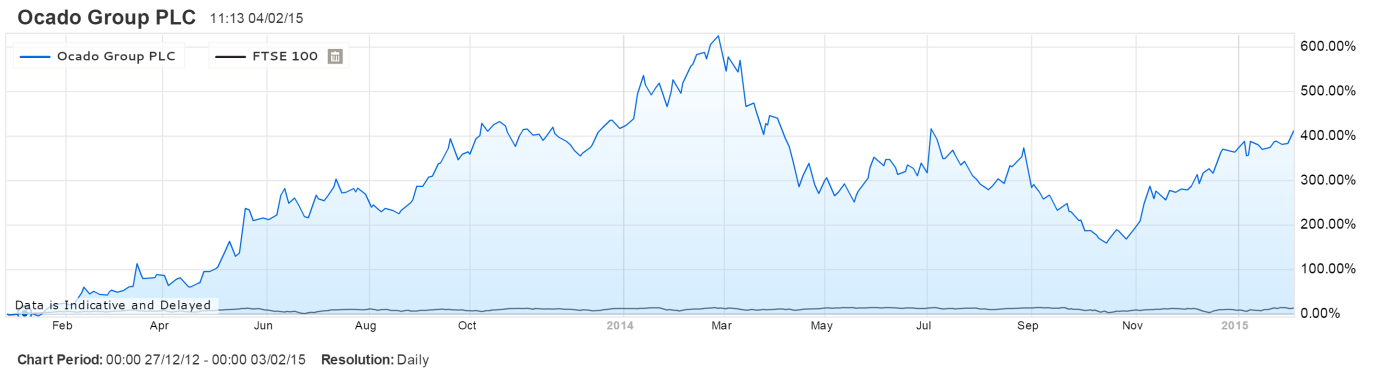
What happened over the next 14 months was nothing short of spectacular. The company rocketed up the stock markets, increasing 600% in value to around £600 per share. The company still hadn’t turned a profit.

It shouldn’t have been too much of a surprise, then, when Ocado’s value headed straight back down again over the next nine months, towards the £210 level. A recovery of sorts followed, and Ocado went into February worth around £415 per share (giving them a market cap of £2.5 billion).

On February 3, Ocado released its earnings to the markets. For the first time in its history, the company delivered a yearly profit. That amounted to a pre-tax profit of £7.2 million, up from a loss of over £12 million in the previous year. Revenues were close to the £1 billion mark. Shares increased 5% off of the back of the announcement.


Related articles
Ocado’s performance against the FTSE 100. Live indices prices chart available.

For a company with a history as volatile as Ocado’s, a 5% move seems a little subdued, and in truth there are a few reasons why the markets didn’t overreact to the announcement. Ocado’s profit did not come entirely as a surprise, with quarterly earnings results pointing to a healthy year. Ocado’s business strategy also means that hitting profit for the first time might not necessarily mean a run of wealth for investors. Rather, Ocado’s owners tend to reinvest any spare cash on aggressive expansion.

CEO Tim Steiner has already mooted a deal that could see his company expand internationally. He was unwilling to divulge any information on what companies Ocado is in discussion with, but did say that he was targeting a deal in 2015.

There are also several possible problems on Ocado’s horizon. Most of the company’s business has been made delivering for Waitrose, in a deal that could be set to end– thanks to a break deal in the contract. Mr. Steiner has refused to speculate on what could happen to his company’s deal with Waitrose, though he has stated that it is Ocado’s interest for it to continue.

The company also has a relationship with Morrisons, to run the flagging supermarket’s much-needed online shopping business. The usefulness of such a relationship may be limited, however, with Morrisons looking set for yet more trouble in the ongoing supermarket price war. As competition in the supermarket sector ratchets up, Morrisons looks in trouble.

Then there is the potential rivalry with a much bigger player, one much closer to Ocado’s business model. Amazon has been using its expertise in online delivery to grow a grocery store over in the US, under the brand AmazonFresh. Only available in a few cities at the moment, the business is widely expected to grow in the coming months: not just in the US, but internationally.

Mr. Steiner was recently asked about the threat of AmazonFresh, with the CEO responding that more competition didn’t concern him. His business already competed with big players in the UK supermarket sector. But Amazon’s similarity to Ocado makes it a much greater threat. Like Ocado, it will invest greatly in winning customers, choosing not to focus on pleasing shareholders. Like Ocado, it can emphasize convenience and technological superiority and as such avoid the threat of discounters Lidl and Aldi. It also has the added boost that comes with a globally recognizable brand and considerable wealth.

Attempting to discern how Amazon might impact Ocado’s business would require feats of insight beyond most of us. What is clear is that the current stratification evident in the grocery industry may well prove to be hugely powerful for Ocado: and increased competition at all levels can only be a win for customers.

Spread bets and CFDs are leveraged products. Spread betting and CFD trading may not be suitable for everyone and can result in losses that exceed your deposits, so please ensure that you fully understand the risks involved. 


SOURCE  This information has been prepared by IG, a trading name of IG Markets Limited. The material on this page does not contain a record of our trading prices, or an offer of, or solicitation for, a transaction in any financial instrument. IG accepts no responsibility for any use that may be made of these comments and for any consequences that result. No representation or warranty is given as to the accuracy or completeness of this information. Consequently any person acting on it does so entirely at their own risk. Any research provided does not have regard to the specific investment objectives, financial situation and needs of any specific person who may receive it. It has not been prepared in accordance with legal requirements designed to promote the independence of investment research and as such is considered to be a marketing communication. Although we are not specifically constrained from dealing ahead of our recommendations we do not seek to take advantage of them before they are provided to our clients.

By Debbie FletcherEmbed

Friday, February 27, 2015

Amazon Plans to Create 3D Printing Delivery Trucks: a Wild Idea or Stroke of Genius?

3D Printing
A patent has surfaced showing Amazon's plans to create 3D printing delivery trucks that actually print products in the truck on the way to be delivered. The document shows just how far the company is willing to go to speed up delivery times.


Amazon has announced many ambitious projects in the past year, most of which have gained substantial attention and buzz. The projects getting most of the press coverage are the internet giant's proposal to use drones to deliver products and making a number of TV pilots, but very recently, another project was announced informally through a new patent that Amazon filed. So far, it is believed that Amazon plans to create (and patent) 3D-printing delivery trucks. Is this a wild idea, or a stroke of genius?

Entering the Industry

The patent, called "Providing Services Related to Item Delivery via 3D Manufacturing on Demand”, is essentially an effort to deliver 3D printed items manufactured on a truck to customers who ordered any given printed item. 3D printing, also known as additive manufacturing, is a process in which three dimensional objects can be printed from a CAD (computer aided design) file. Being a newly commercial and disruptive technology, it makes sense that a diversified company such as Amazon wants to get into the industry.

The Plan

It should be made clear that the 3D printing trucks that Amazon is proposing will double as delivery trucks. The patent lays out a sequential series of steps in regards to how this process will likely happen: first, a customer places an authorized order, the 3D printable order is sent to the manufacturing and delivery truck that is most proximal to the customer, and the item is produced en route and delivered once complete.

Related articles
The patent also covers subtractive printing, which is the process of taking a block of material and removing chunks in order to obtain any given shape remains. It also appears as if Amazon will work with metal machining via CNC equipment, rather than just plastic.

Will this Truly Lead to Better Logistics and Customer Service?

There is speculation that 3D printed items may be manufactured and sent to customers without them even ordering them—Amazon has stated a desire to do this with other items based upon one's search history. In addition to trying to expedite the delivery process, Amazon is also doing this to save valuable warehouse space. In addition to being delivered, an individual could pick up an item from an Amazon Locker. This service could be used for both recreational items and needs. Amazon provided the example of a faucet handle being broken, and ordering a new 3D printed one seamlessly through a smartphone.

It is hard to know when this service may come to fruition. The patent was filed with the Patent and Trademark Office in late 2013, but the application was published just now. Amazon has declined to comment on the matter to news sources, so they might try to keep it under wraps for a little longer.

Although the technology is there, it would take a lot to get this service up and running. Only time will prove the validity and success of this wild idea, and as time passes, this allows other companies the opportunity to jump on the 3D printing and delivery idea. Whether or not Amazon has competition in this endeavor, they will have plenty of work ahead of them to bring this idea to fruition.

The information for this article was provided by the professionals at 99 Truck Parts & Industrial Equipment Ltd., who provide truck parts in Langley.


By Dixie Somers
Embed