bloc 33rd Square Business Tools - robotics 33rd Square Business Tools: robotics - All Post
Showing posts with label robotics. Show all posts

Sunday, June 18, 2017

Qbo One Robot Looks to Impact the Classroom


Robotics

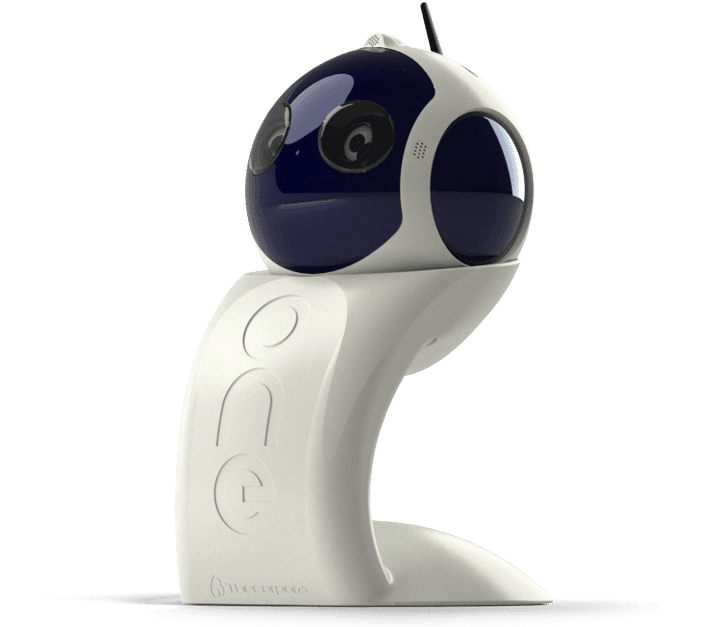
The Qbo robot has been around for a few years, and now it is about to have a little brother. The Qbo One may not be mobile, but it has many of the same features as the original Qbo robot. Look for this cute bot soon on Indigogo.


In 2011, the original Qbo robot turned a few heads in the robotics community, especially when it appeared to recognize itself in a mirror. Soon The Corpora, makers of the cute little robot, will release the next generation Qbo robot, appropriately named the Qbo One. Presented as a much lower cost and more widely available bot, Qbo One doesn't have any mobility features; instead, it’s meant to sit atop your desk and interact with you from there.


Qbo One Robot


The robot has a very attractive curved shape with a round capacitive touch head, eyelids, and a mouth made of LEDs that allows it to express emotions.

Unlike Qbo, Qbo One is designed to be a desktop  interactive robot closely aligned as a product for everyday users.  It is easy to use and understand and could be ideal for educational implementation.

According to The Corpora, Qbo One is a very good platform for schools because the robot can reach out to kids as young as eight years old and teach them robotics and programming using the robot. Kids can learn about various sensors and make them work with simple programming language like Scratch.
Qbo One Robot

Qbo One is based on Raspberry Pi 3 and Arduino. Both boards are attractive embedded platforms among hobbyists from several reasons including their low price, easy way to interface different sensors and actuators and a large community that share information and resources.

Qbo robot
Qbo has seen many updates over the years. The distinctive round head remains on the new model.
Related articles
With the two cameras in its eyes, the Qbo One robot can see, recognize and track faces, capture photos, and enable immersive video calling. Three microphones and natural language processing let you talk to Qbo One from anywhere in the room.

The robot's mouth made of LEDs and a speaker connected to a sound card so he can do sophisticated sound manipulations and the head comes with two digital servos that control up and down movements along with right and left movements.

Q.bo One is fitted with a capacitive sensor on the top of his head that is divided into three sections which lets him react appropriately to touch.

An Indiegogo campaign will begin this month to secure funding for Qbo One. 


SOURCE  The Corpora


By  33rd SquareEmbed


Monday, April 24, 2017

This Robot Could Prevent You From Ever Having To Get A Colonoscopy


Robotics

Biomedical technology has taken the next step toward simplifying the colonoscopy process, which is possibly the least-looked-forward-to medical procedure of all time. The current procedure requires the use of a small camera placed at the end of a flexible tube that is then inserted into a patient’s--body. 


A group of scientists have begun the work to minimize the procedure’s discomfort by creating a digestible snake-like robot that would move itself through the digestive system.

The robot, named SAW — single actuator wave-like robot — was built at the Ben-Gurion University of the Negev in Israel and is evolving into the foreseeable solution for visualizing the insides of both the small and large intestine.


Motion of the Wave

SAW is unlike most moving devices due to its dynamic movement. While most bots have wheels or legs to move, SAW moves using the wave-like motion of its body. This is possible, in part, due to the SAW’s calculate actuator travel life that enables it to move by pushing the area around it. Like a snake that slithers and writhes its body forward, SAW rotates its helix-like shape in a single direction that allows for movement through many interesting terrains.

The intestines are full of many strange, twisting directions that make it difficult for doctors to map patients’ intestines. Conventional medicine uses a swallowable pill-sized camera to help doctors inspect intestines. Unfortunately, this process comes with myriad flaws that make mapping the intestines difficult or impossible. Here are a few of them:


  • They require digestion. Since the pill cameras are swallowed, they follow the body’s natural digestion rate to pass. This means it could take 12 hours to see the insides of a patient.
  • They can be blocked. It isn’t uncommon for pill cameras to become stuck or blocked inside the intestine. When this happens, doctors and patients run the risk of having the pill camera lose its charge while getting passed.
  • They’re only visual. Camera pills can only examine the inside of a patient with a small camera. Ideally, doctors would like to take samples of anything they see in the body, but this isn’t possible — at least not yet.


Big Power in Small Sizes

Currently, the SAW is made of relatively small pieces of interlocking plastic provided by a 3D printer. At its current state, it’s too big to use. The dream of doctors using the SAW is to shrink it down enough to fit in the remarkably thin small intestine. This would give doctors a greater look at something that it’s tough to see — inside the digestive tract.


SAW Robot


Related articles
The future SAW wouldn’t be made of plastic but of simple biocompatible latex or a rubber substance that can withstand digestion while staying flexible.

The team of engineers and researchers at the Ben-Gurion University of the Negev have a great deal of work to do before a useable SAW is released, but the dividends of the work would be well worth the trouble. With a small remote controlled device that would move through natural curves of the body, doctors could conceivably do much more than map internal organs.

Ideas like installing small scalpels to cut tissue samples or electric-cauterizing tools that could possibly stop internal bleeding have already been mentioned. With all the buzz the device is creating, many in the bioengineering world are excited to see where and when the device will become available for testing. The researchers at the Ben-Gurion University of the Negev are getting ready to begin testing on pigs, and, if the results are positive, medical technology will be much better for it.


By  Kayla MatthewsEmbed

Kayla Matthews writes about marketing innovation and business solutions for Inc.com, Convince & Convert and WeWork. You can read more posts by Kayla on her blog, Productivity Theory.


Monday, March 20, 2017

Now We Can Communicate With Robots Using Just Our Brains


Brain-Machine Interfaces

In the past, we could only communicate with robots by giving them very specific instructions. New deep learning technologies have recently allowed robots to teach themselves. Now, researchers have devised a way for people to communicate with robots using just their brains. 


Computer scientists from MIT's Computer Science and Artificial Intelligence Laboratory (CSAIL) and Boston University created a system that monitors a person’s brain waves with an electroencephalography (EEG), which it then uses to determine if the human agrees with the robot’s decision. It can classify brain waves in just 10 to 30 milliseconds.

If the system detects "error-related potentials" (ErrPs), brain signals that the brain creates whenever it notices a mistake, the robot will become aware that it made or was about to make the wrong choice.

The researchers are also working on enabling the robot to identify secondary errors, such as those that occur when the system doesn’t notice the human’s signal that it made a mistake. Once it can do that in real time, the team suspects its accuracy will improve by up to 90%.

At the moment, the system can decide between only two options, but because ErrPs are stronger when more serious errors occur, robots may be able to interpret the brain waves to help them make more complex decisions that incorporate more choices.

The potential uses for this technology are tremendous. Being able to better communicate with robotic systems could improve their effectiveness and lead to improvements in technologies across various industries.

Brain Controlled Robot

Related articles

Healthcare

Brain-wave communication may be especially promising for the healthcare field. Healthcare professionals currently use robots for surgical procedures, patient care and even companionship for patients. Improving communication with these systems could make them much more useful.

Robots may be programmed to perform tasks or communicate for people who are nonverbal. With this new technology, even if someone can not speak and is also physically incapacitated, they could still communicate with the robot using just their brain.

Surgeons often use robots to assist with medical procedures. They sometimes employ tiny microbots to repair injuries, deliver medications and locate tumors inside the body. This type of procedure is extremely non-invasive, cuts down on the possibility of human error and could potentially even makes surgeries easier for doctors by avoiding the poor visibility caused by surgical smoke.

The researchers’ system also has the potential to greatly improve prosthetics. Controlling a robotic prosthetic limb with just one’s mind would make it much easier to control and may feel more natural to those who depend on prosthetics.

Transportation

Driverless vehicle technologies have advanced significantly in recent years, but they’re still susceptible to errors. Human drivers can take over in these situations, but drivers often have just a few seconds to react.

Being able to correct a mistake made by an autonomous vehicle using only brain waves would increase the speed of correcting the mistake because it would require the human driver to take minimal action. Even if an improvement of only a few seconds was achieved, it could make the difference between avoiding an incident and experiencing a crash.

The technology could also allow someone in an autonomous vehicle to more quickly and conveniently customize their experience. They could, for example, tell the computer to alter their route, speed up or slow down and perhaps even change the radio station.

Manufacturing

Robots in manufacturing have become increasingly common and more advanced. The robots of yesteryear were large, could only complete one or two specific tasks, couldn’t be used for detailed work and could injure a person if they got too close.

Today’s bots are multi-talented, can work even with minuscule parts and are designed to work collaboratively with humans. Communicating with robots usually requires thinking in a certain way because the robots’ understanding of human interaction was limited. For example, you might have to look at a specific and different light display for each task you wanted the machine to complete.

Communicating through brain waves allows for more much more natural, quick and nuanced communication that’s less tiring and allows for greater control.


Robotics is becoming progressively more integrated into our way of life and increasingly advanced, as is the way we communicate with these machines. This discovery represents an exciting development in the way we communicate with robots that could make them much more effective and lead to innovations in a variety of industries.


TOP IMAGE SOURCE  Pixabay


By  Kayla MatthewsEmbed

Author Bio - Kayla Matthew is a technology writer and the owner of ProductivityBytes.com. She is also a regular contributor to VentureBeat, MakeUseOf and Motherboard.


Tuesday, December 6, 2016

Difficult Terrain Now Presents No Challenge to ATLAS Humanoid Robot


Humanoid Robots

Four-legged Boston Dynamics robots are well known for their ability to maintain balance in uneven terrain. Now, the same feat has been achieved by researchers using the humanoid robot, ATLAS. Check out the astonishing video!


The Institute for Human and Machine Cognition (IHMC) Robotics Lab in Pensacola, Florida has developed a system by which a Boston Dynamics ATLAS robot can navigate across a series of different surfaces of different sizes and geometries.

As the video below shows, even masonry blocks that have been turned on their sides and placed at various angles in a course present little challenge to ATLAS.

"It vastly extends the set of environments a robot can traverse."
"After a step is taken, the robot explores the new contact surface by attempting to shift the center of pressure around the foot," the researchers stated in a paper that details the walking technique. "The available foothold is inferred by the way in which the foot rotates about contact edges and/or by the achieved center of pressure locations on the foot during exploration."

ATLAS walking on difficult terrain


Related articles
The robot has has no prior knowledge of the terrain laid out in front of it. ATLAS tests the surface one foot at a time, shifting its weight around in the process and finally applying it to the supported foothold. The process is supported by angular momentum provided by the robot’s upper body as the humanoid robot executes some of the more difficult steps.

The project is one of a series of bipedal walking projects being undertaken by the institute.

"The ability to walk on unexpected partial footholds greatly increases the robustness of a robot when employed in cluttered environments," state the researchers. "In addition it vastly extends the set of environments a robot can traverse...In the future, we hope to improve the balancing capabilities of our robot by improving our control algorithms and state estimation and by applying the algorithms to robots with higher joint velocity limits."


SOURCE  DRCihmcRobotics


By  33rd SquareEmbed


Monday, November 7, 2016

This Hexapod Robot Has Some Serious Intelligence


Robotics

HEXA is a new all-terrain hexapod robot that can find its way through different environments. It also supports various machine learning algorithms and image, video, face, and voice recognition, which means it can navigate through dangerous obstacles, avoid falling off a table, and recognize who you are.


White some artificial intelligence companies are busy building robots with wheels and faces, Chinese-based Vincross claims to take a totally different approach. The company is about to launch its first product, the all-terrain robot HEXA, and it will be the first robot that can climb stairs in the market. This six-legged robot-spider can walk, climb, and travel across rough terrain, which makes it suitable for scientific expeditions. Vincross also says the robot can be used in firefighting, rescue operations, and even Elon Musk's Mars plan.

Vincross’s founder and CEO, Sun Tianqi, has extensive experience in robotics and artificial intelligence. Before starting Vincross, Tianqi worked as an AI scientist at Tsinghua University, where he conducted research on neural modeling and neural networks. While studying in university, he also translated the biography of AI’s founding father – Alan Turing: The Enigma.

“My research on artificial intelligence, neuroscience, neural modeling, and later on, machine learning – all of it centered around one thing,” he told Tech in Asia. “I wanted to create a creature.”

Hexapod Robot

Unlike all those robotics companies that make wheeled and motionless products, Vincross stated in a press release, the company believes a robot is not only a body that can interact with the physical world, but also a brain that can learn.

Along these lines, the company has created an open ecosystem for HEXA. According to the company, HEXA is a living being and a primary state of an artificial life. The startup is inviting interested developers to build new functions for the hexapod, to fulfill its immense potential. Vincross said developers can create "skills" for HEXA using the SDK, which will be released soon, and sell their works in the company's Skill Store.

Vincross HEXA


Related articles
"We are seeking 2,048 insightful developers to train HEXA. We call them HEXA's human mentors, and they will be the first group of people to adopt this robot. In a way, HEXA's future begins with them," the company's founder and CEO Sun Tianqi said.

The six legs free the robot from any restraint of the outside world and make it move dexterously on rough terrain. With this uniqueness, HEXA can do what others can't, such as scientific exploration, firefighting and rescue operations.


SOURCE  Vincross


By  33rd SquareEmbed


Friday, October 28, 2016


Artificial Intelligence

There has a growing amount of buzz since D-Wave founder Geordie Rose's latest company emerged from stealth with an audacious patent application. Kindred Systems is working with artificial intelligence and robotics to replicate human intelligence in machines.


A secretive Canadian artificial intelligence company emerging from stealth is rocking the technology world with its list of star-power investors, staff and advisors, and its audacious goal of no less than building machines with human-like intelligence.

According to Kindred's website, "Since its founding in 2014, Kindred has been exploring and engineering systems that enable robots to understand and participate in our world, with the ultimate goal of enabling a future where intelligent machines work together with people to create abundance shared by all."

The vision of Kindred Systems founders Suzanne Gildert and Geordie Rose began at another of Rose's cutting-edge ventures, D-Wave Systems, the quantum computer company. While trying to establish a methodology for training robots, Gildert, who was a physicist at D-Wave came up with the concept of using human control as the basis for the system.

Gildert and Rose quietly left D-Wave in 2014 to found Kindred. “Quantum mechanics is cool, but humanlike intelligence in robots is cooler,” she is reported as saying.

"The opportunity here to build general-purpose machines that have the plethora of capabilities that humans have is unprecedented."
Machine learning has been applied to areas such as image and speech recognition, but machines still struggle to handle basic physical tasks such as picking up and manipulating objects. By improving a robots' physical dexterity with actual human input, Kindred engineers and scientists believe they can dramatically improve robotic performance.

"The light bulb moment was, 'well, a human could supply that training data by moving the robot and if you want good training data you need an immersive situation,"' Gildert told the Chicago Tribune.

Kindred’s central thesis is that human-like intelligence requires a human-like body. This is known in the artificial intelligence field as embodiment.

Kindred recently filed a U.S. patent application in August this year outlining a system in which an operator wearing a head-mounted display, similar to an Occulus Rift and a robotic exo-suit. Data from the suit and from other external sensors is then analyzed by computers and used to control distant robots.

"Humans and AIs working together to control robots are always better than either by themselves," said Rose,


The patent application goes into some detail about the operator interface, a wearable robotic exo-suit that includes head motion sensors, devices to capture arm movements, and haptic gloves. The operator can also use foot pedals to control the robot’s movement and a virtual reality headset to experience what the robot is seeing.

The suit may even use chemical and biometric sensors, as well as EEGs and MRI devices to capture brain waves.

The surrogate robot is conceived of as a 1.2-meter-tall humanoid, possibly covered with synthetic tactile skin, with two (or more) arms ending in hands or grippers, and wheeled treads for locomotion.

Kindred glove
Operator's haptic glove from Kindred's patent application

Cameras on its head would stream high-definition video to its simian operator, while other sensors might include infrared and ultraviolet imaging, GPS, touch, proximity, and strain sensors, and even a radiation detector.


Kindred Robot

Related articles
This may sound like just another teleoperation robot, but Kindred's goals are bigger. According to the patent application, “Although a wealth of information included in human brains for performing various human executable tasks is available, robotic-related devices used to execute these tasks have historically not utilized this information or not made good use of it.”

Eventually the system will be able to learn from its operators, and ultimately carry out tasks without a person in the loop. “Device control instructions and environment sensor information generated over…multiple runs may…be used to derive autonomous control information which may be used to facilitate autonomous behavior in an autonomous device,” says the patent application.

Important to note in the patent application and the advisory board members, is the addition of deep learning. The applicaton suggests that Kindred will manage this using “deep hierarchical learning algorithms” such as a conditional deep belief network (CDBN) or a conditional restricted Boltzmann machine (CRBM), a type of powerful recurrent neural network. Artificial intelligence researchers Yoshua Bengio, Rich Sutton, and Graham Taylor are also on the company's advisory board.

In the future, Kindred plans to publish its findings in academic journals or present them at conferences, a common practice AI researchers use to validate their breakthroughs and invite others to build on them. Rose and Gildert spoke this week at the Machine Learning and the Market for Intelligence conference at the University of Toronto, and are increasingly opening the shutters of Kindred's operations and goals.

Kindred is now focusing on bringing its work into the real world through partnerships with industrial robotics companies, Rose told Bloomberg, who declined to discuss specific discussions or agreements. "We saw an opportunity to use that existing base of robots that will be out there in the world in their hundreds of thousands," Gildert said.

Eventually, the company's technology could be used to help make multi-purpose robots that can learn any task, simply by watching how humans do those things.

"The opportunity here to build general-purpose machines that have the plethora of capabilities that humans have is unprecedented," Rose said.

SOURCES  Chicago Tribune, IEEE Spectrum, Bloomberg


By  33rd SquareEmbed


Wednesday, October 26, 2016

Harvard’s New Robot Teaches Kids To Code

Education

Root is the latest educational robot to hit the scene. Invented by an experienced team from Harvard robotics area, Root can climb up whiteboards and draw on paper.  For kids, Root makes learning to code interactive, and lots of fun.


"It turns paper or whiteboards into an intuitive and interactive coding experience."
Invented by the bright minds at Scansorial (a startup emerging from Harvard University's Wyss Institute), Root is a fun, easy-to-use robot which teaches coding to anyone ages four to 99. The project recently launched on Kickstarter with the aim to secure enough funding for wider distribution to homes and schools.

Root Robot drawing

Related articles
With over 50 sensors and actuators with which it can draw, erase, play music, explore its world, and even defy gravity by using magnetism to drive on wall mounted whiteboards, Root makes learning to code interactive, applicable to many different subjects, and tons of fun.

As coding skills improve, Root’s multi-level app translates programs written in one level to the next, helping growing programmers take each step.

"Root is more than just a robot that drives on walls. It turns paper or whiteboards into an intuitive and interactive coding experience," says Zee Dubrovsky, CEO of Scansorial.

The Scansorial team team has over 50 years of collective experience in launching and building consumer products (iRobot, Sonos, Apple) and software/education services (Microsoft, Disney, PLTW, Harvard, MIT). This includes launching four coding robots (Create, Kilobot, AERobot, Multiplo), launching two graphical coding environments (MIT App Inventor, Minibloq), and launching three consumer robots (Roomba, Scooba, Looj).

From now until November 30, Root will be available for pre-order exclusively through Kickstarter. It's only three days into the campaign and Root has already been picked as a "Project We Love" by Kickstarter staff and today it was honored with the title "Project of the Day".


Coding with Root is a dynamic and creative experience according to the developers. Root reacts to things in the environment, kids react to Root and the interplay is orchestrated with code. 

Kids can program Root to move, turn, draw, erase, scan colors, play music, light up, sense touches, feel bumps, detect magnetic surfaces, perceive light, and respond to sensors in your phone or tablet.


Harvard’s New Robot Teaches Kids To Code


Research has shown that early, positive experiences with computing raise students’ interest in technical subjects later on. "Root will reach students as early as kindergarten, and grow with them as a familiar and consistent platform as they advance, opening doors that otherwise would have been invisible," claim the developers. 


By  33rd SquareEmbed


Wednesday, October 12, 2016

Meet The Russian Humanoid Robot, Fedor


Robots

Fedor is a new humanoid robot developed in Russia for the space program. Although the robot is being designed for space, the list of tasks it impressively performs in a recently released video makes it look like a late entry audition tape for the DARPA Robotics Challenge.


Our readers are familiar with the American and Japanese humanoid robots that competed in the DARPA robotics competition, like ATLAS, and how Valkyrie is being readied for missions in space by NASA. Now meed Russia's entry into the ranks of impressive bot - Fedor (Final Experimental Demonstration Object Research).

Fedor robot

Related articles
Fedor is a humanoid robot developed to help astronauts on their missions. As the video below demonstrates, the robot can manipulate tools, pick up objects, and even drive a car. If we didn't know any better, it looks like the developers were following the DRC handbook for task programming.

The video also shows that like the leader of the Russian republic, Fedor likes to keep in shape, lifting weights and doing a few sets of  push-ups.

According to Sputnik, Fedor will be adapted to a new manned spacecraft to undergo testing by 2021.


SOURCE  Робот Фёдор - помощник космонавта


By  33rd SquareEmbed


Saturday, October 8, 2016


Robotics

A few months ago Sophia, Hanson Robotics’s latest humanoid robot, and the company's chief scientist, Dr. Ben Goertzel, were interviewed at the Converge tech conference in Hong Kong. 


Earlier this year, The Wall Street Journal’s Geoffrey Fowler and Joanna Stern interviewed Sophia, Hanson Robotics’s latest creation, and the company's chief scientist, Dr. Ben Goertzel, at the Converge tech conference in Hong Kong.

"I can emulate pretty much all human expressions."
Sophia is a lifelike robot built of complex motors, software and Hanson's patented Frubber skin material. "I can emulate pretty much all human expressions," states the robot in the video below.

Related articles
Why do we need such humanlike robots?

According to Goertzel, Sophia is being built for a market niches where "people want someone that it is something to interact with. For education, for teaching your kids or adults for for elder care unit for being a ... greeter into the store... you really want something that will bond with you emotionally and socially rather than just a computer interface"

What does the future hold for Sophia?

"As she gets more more intelligent I think she can be more more rational and more wise and compassionate that than humans are now," states Goertzel.


SOURCE  Wall Street Journal


By  33rd SquareEmbed


Wednesday, October 5, 2016

Rise of the Machines

Infographics

What will the office of the future look like? Will robots rule the world of work? The rise of artificial intelligence and robotics means a great deal of what we now consider work will be dramatically modified. This new infographic explores the possibilities. 


The workplace over the last 50 years has transformed and even within the last decade, has dramatically evolved. There are entirely new jobs that didn't exist before and technology that has completely changed our way of life. But what about the next ten years? And the ten years after that? What will the office of the future look like and what will the workforce look like?

Related articles
Of course we can’t say for sure, but this infographic, from Euroffice helps us make some predictions based on the trends that are currently unfolding. For instance, robots are taking over some of the jobs that humans used to do and how artificial intelligence could see the end of traditional ways of working.

Find out if your job is at risk from a robot takeover and what new jobs might be needed.Even your commute to work will be influenced by AI design. Will it be better and easier?

It’s interesting stuff and it’ll be fun to look back on this in 30 years or so and see if we were right! Read on to see how you might be affected by the Rise of the Machines.


””Rise


SOURCE  Euroffice


By  33rd SquareEmbed


Thursday, September 15, 2016


Robotics


Boston Dynamics founder and CEO Marc Raibert got interviewed by TechCrunch’s Brian Heater at the Disrupt conference recently. The two of them spent some time commenting on a video of the company’s various robots over the years.


“We want to make our robots friendly,” Boston Dynamics founder and CEO Mark Raibert told the audience at Disrupt. “Our 250-pound robots — nobody wants to get near them.”

Related articles
The company's SpotMini robot can walk around interior spaces and is being programmed for more domestic tasks, compared with its more military-inspired big brothers. Raibert mentions that this is part of Boston Dynamics being acquired by Google.

"It is true that we have wound down the government work over the course of about a year and a half or so, since we were acquired by Google," Raibert explains. Now he says, "We are more open to the broad range of possible applications."

When asked about the rumors that Google is looking to sell Boston Dynamics, Raibert didn’t really answer. “I’ve heard the rumors, that’s about all I can say,” he said. He does say that his company's progress since the acquisition has been incredible.

"Mobility, dexterity and perception are the key ingredients, and when they are mature, I think robots will be incredibly useful," states Raibert. 


SOURCE  Tech Crunch


By  33rd SquareEmbed


Sunday, September 11, 2016

ATLAS Just Keeps on Learning


Humanoid Robots

Boston Dynamics' ATLAS robot continues to challenge robot developers. In a new example, researchers from Florida's IHMC have managed to train the humanoid robot to balance on one foot on a very narrow piece of wood. 


Our readers will probably remember the DARPA Robotics Challenge last year with a smile, recalling the often humorous falls and fails of the humanoid robots in the competition, at even the seemingly simplest of tasks.

Related articles
Well, researchers at The Florida Institute for Human & Machine Cognition (IHMC) Robotics Lab seem to want to learn from that experience, and prevent it from happening to their robot in the future. They have taught their Boston Dynamics' ATLAS robot, a new skill: balancing on one foot on a narrow piece of plywood for almost a full thirty seconds.

ATLAS is a pretty proficient balancer it would seem, but probably more interesting is the humanlike way it tries to regain its balance at the end of the video. In a fraction of a second, the robot leans its weight to the side, rotates its torso, and shifts its foot placement—just as you or I might do in the same situation.

According to the researchers, "This video was recorded during a lucky run, usually the robot is not able to maintain balance for this long."

This is a level of coordination is impressive considering ATLAS was only learning how to stand up a few months ago.


SOURCE  IHMC


By  33rd SquareEmbed


Friday, September 9, 2016

Breakthrough As Robot Used to Sew Article of Clothing


Robotics

A Seattle-based startup has announced that it has used an industrial robot to sew together a T-shirt, achieving the long-sought goal of automation for garment production. Sewbo’s technology may allow manufacturers to create higher-quality clothing at lower costs.

Sewbo Inc., a Seattle-based startup has announced that it has achieved the long-sought goal of automated sewing, by using an industrial robot to sew together a T-shirt. This milestone represents the first time that such a robot has been used to sew an entire article of clothing.

Related articles
The technology, once more fully developed could spell the end of the Asian sweat shop, according to some. More than two-thirds of Southeast Asia's 9.2 million textile and footwear jobs are threatened by automation technologies like Sewbo's. Eighty-eight percent of those jobs are in Cambodia, 86 percent in Vietnam and 64 percent in Indonesia.

"Our technology will allow manufacturers to create higher-quality clothing at lower costs in less time than ever before."
Despite widespread use in other industries, automation has failed to find a place in clothing and apparel manufacturing due to robots’ inability to handle limp, flexible fabrics.

Sewbo has overcome these obstacles by temporarily stiffening fabrics, making it easy for conventional robots to build clothes as if they were made from sheet metal. Afterwards, the process is reversed to produce soft, fully assembled garments.


Breakthrough As Robot Used to Sew Article of Clothing

“Our technology will allow manufacturers to create higher-quality clothing at lower costs in less time than ever before,” said Jonathan Zornow, the technology’s inventor. “Avoiding labor issues and shortening supply chains will help reduce the complexity and headaches surrounding today’s intricate global supply network. And digital manufacturing will revolutionize fashion, even down to how we buy our clothes by allowing easy and affordable customization for everyone.”

Sewbo performed their breakthough using an off-the-shelf industrial robot, which they taught to operate a consumer sewing machine. Having successfully proved its core concept, Sewbo is now expanding its team and working towards fully commercializing its technology.


SOURCE  Sewbo


By  33rd SquareEmbed