bloc 33rd Square Business Tools - regrowing organs 33rd Square Business Tools: regrowing organs - All Post
Showing posts with label regrowing organs. Show all posts

Tuesday, April 8, 2014

Regenerative Medicine First - Organ Made Young Again In Living Animal

 Regenerative Medicine
A team at the University of Edinburgh managed to rejuvenate the organ in mice by manipulating DNA. The study may have broad implications for regenerative medicine.


Scientists have for the first time used regenerative medicine to fully restore a degenerated organ in a living animal, a discovery that could pave the way for future human therapies.

The team from the Medical Research Council (MRC) Centre for Regenerative Medicine, at the University of Edinburgh, rebuilt the thymus of very old mice by reactivating a natural mechanism that gets shut down with age.

"This interesting study suggests that organ regeneration in a mammal can be directed by manipulation of a single protein, which is likely to have broad implications for other areas of regenerative biology."


The regenerated thymus was very similar to one in a young mouse in terms of structure and the genes expressed. The function of the organ was also restored, and mice receiving the treatment began making more T cells – a type of white blood cell important in fighting infection. However, the researchers do not yet know if the immune system of the older mice was strengthened. The research was published in the journal Development.

Professor Clare Blackburn from the MRC Centre for Regenerative Medicine, at the University of Edinburgh, who led the research, said: “By targeting a single protein, we have been able to almost completely reverse age-related shrinking of the thymus. Our results suggest that targeting the same pathway in humans may improve thymus function and therefore boost immunity in elderly patients, or those with a suppressed immune system. However, before we test this in humans we need to carry out more work to make sure the process can be tightly controlled.”

Related articles
The thymus, located in front of the heart, is the first organ to deteriorate as we age. This shrinking is one of the main reasons our immune system becomes less effective and we lose the ability to fight off new infections, such as flu, as we get older.

Researchers targeted a key part of this process – a protein called FOXN1, which helps to control how important genes in the thymus are switched on. They used genetically modified mice to enable them to increase levels of this protein using chemical signals. By doing so they managed to instruct immature cells in the thymus – similar to stem cells – to rebuild the organ in the older mice. The regenerated thymus was more than twice the size than in the untreated mice.

Dr Rob Buckle, Head of Regenerative Medicine at the MRC, said: “One of the key goals in regenerative medicine is harnessing the body’s own repair mechanisms and manipulating these in a controlled way to treat disease. This interesting study suggests that organ regeneration in a mammal can be directed by manipulation of a single protein, which is likely to have broad implications for other areas of regenerative biology.”

One of the researchers, Dr Nick Bredenkamp told the BBC, that the technique could eventually be adapted to work in people, but it would need to be "very tightly controlled" to ensure the immune system did not then go into overdrive and attack the body.

Previous attempts to provoke thymus regeneration have involved using sex hormones, but these have resulted in only temporary recovery of size and function of the organ. In this study, the recovery of the thymus was sustainable, but more work is needed to ensure there are no unintended consequences of increasing FOXN1.

The authors conclude that, "establishing that modulation of a single transcription factor is sufficient to instigate regeneration of an entire organ, our findings provide a provocative paradigm that may be of broad impact for regenerative biology strategies."


SOURCE  Centre for Regenerative Medicine

By 33rd SquareEmbed

Monday, April 7, 2014

zebrafish embryo by instructing stem cells

 Stem Cells
Researchers have overcome one of the greatest challenges in biology and taken a major step toward being able to grow whole organs and tissues from stem cells. By manipulating the appropriate signaling, the researchers have turned embryonic stem cells into a fish embryo, essentially controlling embryonic development.


Scientists at the University of Virginia School of Medicine have overcome one of the greatest challenges in biology and taken a major step toward being able to grow whole organs and tissues from stem cells. By manipulating the appropriate signaling, the researchers have turned embryonic stem cells into a fish embryo, essentially controlling embryonic development.

"We have generated an animal by just instructing embryonic cells the right way."


The research will have dramatic impact on the future use of stem cells to better the human condition, providing a framework for future studies in the field of regenerative medicine aimed at constructing tissues and organs from populations of cultured pluripotent cells.

The findings have been published online by Science and will appear in a forthcoming print edition of the journal.

In accomplishing this, Bernard and Chris Thisse have overcome the most massive of biological barriers. “We have generated an animal by just instructing embryonic cells the right way,” said Chris Thisse of the School of Medicine’s Department of Cell Biology.

zebrafish embryo

Related articles
The importance of that is profound. “If we know how to instruct embryonic cells,” she said, “we can pretty much do what we want.” For example, scientists will be able one day to instruct stem cells to grow into organs needed for transplant.

The researchers were able to identify the signals sufficient for starting the cascade of molecular and cellular processes that lead to a fully developed fish embryo. With this study came an answer to the longstanding question of how few signals can initiate the processes of development: amazingly, only two.

The study has shed light on the important roles these two signals play for the formation of organs and full development of a zebrafish embryo. Moreover, the Thisses are now able to direct embryonic development and formation of tissues and organs by controlling signal locations and concentrations.

The embryo they generated was smaller than a normal embryo, because they instructed a small pool of embryonic stem cells, but “otherwise he has everything” in terms of appropriate development, said Bernard Thisse of the Department of Cell Biology.

Their next steps will be to attempt to reproduce their findings using mice. They expect molecular and cellular mechanisms will be extremely similar in mice and other mammals – including humans.


SOURCE  University of Virginia

By 33rd SquareEmbed

Monday, February 24, 2014


 Regenerative Medicine
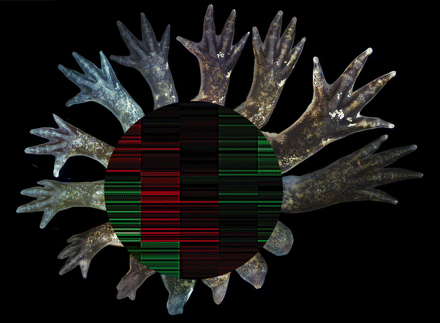
At the SENS Foundation Conference, Malcolm Maden from the University of Florida detailed how the organism can regrow limbs and organs, and what implications this may have for regenerative medicine.


The most amazing organ regenerative ability is displayed by salamanders and other Urodele amphibians such as axolotls which can regenerate brains, spinal cord, limbs, tails, heart, lower jaw and other structures.

At the SENS Foundation Conference (SENS6), Malcolm Maden from the University of Florida detailed how the organism can regrow limbs and organs, and what implications this may have for regenerative medicine.

There are many reasons for studying regenerative mechanisms in these organisms and one of the most intriguing may be the relation between regeneration and aging.

How old are the cells of a regenerated organ -- the same as the host animal or is age reset in a dedifferentiated multipotent stem cell? Nothing is known about this phenomenon apart from the demonstration that regenerative ability does not decline with age in Urodeles -- the quality of the last regenerate is as good as the first.

limb regeneration

Related articles
Even without this knowledge, the ability to induce organ regeneration in humans would have a huge impact on aging and longevity.

According to Maden, his team has had some success at inducing regeneration in mammals by extrapolating from our understanding of axolotl regeneration, in particular concerning one developmental signaling molecule, retinoic acid.

As Maden shows, this molecule is critically required for limb development, limb regeneration, heart regeneration and when administered in excess induces the duplication of limbs.  His research is revealing the mechanism of action and targets in the nucleus are gradually and how it interacts with other developmental signaling pathways.

Malcolm Maden - limb regeneration

Most importantly for Maden, his team has found that retinoic acidcan induce a regenerative response in mammalian organs which cannot normally regenerate such as the lung and the spinal cord.

"We have therefore referred to this molecule as a regeneration-inducing molecule. Our recent studies have also revealed the role of retinoic acid in neurodegenerative diseases such as Alzheimer's disease and in a mouse model of this disease it has the remarkable effect of reducing plaque load and the levels of the toxic Ab peptide in the brain," he says. "Retinoic acid may thus really have life-extending properties and we anticipate that further research may also give us insights into the ageing process itself."


SOURCE  SENS Foundation

By 33rd SquareSubscribe to 33rd Square

Thursday, May 23, 2013

Salamander Macrophages Found To Be Key To LImb Regeneration

 
Regenerative Medicine
Salamanders’ immune systems have been found to be essential to the animal's amazing ability to regrow limbs, and could also underpin their ability to regenerate spinal cords, brain tissue and even parts of their hearts, scientists have found.


Salamanders’ immune systems are key to their remarkable ability to regrow limbs, and could also underpin their ability to regenerate spinal cords, brain tissue and even parts of their hearts, scientists have found.

In research published in the Proceedings of the National Academy of Sciences (PNAS) researchers from the Australian Regenerative Medicine Institute (ARMI) at Monash University found that when immune cells known as macrophages were systemically removed, salamanders lost their ability to regenerate a limb and instead formed scar tissue.

Lead researcher, Dr James Godwin, a Fellow in the laboratory of ARMI Director Professor Nadia Rosenthal, said the findings brought researchers a step closer to understanding what conditions were needed for regeneration.

"Previously, we thought that macrophages were negative for regeneration, and this research shows that that's not the case - if the macrophages are not present in the early phases of healing, regeneration does not occur," Dr Godwin said.


Salamander limb regrowth


"Now, we need to find out exactly how these macrophages are contributing to regeneration. Down the road, this could lead to therapies that tweak the human immune system down a more regenerative pathway."

Related articles
Salamanders deal with injury in a remarkable way. The end result is the complete functional restoration of any tissue, on any part of the body including organs. The regenerated tissue is scar free and almost perfectly replicates the injury site before damage occurred.

"We can look to salamanders as a template of what perfect regeneration looks like," Dr Godwin said.

Aside from "holy grail" applications, such as healing spinal cord and brain injuries, Dr Godwin believes that studying the healing processes of salamanders could lead to new treatments for a number of common conditions, such as heart and liver diseases, which are linked to fibrosis or scarring. Promotion of scar-free healing would also dramatically improve patients' recovery following surgery.

There are indications that there is the capacity for regeneration in a range of animal species, but it has, in most cases been turned off by evolution.

"Some of these regenerative pathways may still be open to us. We may be able to turn up the volume on some of these processes," Dr Godwin said.

"We need to know exactly what salamanders do and how they do it well, so we can reverse-engineer that into human therapies."


SOURCE  Monash University

By 33rd SquareSubscribe to 33rd Square