
Cognitive Enhancement
A new systematic review of the so-called smart drug, modafinil has been published online and shows that the drug does indeed imbue significant cognitive benefits to users, at least on a particular subset of tasks. Could this study lead the way to wider acceptance and use of the drug thought to be the inspiration for the movie, Limitless? |
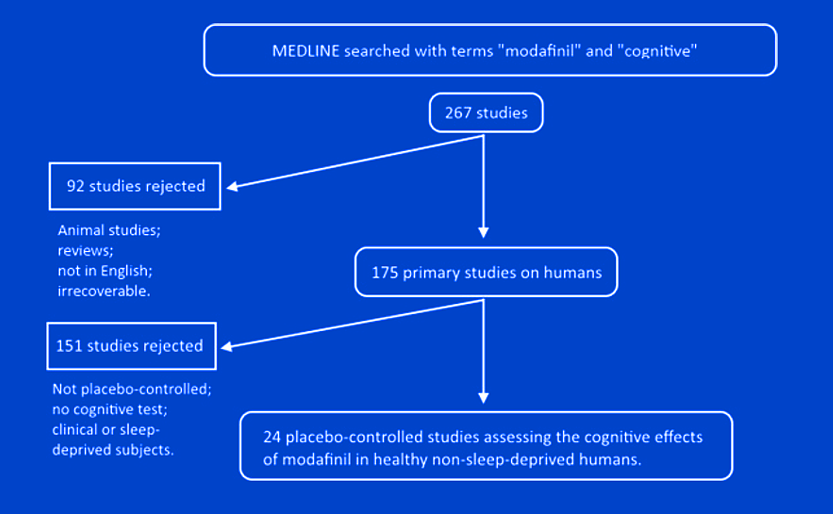
University of Oxford and Harvard Medical School researchers have reviewed nearly all available academic studies on cognitive enhancement with modafinil from January 1990 to December 2014. They found 24 studies dealing with different benefits associated with taking modafinil, including planning and decision making, flexibility, learning and memory, and creativity.
The study was published in the journal European Neuropsychopharmacology.
Modafinil, also marketed as Provigil
 , Modalert and Alertec, was developed to treat narcolepsy, but it is widely used off-licence as a ‘smart drug’ to promote cognitive enhancement, where qualities such as alertness and concentration are desired to assist someone with, for example, exam preparation.
Former studies on sleep-deprived individuals have shown a strong positive effect of modafinil on these functions, but there has been less attention and scientific consensus on the drug’s overall effectiveness as a cognitive enhancer in people that are not sleep-deprived – presumably the majority of people taking it.
The researchers, Dr Ruairidh Battleday and Dr Anna-Katharine Brem, found that the performance-enhancing capacity of modafinil varied according to the task. What emerged was that the longer and more complex the task tested, the more consistently modafinil conferred cognitive benefits.
Modafinil was found to make no difference to working memory, or flexibility of thought, but did improve decision-making and planning.
Very encouragingly, the 70% of studies that looked at the effects of modafinil on mood and side effects showed very little overall effect, although a couple reported insomnia, headache, stomach ache or nausea (which were also reported in the placebo group).
"It appears that modafinil more reliably enhances cognition: in particular 'higher' brain functions that rely on contribution from multiple simple cognitive processes." |
| Related articles |
Professor Guy Goodwin, President of the European College of Neuropsychopharmacology (ECNP) commented: "This overview suggests that, on current evidence, modafinil enhances cognition independent of its known effects in sleep disordered populations. Thus, the authors say that 'modafinil may well deserve the title of the first well-validated pharmaceutical nootropic agent'. In other words, it's the first real example of a 'smart drug', which can genuinely help, for example, with exam preparation. Previous ethical discussion of such agents has tended to assume extravagant effects before it was clear that there were any. If correct, the present update means the ethical debate is real: how should we classify, condone or condemn a drug that improves human performance in the absence of pre-existing cognitive impairment?
"As the authors point out, modafinil is not licenced for this use, and it will not be because it would be outside the current terms of reference of regulatory bodies. The non-medical use of mind altering drugs has hitherto broadly conflicted with the work ethic of many societies, has been very popular but leads to a range of demonstrable harms. Regulation has been and remains problematic. We cannot know either if demand for modafinil in the same societies will actually be significant, whether society will be more accepting and how regulation will then be framed.'
SOURCE Oxford University
| By 33rd Square | Embed |


