bloc 33rd Square Business Tools - limb regeneration 33rd Square Business Tools: limb regeneration - All Post
Showing posts with label limb regeneration. Show all posts

Friday, August 22, 2014


 Biological Regeneration
Researchers discovered that green anole lizards turn on at least 326 genes in specific regions of a regenerating tail, including genes involved in embryonic development, response to hormonal signals and wound healing.


By understanding the secret of how lizards regenerate their tails, researchers may be able to develop ways to stimulate the regeneration of limbs in humans. Now, a team of researchers from Arizona State University is one step closer to solving that mystery. The scientists have discovered the genetic “recipe” for lizard tail regeneration, which may come down to using genetic ingredients in just the right mixture and amounts.

An interdisciplinary team of scientists used next-generation molecular and computer analysis tools to examine the genes turned on in tail regeneration. The team studied the regenerating tail of the green anole lizard (Anolis carolinensis), which when caught by a predator, can lose its tail and then grow it back.

The findings have been published recently in the journal PLOS ONE.

"By following the genetic recipe for regeneration that is found in lizards, and then harnessing those same genes in human cells, it may be possible to regrow new cartilage, muscle or even spinal cord in the future."


"Lizards basically share the same toolbox of genes as humans," said lead author Kenro Kusumi, professor in ASU's School of Life Sciences and associate dean in the College of Liberal Arts and Sciences. "Lizards are the most closely-related animals to humans that can regenerate entire appendages. We discovered that they turn on at least 326 genes in specific regions of the regenerating tail, including genes involved in embryonic development, response to hormonal signals and wound healing.”

Other animals, such as salamanders, frog tadpoles and fish, can also regenerate their tails, with growth mostly at the tip. During tail regeneration, they all turn on genes in what is called the ‘Wnt pathway’ — a process that is required to control stem cells in many organs such as the brain, hair follicles and blood vessels. However, lizards have a unique pattern of tissue growth that is distributed throughout the tail.

lizard tail regeneration
Overview of the stages of lizard tail regeneration. Source Kuzumi et al/PLOS ONE
Related articles

"Regeneration is not an instant process," said Elizabeth Hutchins, a graduate student in ASU's molecular and cellular biology program and co-author of the paper. "In fact, it takes lizards more than 60 days to regenerate a functional tail. Lizards form a complex regenerating structure with cells growing into tissues at a number of sites along the tail.”

"We have identified one type of cell that is important for tissue regeneration," said Jeanne Wilson-Rawls, co-author and associate professor with ASU’s School of Life Sciences. "Just like in mice and humans, lizards have satellite cells that can grow and develop into skeletal muscle and other tissues."

"Using next-generation technologies to sequence all the genes expressed during regeneration, we have unlocked the mystery of what genes are needed to regrow the lizard tail," said Kusumi. "By following the genetic recipe for regeneration that is found in lizards, and then harnessing those same genes in human cells, it may be possible to regrow new cartilage, muscle or even spinal cord in the future."

The researchers hope their findings will help lead to discoveries of new therapeutic approaches to spinal cord injuries, repairing birth defects, and treating diseases such as arthritis.


SOURCE  Science Daily

By 33rd SquareEmbed

Monday, February 24, 2014


 Regenerative Medicine
At the SENS Foundation Conference, Malcolm Maden from the University of Florida detailed how the organism can regrow limbs and organs, and what implications this may have for regenerative medicine.


The most amazing organ regenerative ability is displayed by salamanders and other Urodele amphibians such as axolotls which can regenerate brains, spinal cord, limbs, tails, heart, lower jaw and other structures.

At the SENS Foundation Conference (SENS6), Malcolm Maden from the University of Florida detailed how the organism can regrow limbs and organs, and what implications this may have for regenerative medicine.

There are many reasons for studying regenerative mechanisms in these organisms and one of the most intriguing may be the relation between regeneration and aging.

How old are the cells of a regenerated organ -- the same as the host animal or is age reset in a dedifferentiated multipotent stem cell? Nothing is known about this phenomenon apart from the demonstration that regenerative ability does not decline with age in Urodeles -- the quality of the last regenerate is as good as the first.

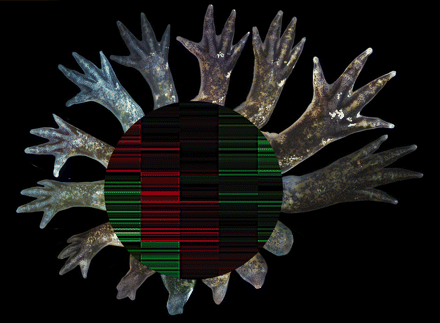
limb regeneration

Related articles
Even without this knowledge, the ability to induce organ regeneration in humans would have a huge impact on aging and longevity.

According to Maden, his team has had some success at inducing regeneration in mammals by extrapolating from our understanding of axolotl regeneration, in particular concerning one developmental signaling molecule, retinoic acid.

As Maden shows, this molecule is critically required for limb development, limb regeneration, heart regeneration and when administered in excess induces the duplication of limbs.  His research is revealing the mechanism of action and targets in the nucleus are gradually and how it interacts with other developmental signaling pathways.

Malcolm Maden - limb regeneration

Most importantly for Maden, his team has found that retinoic acidcan induce a regenerative response in mammalian organs which cannot normally regenerate such as the lung and the spinal cord.

"We have therefore referred to this molecule as a regeneration-inducing molecule. Our recent studies have also revealed the role of retinoic acid in neurodegenerative diseases such as Alzheimer's disease and in a mouse model of this disease it has the remarkable effect of reducing plaque load and the levels of the toxic Ab peptide in the brain," he says. "Retinoic acid may thus really have life-extending properties and we anticipate that further research may also give us insights into the ageing process itself."


SOURCE  SENS Foundation

By 33rd SquareSubscribe to 33rd Square