bloc 33rd Square Business Tools - hydrogen fuel 33rd Square Business Tools: hydrogen fuel - All Post
Showing posts with label hydrogen fuel. Show all posts

Tuesday, March 15, 2016

The Battle to Fuel the Future of Cars


Automotive  

The brightest minds in the automotive world are going head to head to decide how you will power your car in the future. Will the car you drive run on hydrogen or will it be powered by a battery?


The aim of both hydrogen and electric powered vehicles is to provide the world with cars that run as well as traditionally fuelled models, while reducing the carbon footprint of the automotive industry as a whole.

Related articles
Both hydrogen and battery electric vehicles currently produce zero emissions, but that does not necessarily tell the whole story as the energy they run on has to be produced somehow.
Proponents of hydrogen point to how ubiquitous the element is and how much more power a hydrogen fuel stack can produce when compared to a battery.

They will also point out how limited battery technology currently is and how this is a limiting factor in the performance of battery electric vehicles. Fans of electric cars will retort by saying how much more mature, and green, the infrastructure for electric cars is when compared to hydrogen powered vehicles. If you are still trying to decide which fuel will be dominating the future of driving, then why not read this infographic to find out the facts about both?


Electric vs Hydrogen
Source - Electric vs Hydrogen by carleasingmadesimple.com


By 33rd SquareEmbed


Tuesday, August 25, 2015

Toyota Mirai's Range Rated at 312 Miles


Automotive  


Toyota recently introduced the fuel cell-powered Mirai sedan to the Japanese market, with U.S. sales scheduled to begin later this year, hoping that the car's exceptionally long range, in addition to the fact that it's a zero-emission vehicle will make it competitive with electric vehicles.


Being able to cover much longer distances before needing to be refueled is one of the key advantages that hydrogen-powered cars are said to have over electric cars. This is one of the reasons why Toyota decided to abandon plans for developing long-range electric cars – which is what most other car makers have been doing lately – and focus on fuel-cell vehicles, instead. Toyota recently introduced the Mirai sedan to the Japanese market, with U.S. sales scheduled to begin later this year, hoping that the car's exceptionally long range, in addition to the fact that it's a zero-emission vehicle, will make it a strong competitor to the Model S, the most popular electric vehicle currently on sale.

The Japanese car maker has been claiming that the Mirai is right up there with the Tesla Model S when it comes to range, saying that it is capable of traveling up to 300 miles before having to go to a hydrogen refueling station. Those claims have now received an official confirmation, with the EPA rating the car's fuel economy at 67 mpge with a range of 312 miles, which is considerably better than the Model S P85D, rated at 265 miles.

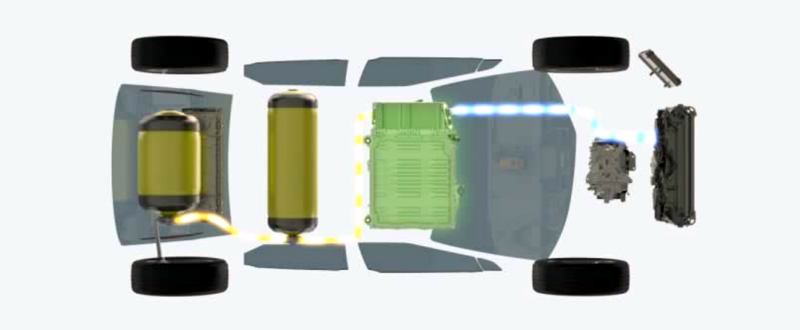
Mirai Fuel Cell powered vehicle


The 67-mpge rating also means that it is more fuel-efficient than any gasoline-powered car on the market, and it exceeds even the most optimistic estimates made by auto industry observers over the past couple of months.

"What we may be seeing here is that type of surfing, but in this case the whale chose to give the dolphin a different type of ride."


"Just as the Prius introduced hybrid-electric vehicles to millions of customers nearly 20 years ago, the Mirai is now poised to usher in a new era of efficient, hydrogen transportation," said Toyota North America CEO Jim Lentz in a statement, announcing EPA's ratings for the Mirai.

Related articles

The Mirai is considered to be the world's first mass-produced hydrogen-powered vehicle, but it is not the only fuel-cell car available for purchase at the moment, with the Hyundai Tucson CUV being available for lease for $499 a month, but it is far more efficient than its South Korean counterpart. The Tucson's fuel economy is rated at 49 mpg in the city and 51 mpg on the highway.

However, the fact that the Mirai is obviously highly fuel-efficient doesn't address the issue that all hydrogen-powered vehicles are bound to face in the following years – the scarcity of hydrogen refueling stations. At the moment, there are only 10 stations in California, which is the only state that the Mirai will be sold in.

Toyota is well aware that the lack of supporting infrastructure may prevent its fuel-cell vehicles from gaining a widespread adoption, which is why it has been working together with authorities in Japan and the U.S. to expand the refueling station network, investing millions of dollars towards the installation of new stations.

The Mirai is scheduled to go on sale in California in October 2015, with a price tag of $58,325, which can be brought down to around $45,000 with federal and state incentives. In addition to that, it will be available for lease for $499 per month, with $3,649 due at signing.

By Jordan PerchEmbed


Author Bio - Jordan Perch is an automotive fanatic and “safe driving” specialist. He is a writer for DMV.com, which is a collaborative community designed to help ease the stress and annoyance of “dealing with the DMV”

Tuesday, February 17, 2015

Toyota Following in Tesla's Footsteps, Opening Up Thousands of Fuel Cell Patents
Automotive  
Following Elon Musk's lead, Toyota has opened up thousands of fuel cell-related patents in an effort to get the fossil fuel replacement technology into higher acceptance and production. The company hopes to create demand for hydrogen stations by encouraging other automakers to bring their own fuel cell vehicles to the market. 


Elon Musk's philosophy of patent sharing seems to be making quite an impact across the auto industry. He made Tesla's electric car patents available to all automakers recently, in an effort to give the EV movement a much-needed boost, showing his commitment to promotion of EVs as the only viable alternative to conventional cars. Now, that idea of opening up patents to speed up the development of a novel technology is being embraced by Toyota, which announced that it will share its hydrogen fuel cell technology in an attempt to motivate other car makers to start developing fuel cell vehicles.

Related articles
The Japanese manufacturer has spent billions of dollars on developing fuel cell technologies over the past decade or so, and recently started selling the Mirai – one of the world's first commercially available hydrogen-powered vehicles, but it is well aware that FCVs are facing a classic “chicken and egg” problem, with automakers unwilling to start mass production before a proper refueling infrastructure is put in place, and with energy companies refusing to build a network of refueling stations before there is sufficient consumer demand for these vehicles.

That's exactly what Toyota is trying to achieve with the release of about 5,680 patents – create demand for hydrogen stations by encouraging automakers to bring their own fuel cell vehicles to the market. “At Toyota, we believe that when good ideas are shared, great things can happen,” said Toyota's Senior Vice President, Bob Carter, before making the announcement on the company's decision to share its technology, at the CES in Las Vegas, and added: The first generation hydrogen fuel cell vehicles, launched between 2015 and 2020, will be critical, requiring a concerted effort and unconventional collaboration between automakers, government regulators, academia and energy providers. By eliminating traditional corporate boundaries, we can speed the development of new technologies and move into the future of mobility more quickly, effectively and economically.

Toyota Hydrogen Fuel Cell

Toyota said that 3,350 of those patents have to do with fuel cell system software control, almost 2,000 of them are about fuel cell stacks, while 290 are related to high-pressure hydrogen tanks. In addition to car manufacturers, these patents will be available to fuel cell parts suppliers, as well. What's more, energy companies will have access to 70 patents on hydrogen fueling stations, which means Toyota is thinking about the supporting infrastructure at the same time. While the patents for fuel cell vehicles will only be available for use by other automakers free of charge until 2020, and after that will likely be required to pay a certain fee, the ones that are related to hydrogen production and supply will continue to be free “for an unlimited duration”, as the company said in its press release.

With this move, Toyota demonstrates just how confident it is that hydrogen is the way to go for ensuring a carbon-free future, and hopes to get the support of other companies while trying to advance fuel cell technology on its way toward commercialization.


By Jordan PerchEmbed

Author Bio - Jordan Perch is an automotive fanatic and “safe driving” specialist. He is a writer for DMV.com, which is a collaborative community designed to help ease the stress and annoyance of “dealing with the DMV”

Tuesday, February 3, 2015

Researcher Identifies Bacteria That Produce Hydrogen in Extreme Situations

 Biotechnology  
A bacterium that can produce hydrogen, an element that one day could lessen the world’s dependence on oil, has been discovered in Soap Lake, Washington.


Missouri University of Science and Technology researcher Dr. Melanie Mormile has discovered a bacterium that can produce hydrogen, an element that one day could lessen the world’s dependence on oil.

"Usually, I tend to study the overall microbial ecology of extreme environments, but this particular bacterium has caught my attention."


Mormile, professor of biological sciences at Missouri S&T, and her team discovered the bacterium Halanaerobium hydrogeninformans in Soap Lake, Washington. It can “produce hydrogen under saline and alkaline conditions in amounts that rival genetically modified organisms,” Mormile says.

Mormile’s findings were featured in Frontiers in Microbiology.

Halanaerobium hydrogeninformans

Related articles
“Usually, I tend to study the overall microbial ecology of extreme environments, but this particular bacterium has caught my attention,” Mormile says. “I intend to study this isolate in greater detail.”

Mormile, an expert in the microbial ecology of extreme environments, wasn’t searching for a bacterium that could produce hydrogen. Instead, she first became interested in bacteria that could help clean up the environment, especially looking at the extremophiles found in Soap Lake. An extremophile is a microorganism that lives in conditions of extreme temperature, acidity, alkalinity or chemical concentration. Living in such a hostile environment, Halanaerobium hydrogeninformans has metabolic capabilities under conditions that occur at some contaminated waste sites.

With Halanaerobium hydrogeninformans she expected to find an iron-reducing bacterium and describe a new species. What she found was a new species of bacterium that can produce hydrogen and 1, 3-propanediol under high pH and salinity conditions that might turn out to be valuable industrially. An organic compound, 1, 3-propenediol can be formulated into industrial products including composites, adhesives, laminates and coatings. It’s also a solvent and can be used as antifreeze.

The infrastructure isn’t in place now for hydrogen to replace gasoline as a fuel for planes, trains and automobiles. But if hydrogen becomes an alternative to gasoline, Halanaerobium hydrogeniformans mass-produced on an industrial scale, might be one solution – although it won’t be a solution anytime soon.

“It would be great if we got liters and liters of production of hydrogen,” Mormile says. “However, we have not been able to scale up yet.”

Mormile holds two patents for her work on the Soap Lake bacterium’s biohydrogen formation under very alkaline and saline conditions.


SOURCE  Missouri University of Science and Technology

By 33rd SquareEmbed

Tuesday, December 2, 2014


 Fuel Cell Vehicles  
Audi has introduced a new fuel cell concept car at the 2014 Los Angeles Auto Show. The A7 H-tron Quattro is an emission-free car that is supposed to demonstrate that the company has achieved significant advancements in the development of fuel cell technology.


It seems that Toyota's enthusiasm for hydrogen-powered vehicles has started to rub off on other car makers, with the likes of Honda and BMW developing fuel cell vehicles and planning to start mass production in the next couple of years, and with Hyundai already leasing a fuel cell SUV. The latest company to jump on the fuel-cell bandwagon is Audi, after introducing a new fuel cell concept car at the 2014 Los Angeles Auto Show earlier this week. The German automaker unveiled the A7 H-tron Quattro, an emission-free car that is supposed to demonstrate that the company has achieved significant advancements in the development of fuel cell technology.

Related articles
The A7 Sportback has all the characteristics that can make hydrogen-powered cars look much better than other alternative fuel vehicles – longer range, no carbon emissions, and short recharge times. But, it comes with a twist, as it's not a conventional hydrogen-powered car, like the newly unveiled Toyota Mirai, and is fitted with an electric powertrain to go with a hydrogen fuel cell, making it the first fuel-cell plug-in hybrid vehicle in the world.

"The H-tron concept car shows that we have also mastered fuel cell technology. We are in a position to launch the production process as soon as the market and infrastructure are ready."


Audi decided to use the platform of the luxury fastback sedan and convert it into a hybrid that is equipped with two 85-kilowatt electric motors – one for the front, and the other for the rear axle – making it an all-wheel-drive car, along with a fuel cell stack that converts hydrogen into electricity at efficiencies of up to 60%, according to the automaker. Each motor has a power output rated at 113 horsepower, and 199 lb-ft of torque, that according to Audi, is enough for a top speed of 111 mph, and a 7.1-second 0-60 mph acceleration time, numbers that make the A7 H-tron Quattro probably the first high-performance hydrogen-powered car.

Thanks to the 8.8-kWh lithium-ion battery, the car can travel up to 31 miles on electricity only. The battery can be recharged by plugging it into an electric socket, as well as through regenerative braking. The company says that it takes about two hours for the battery to be fully recharged. Under the hood, there are four hydrogen tanks, that have a combined storage capacity of about 11 pounds, providing a driving range of 311 miles, or a fuel efficiency rated at about 62 miles per gallon equivalent, which puts it right up there with Toyota's Mirai.

However, the A7 H-tron Quattro is only a “technology demonstrator”, as Audi says, without giving any guarantees that it will ever go into production. In any case, it clearly shows that the German automaker is embracing the idea of developing hydrogen-powered cars as an alternative to conventional, internal-combustion engine vehicles, but before the supporting infrastructure is put in place, Audi won't start mass production of a fuel cell car. "The H-tron concept car shows that we have also mastered fuel cell technology. We are in a position to launch the production process as soon as the market and infrastructure are ready," says Ulrich Hackenberg, the company's Chief Technical Officer.

By Jordan PerchEmbed

Author Bio - Frequent 33rd Square contributor Jordan Perch is an automotive fanatic and “safe driving” specialist. He is a writer for DMV.com, which is a collaborative community designed to help ease the stress and annoyance of “dealing with the DMV.”

Tuesday, April 15, 2014

Hydrogen Storage

 Fuel Cell Technology  
Engineers have created new ceramic materials that could be used to store hydrogen safely and efficiently. The researchers have created compounds made from mixtures of calcium hexaboride, strontium and barium hexaboride.


Researchers have created new ceramic materials that could be used to store hydrogen safely and efficiently.  The work was undertaken at the University of California, San Diego.

Storing hydrogen has become increasingly important as hydrogen fuel cells become more popular power sources in industry and elsewhere. But hydrogen, the lightest element on the periodic table, is difficult to store. It tends to diffuse through the walls of pressurized tanks. It also needs to be compressed in order to occupy manageable amounts of space when stored.

Related articles
The researchers created, for the first time, compounds made from mixtures of calcium hexaboride, strontium and barium hexaboride (image above). They also have shown that the compounds could be manufactured using a simple, low-cost manufacturing method known as combustion synthesis.

The research is at the proof of concept stage and is part of a project funded by the National Science Foundation, a collaboration between UC San Diego, Alfred University in upstate New York and the University of Nevada, Reno.

"We are looking for solid materials that can store and release hydrogen easily."


The manufacturing process for the ceramics is faster and simpler than traditional methods used to manufacture these types of materials. The researchers presented their work recently at the third International Symposium on Nanoscience and Nanomaterials in Mexico.

Graduate student James Cahill will present the work at Research Expo, April 17, at the Jacobs School. “We are looking for solid materials that can store and release hydrogen easily,” said Olivia Graeve, a professor at the Jacobs School of Engineering at UC San Diego, who has gained international recognition as a nanomaterials manufacturing expert.

The resulting ceramics are essentially crystalline structures in a cage of boron. To store hydrogen, the researchers would swap the calcium, strontium and boron with hydrogen atoms within the cage.
Engineers mixed boron with metal nitrates and organic fuels, such as urea, in a box furnace at temperatures below 400 degrees Celsius—roughly 750 degrees Fahrenheit—cooler than a commercial pizza oven.  The nitrates and organic fuels ignite, generating heat that then drives the reaction without the need for an external source of power. This method is known as combustion synthesis.

“It’s a very simple, nice process,” Graeve explained.


SOURCE  UCSD

By 33rd SquareEmbed