bloc 33rd Square Business Tools - demis hassabis 33rd Square Business Tools: demis hassabis - All Post
Showing posts with label demis hassabis. Show all posts

Wednesday, February 1, 2017

A Super-Powered Panel Discusses Superintelligence


Artificial Intelligence

At the Beneficial AI Conference recently, Elon Musk, Stuart Russell, Ray Kurzweil, Demis Hassabis, Sam Harris, Nick Bostrom, David Chalmers, Bart Selman, and Jaan Tallinn chatted with moderator Max Tegmark what likely outcomes might be if we succeed in building human-level AGI, and also what we would like to happen.


Last month a panel of experts gathered at the Beneficial AI Conference, in Asilomar, California organized by the Future of Life Institute to discuss the most important issue of this century. The amazing group of AI researchers from academia and industry, and thought leaders in economics, law, ethics, and philosophy for five days dedicated to beneficial AI.


Beneficial AI Conference


Related articles
Below, Elon Musk, Stuart Russell, Ray Kurzweil, Demis Hassabis, Sam Harris, Nick Bostrom, David Chalmers, Bart Selman, and Jaan Tallinn discuss with moderator Max Tegmark what likely outcomes might be if we succeed in building human-level AGI, and also what we would like to happen.

When Tegmark polls the panel about when this may happen, the consensus (apart from Musk who plays to the crowd) is that this will happen in the time frame of years. Tegmark comments that the timescale makes a huge difference—hard takeoff versus soft takeoff.

"We're talking about human AI. Human AI is by definition at human levels, therefore is human."
Kurzweil talked about how the growth of AGI might be better in a slow takeoff scenario. "As technologists we should do everything we can to keep the technology safe and beneficial. As we do each specific application, like self driving cars, there's a whole host of ethical issues to address, but I don't think we can solve the problem just technologically." Kurzweil projects that even if the most perfect and safe AI is created, it might be at the expense of the political system or other factors, it won't be an ideal outcome.

"We're talking about human AI. Human AI is by definition at human levels, therefore is human," he states. According to the futurist, the issue of how we make humans ethical is the same issue as how we make AIs human-level ethical.

In conjunction with the AI conference in Asilomar a large group of the leaders in AI and related fields teamed up and extended the open letter into a set of 23 principles for AI research, design and use, intended to ensure that AI lives up to its great potential to help and empower people in the decades and centuries ahead.

Artificial intelligence has already provided beneficial tools that we use every day by people around the world. According to the conference participants, continued development, guided by the following principles, will offer amazing opportunities to help and empower people in the decades and centuries ahead.


The Asilomar Principles 

1) Research Goal: The goal of AI research should be to create not undirected intelligence, but beneficial intelligence. 
2) Research Funding: Investments in AI should be accompanied by funding for research on ensuring its beneficial use, including thorny questions in computer science, economics, law, ethics, and social studies, such as: 
  • How can we make future AI systems highly robust, so that they do what we want without malfunctioning or getting hacked?
  • How can we grow our prosperity through automation while maintaining people’s resources and purpose?
  • How can we update our legal systems to be more fair and efficient, to keep pace with AI, and to manage the risks associated with AI?
  • What set of values should AI be aligned with, and what legal and ethical status should it have?
3) Science-Policy Link: There should be constructive and healthy exchange between AI researchers and policy-makers. 
4) Research Culture: A culture of cooperation, trust, and transparency should be fostered among researchers and developers of AI. 
5) Race Avoidance: Teams developing AI systems should actively cooperate to avoid corner-cutting on safety standards. 

Ethics and Values

6) Safety: AI systems should be safe and secure throughout their operational lifetime, and verifiably so where applicable and feasible. 
7) Failure Transparency: If an AI system causes harm, it should be possible to ascertain why. 
8) Judicial Transparency: Any involvement by an autonomous system in judicial decision-making should provide a satisfactory explanation auditable by a competent human authority. 
9) Responsibility: Designers and builders of advanced AI systems are stakeholders in the moral implications of their use, misuse, and actions, with a responsibility and opportunity to shape those implications. 
10) Value Alignment: Highly autonomous AI systems should be designed so that their goals and behaviors can be assured to align with human values throughout their operation. 
11) Human Values: AI systems should be designed and operated so as to be compatible with ideals of human dignity, rights, freedoms, and cultural diversity. 
12) Personal Privacy: People should have the right to access, manage and control the data they generate, given AI systems’ power to analyze and utilize that data. 
13) Liberty and Privacy: The application of AI to personal data must not unreasonably curtail people’s real or perceived liberty. 
14) Shared Benefit: AI technologies should benefit and empower as many people as possible. 
15) Shared Prosperity: The economic prosperity created by AI should be shared broadly, to benefit all of humanity. 
16) Human Control: Humans should choose how and whether to delegate decisions to AI systems, to accomplish human-chosen objectives. 
17) Non-subversion: The power conferred by control of highly advanced AI systems should respect and improve, rather than subvert, the social and civic processes on which the health of society depends. 
18) AI Arms Race: An arms race in lethal autonomous weapons should be avoided.
Longer-term Issues 
19) Capability Caution: There being no consensus, we should avoid strong assumptions regarding upper limits on future AI capabilities. 
20) Importance: Advanced AI could represent a profound change in the history of life on Earth, and should be planned for and managed with commensurate care and resources. 
21) Risks: Risks posed by AI systems, especially catastrophic or existential risks, must be subject to planning and mitigation efforts commensurate with their expected impact. 
22) Recursive Self-Improvement: AI systems designed to recursively self-improve or self-replicate in a manner that could lead to rapidly increasing quality or quantity must be subject to strict safety and control measures. 
23) Common Good: Superintelligence should only be developed in the service of widely shared ethical ideals, and for the benefit of all humanity rather than one state or organization.

If you'd like to join Demis Hassabis, Yann LeCun, Yoshua Bengio, Stuart Russell, Peter Norvig, Ray Kurzweil, Jeff Dean, Tom Gruber, Francesca Rossi, Bart Selman, Leslie Kaelbling, Guru Banavar and others as a signatory, you'll find the principles and a signature form here.

Learn more about the Asilomar AI Principles that resulted from the conference and the process involved in developing them.


SOURCE  Future of Life Institute


By  33rd SquareEmbed


Wednesday, October 12, 2016

DeepMind Unleashes Another Major Artificial Intelligence Breakthrough


Artificial Intelligence

Racing to the Singularity, DeepMind has introduced a new form of memory-augmented neural network called a 'differentiable neural computer', and shown that it can learn to use its memory to answer questions about complex, structured data, including artificially generated stories, family trees, and even a map of the London Underground. 


Google DeepMind, the artificial intelligence acquisition by the search engine giant that recently shocked the world by beating the best human player at the ancient game Go, and improving text-to-speech dramatically, has made another breakthrough in the development of AI. The company founded by Demis Hassabis, has now created an advanced machine learning system that combines a neural network with conventional computer memory.

Related articles
The researchers at DeepMind, including Hassabis, call their creation a “differentiable neural computer”, or DNC. The system can learn from examples like neural networks, but they can also store complex data like computers. The team demonstrated the system planning the best route between distant stations on the London Underground or working out relationships between relatives on family trees.

The research has been published in the journal Nature.

differentiable neural computer

"We hope that DNCs provide both a new tool for computer science and a new metaphor for cognitive science and neuroscience."
Before the creation of the DNC, neural networks have only been able to access the data contained within their own network. DeepMind says their system provides neural networks with access to previously incompatible external data, such as text encoded in conventional digital form.

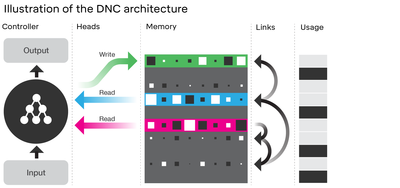
As the diagram above shows, the neural network controller receives external inputs and, based on these, interacts with the memory using read and write operations known as 'heads' in the DNC. To help the controller navigate the memory, DNC stores 'temporal links' to keep track of the order things were written in, and records the current 'usage' level of each memory location.

In the publication, the researchers showed that a DNC can learn on its own to write down a description of an arbitrary graph and answer questions about it. When they described the stations and lines of the London Underground, they asked the DNC to answer questions like, “Starting at Bond street, and taking the Central line in a direction one stop, the Circle line in a direction for four stops, and the Jubilee line in a direction for two stops, at what stop do you wind up?” Or, the DNC could plan routes given questions like “How do you get from Moorgate to Piccadilly Circus?”

In the future the DNC more useful in the real world than existing AI systems, it will need to be expanded to access far larger memories.

"We hope that DNCs provide both a new tool for computer science and a new metaphor for cognitive science and neuroscience: here is a learning machine that, without prior programming, can organise information into connected facts and use those facts to solve problems," write the researchers.

Certainly the development of the DNC is a big step towards artificial general intelligence. We will be following this development closely.


SOURCE  DeepMind


By  33rd SquareEmbed


Friday, July 15, 2016

Demis Hassabis Looks Towards General Artificial Intelligence


Artificial Intelligence

Recently Demis Hassabis discussed his work as AI researcher, neuroscientist and video games designer to discuss what is happening at the cutting edge of AI research, including the recent historic AlphaGo match, and its future potential impact on fields such as science and healthcare, and how developing AI may help us better understand the human mind.


Demis Hassabis, Co-Founder and CEO of DeepMind, the world’s leading General Artificial Intelligence (AI) company, which was acquired by Google in 2014 in their largest ever European acquisition.

AlphaGo article in Nature
In this talk, Hassabis draws on his eclectic experiences as an AI researcher, neuroscientist and video games designer to discuss what is happening at the cutting edge of AI research, including the recent historic AlphaGo match, and its future potential impact on fields such as science and healthcare, and how developing AI may help us better understand the human mind.

Along with a detailed breakdown of how DeepMind created AlphaGo, and what it took to beat Lee Sedol, Hassabis shows off some other research bing worked on at the company.

This includes work on having artificial intelligence work in 3D environments. The team re-purposed the Quake Engine.

"We're starting to integrate some of these different things together: deep reinforcement learning with memory and 3D vision perception," Hassabis describes.

"As we take this forward, we're kind of thinking one of our goals over this next year is to [kind of] create a rat-level AI; an AI agent that is capable of doing all of the things a rat can do."

Demis Hassabis Looks Towards General Artificial Intelligence
The goal is noteworthy, especially in light of the tremendous advance in artificial general intelligence (AGI) that AlphaGo represents.
 
"One of our goals over this next year is to [kind of] create a rat-level AI; an AI agent that is capable of doing all of the things a rat can do."
Related articles
The talk was recorded at the Center for Brains, Minds and Machines (CBMM), a National Science Foundation funded Science and Technology Center focused on the interdisciplinary study of intelligence.

"We aim to create a new field — the Science and Engineering of Intelligence — by bringing together computer scientists, cognitive scientists, and neuroscientists to work in close collaboration," states the organization's website. " This new field is dedicated to developing a computationally based understanding of human intelligence and establishing an engineering practice based on that understanding."


SOURCE  Center for Minds, Brains and Machines


By 33rd SquareEmbed


Thursday, March 10, 2016

What Does The Defeat of Lee Sedol Mean?


Artificial Intelligence

AlphaGo, the AI system built by Google DeepMind has already beaten is human opponent and champion Lee Sedol in the first two of five matches in the latest human vs. computer battle, this time in the ultra complex game Go. Why is this contest so important?


History has made the names Kasparov, Rutter and Jennings famous already. These men are not as well known for their incredible accomplishments, but rather their defeats at games to artificial intelligence.  Now a new name is being etched onto the list, that of Lee Sedol, the world champion of the game Go.

Although he has not officially lost the challenge to Google DeepMind's AlphaGo system, Sedol's reaction after the first two contests in the five match series points to the impression that he doesn't have an answer to the question of how to beat AlphaGo.

Watching the second match as Sedol's time before overtime fell beneath ten minutes, his emotions were evident. Sedol said at the post-game press conference,"I would like to express my respect to Demis and his team for making such an amazing program like AlphaGo. I am surprised by this result. But I did enjoy the game and am looking forward to the next one."

"Sedol spent all of his life perfecting his GO skills, and now some computer program comes and defeat him. And not some ad hoc program, but rather the start of AGI.
While there are still three games left in the contest, AlphaGo has already set the bar as the first computer program to defeated a top-ranked human Go player on a full 19x19 board with no handicap twice in a row.

More importantly though, this latest abdication of human superiority of a challenging intellectual task promises to deliver so much more than the previous examples.  When IBM's Deep Blue beat chess champion Garry Kasparov in 1997 and when the company later used Watson to win against Brad Rutter and Ken Jennings, the most successful players on the game show Jeopardy!, the company had used purpose built narrow AI systems.

What AlphaGo represents is the dawn of artificial general intelligence, or AGI. As with knowledge or chess, the AI could not just be a programmed series of instructions of what to do in certain board scenarios. Go is a game of profound complexity with 1,000,000,000,000,000,000,000,000,000,000,000,000,000,000,000,000,000,000,000,000,000,000
,000,000,000,000,000,000,000,000,000,000,000,000,000,000,000,000,000,000,000,000,000,000,
000,000,000,000,000,000,000,000,000,000,000,000,000 possible positions - that's more than the number of atoms in the universe, and more than a googol (10 to the power of 100) times larger than chess. The game has been known for many years as the 'holy grail' of AI.

The project is detailed in a recent paper published in Nature. The new approach to computer Go combines Monte-Carlo tree search with deep neural networks that have been trained by supervised learning, from human expert games, and by reinforcement learning from games of self-play.

As one poster on the KurzweilAI forum writes,
Sedol spent all of his life perfecting his GO skills, and now some computer program comes and defeat him. And not some ad hoc program, but rather the start of AGI. 
I will feel horrible If some computer program will constantly defeat me at my area of expertise, sending me home to live from UBI. I will feel worthless, I will feel like a child again, like eventing I did in the last 20 years to become good at what I do was for nothing... All the sacrifices my career demanded, all was done for nothing...  
What a horrible feeling....
Related articles
AlphaGo made a number of  moves in the latest game that surprised the expert commentators, leading
Michael Redmond, 9-dan, American commentator to comment, “I was impressed with AlphaGo’s play. There was a great beauty to the opening. Based on what I had seen from its other games, AlphaGo was always strong in the end and middle game, but that was extended to the beginning game this time. It was a beautiful, innovative game.”

Certainly at times the super-human ability of AlphaGo's play seemed to confuse the commentators in the early stages at times. It was difficult in some cases to tell if the system was producing errors or bad moves until the sequences were played out.

This play by AlphaGo seems to match the performance DeepMind recently established with their approaches to playing Atari-type video games like Space Invaders and Breakout, (as founder Demis Hassabis explains here). In the beginning, the so-called deep reinforcement learning framework system, which only sees the pixels of the display for input, does not fair very well. But by letting the system continue to play, and learn on its own, it becomes super-human in ability after a few hundred games.

Deep Mind Space Invaders

Evidently AlphaGo has played more than a few games prior to the match with Sedol.


As Hassabis explains, "You’ve heard me talk about is the difference between this and Deep Blue. So Deep Blue is a hand-crafted program where the programmers distilled the information from chess grandmasters into specific rules and heuristics, whereas we’ve imbued AlphaGo with the ability to learn and then it’s learnt it through practice and study, which is much more human-like."

DeepMind's approach may next be applied to simulations, healthcare and robotics."I love games, I used to write computer games. But it’s to the extent that they’re useful as a testbed, a platform for trying to write our algorithmic ideas and testing out how far they scale and how well they do and it’s just a very efficient way of doing that," Hassabis tells the Verge. "Ultimately we want to apply this to big real-world problems."

Hassabis has frequently expressed interest in creating a 'robot scientist', and this victory marks one of the early stages of that quest.

The next game will be March 12 at 1pm (4am GMT/8pm PT/11pm ET) Korea Standard Time, followed by games on March 13, and March 15. The games are livestreamed on DeepMind's YouTube channel.


SOURCE  Google


By 33rd SquareEmbed


Saturday, November 21, 2015

Has DeepMind's AI System Solved Go?


Artificial Intelligence

Demis Hassabis of Google's DeepMind  hinted recently that his research team may have a "surprise" coming with regards to Go in a few months. Could they have solved the centuries old game that has so far remained so difficult?


In a recent interview with the Royal Society of London, Google DeepMind's Demis Hassabis dropped a big hint about what the company that has amazed analysts recently with its machine learning software is working on.

Related articles
“Maybe you will have a surprise about Go?” Hassabis’s interviewer asked (see full interview below).

Hassabis replies. “I can’t talk about it yet, but in a few months I think there will be quite a big surprise.”

In the field of artificial intelligence, the centuries old game Go remains a huge hurdle to overcome. It is one of the few remaining areas where human superiority over computers remains strong. No system has ever beaten a top human Go player — at least not without a huge helping hand.

"Men are born for games. Nothing else. Every child knows that play is nobler than work. He knows too that the worth or merit of a game is not inherent in the game itself but rather in the value of that which is put at hazard... all games aspire to the condition of war for here that which is wagered swallows up game, player, all.”
― Cormac McCarthy, Blood Meridian
Like chess, Go is a deterministic perfect information game. No information is hidden from either player, and there is no elements of chance, that make up other games like Coup. As with chess, Go is an analogy for war between two sides.

Play starts with an empty board, where players alternate the placement of black and white stones, attempting to surround territory while avoiding capture by the enemy. On the surface it may seem simpler than chess, but it’s not.

When IBM's Deep Blue defeated Gary Kasparov at chess in 1996, the best Go programs couldn’t even challenge a decent amateur. Since then, even with huge computing advances, the solution of expert-level Go remains one of AI’s greatest unsolved riddles.

The mysteries and complexity of the game-play in Go were studied by Alan Turing and I.J. Good, who even wrote a 1965 article for New Scientist entitled “The Mystery of Go.”

The race is now on to create artificial intelligence that can beat Go. Facebook has announced they have a team working on the 19x19 problem.

Hassabis has already proven himself an expert game solver and creator. He was a chess prodigy as a child and went on to create best-selling video games in his teens before really applying himself by picking up a PhD in Neuroscience, forming DeepMind, and selling the company to Google for hundreds of millions of dollars.

The snippets of deep learning development the UK-based team has released so far have been very interesting, including self-learning systems that can learn and conquer 1980's video games on their own. DeepMind has combined deep learning with a technique called reinforcement learning. Their software learns by taking actions and receiving feedback on their effects, as humans or animals often do.

Solving Go represents a monumental leap for artificial intelligence development. The game is an act of strategy and thinking about the future—thinking about what’s going to happen next. Getting computers to do this in a similar way essentially means they are closer to acting like human intelligence.


SOURCE  Ida Zulauf


By 33rd SquareEmbed


Thursday, October 22, 2015

Prominent AI Researcher Takes Critical Look at DeepMind


Artificial Intelligence  


According to Ben Goertzel, "100 smart guys working together toward pure & applied AGI, with savvy leadership and Google's resources at their disposal, is nothing to be sneered at....   But still, let's not overblow what they've achieved so far....." What else does he think about DeepMind?


In the past few months, the work of DeepMind has been recognized for the major advances they have made in the field of artificial intelligence. The UK-based company was even acquired by Google last year for  $400 million dollars, after only a few years of operation. DeepMind's recursive learning algorithms, which are partly based on the neuroscience research of company founder Demis Hassabis, have so far proven to be very adept at learning to play 1980's video games at superhuman levels all by themselves. This work has been well received by the press and other AI researchers, with many pointing to Google and DeepMind being on the cusp of artificial general intelligence (AGI).

Ben Goertzel, another leading AI researcher offers a more muted view of Hassabis and co's work however. "So far as I can tell there's nothing big and new there," Goertzel writes on his blog. Referring to a recent talk given by Hassabis (embedded below), Goertzel states, "Demis describes Deep Mind's well-known work on reinforcement learning and video games, and then mentions their (already published) work on Neural Turing Machines...  Nothing significant seems to be mentioned beyond what has already been published and publicized previously..."


DeepMind

Related articles


    "Nothing significant seems to be mentioned beyond what has already been published and publicized previously."


    Goertzel and the main researchers behind DeepMind are very familiar with each other's work. They were both speakers at the 2010 Singularity Summit hosted by Ray Kurzweil.

    "Demis, Shane Legg and many other Deep Mind researchers are known to me to be brilliant people with a true passion for AGI," continues Goertzel.  "What they're doing is fantastic!   However, currently none of their results look anywhere close to human-level AGI; and the design details that they've disclosed don't come anywhere near to being a comprehensive plan for building an AGI."


    Goertzel suggests that his own AI initiative, OpenCog could yield a working AGI framework faster than DeepMind. "With an open source approach properly orchestrated and managed we could get 500-1000 people -- academics, professional developers, hobbyists -- or more actively and aggressively working together, thus far outpacing what even Google Deep Mind can do."


    By 33rd SquareEmbed


    Friday, May 15, 2015


     Artificial Intelligence
    Speaking recently at Google's Zeitgeist event DeepMind's co-founder Demis Hassabis described his personal journey in exploring artificial intelligence and building general purpose learning machines.


    According to Google DeepMind's Demis Hassabis, in order to find the theory of everything, we must first solve the question of intelligence. He spoke recently at Google's Zeitgeist event.

    Hassabis is the man behind DeepMind Technologies, a neuroscience-inspired artificial intelligence company which was recently acquired by Google.

    Hassabis was a chess master at the age of 12 who graduated with a double first from Cambridge before founding the pioneering videogames company Elixir Studios, producing award-winning games for Microsoft and Universal.

    Demis Hassabis' Theory of Everything

    Related articles
    His video games, which included the classic Theme Park, which he created at age 17 all featured an element of artificial intelligence, and he ascribes his ambition to unravel intelligence as a choice between, "the only two subjects really worth studying: physics and neuroscience." Physics, he points out, is the study of the outside world and neuroscience is the study of the internal world of our minds.

    "When I thought about this more, I came the conclusion that the mind was more important, because that is the way we actually interpret the external world out there," says Hassabis. This philosophy echoes Emmanuel Kant's phrase, "the mind interprets the world."

    After he sold his games company, Hassabis returned to school to obtain his PhD in Cognitive Neuroscience from University College London and then continued his neuroscience and artificial intelligence research for a period.  He focused on imagination, memory and the function of the hippocampus, because "these are two of the capabilities that we don't know how to do very well in AI." He wanted to use the study of neuroscience to inspire work in artificial intelligence.

    In 2010 he co-founded DeepMind, a company with a lofty goal of being an "Apollo program mission for AI." The company how has over a hundred researchers working on neuroscience-inspired artificial general intelligence.

    DeepMind Mission

    The company intends to create a general purpose learning machine, or artificial general intelligence (AGI). Hassabis refers to them as, "AI Scientists."  They plan to do this by 1) solving intelligence and 2) using the AI Scientists to solve everything else.  Going back to Hassabis' initial decision, he hopes solving intelligence will help solve the problems of physics.

    All of DeepMind's work involves creating learning algorithms.  Famously, the company has recently showcased this general purpose learning algorithm in a paper in Nature where they created a system that has taught itself to play Atari video games, and become super-human in ability to do so.

    Reinforcement Learning Framework

    The conceptual model Hassabis and the DeepMind team came up with for developing their learning algorithms is called Reinforcement Learning Framework.  In the video above the way the system plays games like Space Invaders  and Breakout is really astonishing.

    Now the company is progressing and moving to work on other capabilities of intelligence like concepts and memory.  These are also based on a deep understanding of neuroscience as inspiration. "One way to think about artificial general intelligence is that it is a process that automatically converts unstructured information into actionable knowledge.

    "By trying to distill intelligence into an algorithmic construct and comparing it to the human mind, that might help us to unlock some of the deepest mysteries of the mind, like consciousness, creativity and even dreams."

    DeepMind is also working on learning systems beyond simple video games.  This includes 3D games, Go (considered to be a much harder game for AI compared to chess), simulations and even eventually robotics. The system is also being adapted in the near term for recommendation systems on YouTube and for predictive healthcare applications (look out Watson!)

    Hassabis claims in the talk that human-level AI is still several decades away, but we need to start the debate about it now.  He is a signer of the recent open letter on the safety of artificial intelligence, and made the creation of an ethics board a central part of his deal with Google.

    Two things emerge from this talk.  First DeepMind's work points to the soon-to-arrive future of artificial intelligence and the importance of the subject.  Second, the lecture really demonstrates the intelligence of Hassabis himself.  Some may consider naming your lecture after a movie about arguably the most brilliant minds of our time, as a pure act of ego.

    Considering the accomplishments this man has already achieved at his young age though, he is deserving of being mentioned in the same breath as Alan Turing and Stephen Hawking.  As DeepMind continues to build their general purpose learning machine, his personal recognition is sure to escalate until he too is a house-hold name.

    "I think that by trying to distill intelligence into an algorithmic construct and comparing it to the human mind, that might help us to unlock some of the deepest mysteries of the mind, like consciousness, creativity and even dreams," Hassabis concludes.


    SOURCE  ZeitgeistMinds

    By 33rd SquareEmbed

    Tuesday, February 24, 2015


     Artificial Intelligence
    Ahead of the publication in Nature of Google DeepMind's new research on advanced neural networks, the journal has released a video featuring interviews with company founder Demis Hassabis, and some of the developers behind the breakthrough.


    F or those of use who are old enough, Space Invaders was once a great early video game.  Now, Google's Deep Mind is using the classic video game to train a neural network-based artificial intelligence.

    In an upcoming paper titled, "Human-level control through deep reinforcement learning," the software engineers and computational neuroscientists at DeepMind explain how their systems are extending beyond Siri and image recognition.

    Space Invaders

    Related articles
    The limited domains of what AI can do now is a challenge being taken head-on by company founder Demis Hassabis and his team. The work expands on the Neural Turing Machine and is, "the work on the paper is the first example of a full system that can actually learn to master a wide range of diverse tasks," says Hassabis in the Nature video above.

    "The work on the paper is the first example of a full system that can actually learn to master a wide range of diverse tasks."


    Along with Space Invaders, the DeepMind system has mastered a number of video games, using only the visual information of the games as a person would. "The only way to do this is have the machines and the algorithms do it themselves, directly from the data," says Hassabis.

    The video also introduces two of the key developers behind the DeepMind system, Volodymyr Mnih and Koray Kavukcuoglu.  Mnih was a student of deep learning pioneer Geoffrey Hinton (now also with Google) at the University of Toronto. Kavukcouglu was a student of Yann LeCun, working unsupervised learning of feature extractors and multi-stage architectures for object recognition. The pair explain how the DeepMind system works.

    "What the system produces as an output is a prediction for how much reward it expects to get if it presses this key right now, and continues playing," explains Mnih. Mnih also explains why this makes the system better at games like Space Invaders, but less adept at maze oriented games like Pac Man.

    Kavukcuoglu also explains that the present system has a limited memory function, so that it cannot remember what it has done far into the past.  This limits the planning function of the system. Deciding what to put into memory and how to use it is one aspect the DeepMind team is working on.

    Is DeepMind on the path to artificial general intelligence (AGI)? 

    "If we look ten years plus out, the kind of technology that we've published now and a lot further, and building up those capabilities so eventually we can have scientific advances being assisted by AI, either AI scientists or AI-assisted scientists and actually making new breakthroughs with the helo of machine learning," says Hassabis.


    SOURCE  Nature Video

    By 33rd SquareEmbed

    Thursday, December 11, 2014

    Eric Schmidt Says Fears About Artificial Intelligence are 'Misguided'

     Artificial Intelligence
    According to Google's Eric Schmidt, people have been concerned about machines taking over the world for centuries, and the recent high profile warnings about AI are "misguided."


    Eric Schmidt, chief executive at Google says fears over artificial intelligence and robots replacing humans in jobs are “misguided”. He says AI is likely going to make humanity better.

    “These concerns are normal,” he said during a talk the Financial Times Innovate America event in New York this week. "Go back to the history of the loom. There was absolute dislocation… but I think all of us are better off with more mechanized ways of getting clothes made."

    Related articles
    Schmidt demonstrated his point by highlighting how economies have prospered over the years: “There's lots of evidence that when computers show up, wages go up and there’s a lot of evidence that people who work with computers are paid more than people without,” he said.

    According to Schmidt, people who don’t currently work with computers should learn to do so quickly, saying that the “correct concern is what we're going to do to improve the education systems and incentive systems globally, in order to get people prepared for this new world, so they can maximize their income.”

    Schmidt argues that machines are a lot more basic than people think they are. He described an experiment that Google carried out three years ago, which was created to see what an artificial ‘brain’ could learn. 10 million still images were fed into the ‘brain’ - a network of 1,000 computers programmed to soak up information in the same way a human brain does.

    “It discovered the concept of ‘cat’,” Schmidt said. “I'm not quite sure what to say about that, except that that's where we are.”

    According to many though, Google and other organizations' rapid advances in artificial intelligence are a real threat.  Famously, Elon Musk and Stephen Hawking have recently put forth multiple statements on the subject. Hawking, author of A Brief History of Time, told the BBC that AI “could spell the end of the human race".

    Recently, Google acquired DeepMind a London-based AI start-up that just unveiled a computer prototype that is capable of mimicking specific aspects of the human brain’s activity. DeepMind's system has been shown to be able to play video games in a similar way to humans.

    According to a research paper produced by  DeepMind, the computer prototype acts a kind of neural Turing machine, which can access an external memory like a conventional Turing machine. Reportedly it “takes inspiration from both models of biological working memory and the design of digital computers.”

    ATLAS Karate Kid
    Google now owns Boston Dynamics, makers of the ATLAS humanoid robot
    Google has also recently purchased multiple robotics companies, including Nest, Boston Dynamics, Meka and Redwood Robotics which make humanoid robots, and Industrial Perception, a company which has developed computer vision systems and robot arms for loading and unloading trucks. Also, Google has intensively been developing self driving cars for many years now.

    DeepMind's Shane Legg said in an interview earlier this year that artificial intelligence is the “number one risk for this century”, and believes it could contribute to human extinction. “Eventually, I think human extinction will probably occur, and technology will likely play a part in this.”

    Legg and DeepMind co-founder Demis Hassabis even made it a condition that Google form an AI ethics board as part of the sale of their company. The board was put in place to ensure the technology is developed safely and in such a way that mitigates the existential risks of AI.

    In a recent piece in MIT Technology Review, about Hassabis Tom Simonite writes,

    Hassabis’s reluctance to talk about applications might be coyness, or it could be that his researchers are still in the early stages of understanding how to advance the company’s AI software. One strong indicator that Hassabis believes progress toward a powerful new form of AI will be swift is that he is setting up an ethics board inside Google to consider the possible downsides of advanced artificial intelligence. “It’s something that we or other people at Google need to be cognizant of. We’re still playing Atari games currently,” he says, laughing. “But we are on the first rungs of the ladder.”

    Hassabis can be seen explaining DeepMind's video game playing AI below:


    "Last time I checked, we had the power cord in our hand."


    As an at-its-core artificial intelligence company, Schmidt needs to downplay the risks of the technology.  The company's longstanding motto is, “don't be evil.”

    In the end though Schmidt is confident humans will have control, saying that if AI somehow took over the human race it would have to happen “behind our backs.” “Last time I checked, we had the power cord in our hand.”


    SOURCE  Newsweek, 9 to 5 Google

    By 33rd SquareEmbed

    Monday, March 24, 2014


     Larry Page
    At TED2014, Charlie Rose interviewed Google CEO Larry Page about his far-off vision for the company. It includes aerial bikeways and internet balloons … and then it gets even more interesting.


    Onstage at TED2014, Charlie Rose interviewed Google CEO Larry Page about his far-off vision for the company. It includes aerial bikeways and internet balloons … and then it gets even more interesting.

    "We're really just at the beginning, and that's what I'm excited about."


    As Page talks through the company’s recent acquisition of Deep Mind, an AI that is learning some surprising things.

    Page explains how DeepMind's technology has allowed artificial intelligence to play 1980's video games with super-human abilities only sensing what we would see with our eyes. Moreover, the same system can learn multiple games.

    Larry Page

    Related articles
    "Imagine if this kind of intelligence were thrown at your schedule or information needs," posits Page. "We're really just at the beginning, and that's what I'm excited about."

    Page praises DeepMind's Demis Hassabis and his background in artificial intelligence and computational neuroscience for the developments and potential.

    Project Loon

    For Page, invention is not enough, commercialization - positive commercialization is important. As an example, he cites Google's Loom, that has the goal of providing internet access through a network of balloons.

    When Rose asked Page about what quality of mind has served him best for thinking about the future and changing the present, Page responds that many companies that fail simply miss the future.  "What is that future really going to be, and how do we create it?"


    SOURCE  TED

    By 33rd SquareEmbed