bloc 33rd Square Business Tools - DeepMind 33rd Square Business Tools: DeepMind - All Post
Showing posts with label DeepMind. Show all posts

Thursday, June 15, 2017

Future Facts: Predictions Of The Medical World And What They Mean For You


Medicine

In the middle of the 20th century, health scientists believed that it would take five decades for the body of medical knowledge to double in terms of reach and capacity. By the year 2010, that estimate was revised to less than four years. By the end of this decade, medical knowledge is expected to double at least once a year.


The two major medical science breakthroughs that will completely redefine healthcare are stem cell procedures and genetic engineering; these two new treatment methods will likely be widely practiced by 2050. In the meantime, the following predictions are likely to develop in the next few years, and they will have a major impact on the type of healthcare that will be available to you:

Robotic Medical Assistants

The use of robots in medical settings dates back to the 20th century, when they were used in hospitals to dispense medications from the main pharmacy to various inpatient units. Early robots followed optical tracks on the floor to guide themselves and deliver prescriptions that could only be unlocked with certain codes and permissions. In Japan, nursing ward robots can actually help patients get out of bed and move around. A phlebotomy robot is being developed by Silicon Valley engineers for absolute accuracy in drawing blood samples.

Japanese medical robot


Related articles

Family Nurse Practitioners

The scope of the nursing profession is being expanded for the benefit of patients in the United States, a country that is expected to be impacted by a shortage of family doctors in 2025. Reforms in nursing education and online fnp programs are encouraging registered nurses to seek Master of Science degrees that will allow them to provide medical care as family nurse practitioners. In the near future, you may be calling these family nurse practitioners "doctor."

Artificial Intelligence

Medical information technology is rapidly expanding thanks to major artificial intelligence entities such as the Watson supercomputer developed by IBM. AI solutions are already parsing medical research studies and helping physicians come up with better patient care solutions. At this time, the National Health Service of the United Kingdom is working with Google DeepMind to improve its ophthalmology services.

In the end, the aforementioned advances are just the tip of the iceberg in terms of medical science. Technology and rapidly advances science is constantly changing the world of medicine and what it means for you. While there is no sure way to determine what the future holds, we can be confident some exciting advances are sure to be on their way.


By  Emma SturgisEmbed

Emma is a freelance writer currently living in Boston. When not writing, she enjoys baking and indoor rock climbing. Find her on Google +.


Sunday, January 15, 2017

Predictive Analytics: How AI can Run Future Market Growth


Artificial Intelligence

From helping consumers compare insurance quotes to fighting back against telemarketing phone dialers, artificial intelligence has slowly but surely established a home in the public eye that has become increasingly difficult to miss.


To say that the stage is set for artificial intelligence to take the world over might still be a bit of an overstatement, but if the context were changed from "world" to "financial market", then that statement just might be better-founded than some have yet to discover.

Related articles

Money management and AI

Artificial intelligence has, to say the least, proven to be far more than just a notion of science fiction on the distant horizon. The rise of tangible AI solutions in medicine and computer markets, and the upward-trending investments in their further development, has forced many experts to both critically consider the future and reexamine the past.

The meteoric development of modern AI technology has restored some of the attention given to older AI concepts that had more or less fallen by the wayside, such as neural networks. These supposed automatic trading algorithm solutions that investors might have glanced at skeptically before are now being looked at with measured curiosity today.

What investors have observed is just the same as what those in any other market have realized; that the potential for these AI solutions to be refined and deepened is far greater than many would have expected.

With these many implications of the AI's ceiling being higher and more attainable than previously believed, many investors have found it difficult not to wonder if there just may be potential yet for the concept of AI-calculated market predictions.

What Does The Defeat of Lee Sedol Mean?

Deep learning and the financial market's future

What has given the most encouragement for a reinvestment of interest in the role of AI in financial algorithm generation is the "deep learning" concept. With deep learning, the DeepMind AI subsidiary of Google was able to swiftly achieve mastery in Go, a game with so many different possible arrangements that they're nearly impossible to quantify.

Deep learning came to be as a natural progression of the foundation laid by neural network concepts introduced two decades prior. DeepMind's unique composition enables it to operate with the powers of two distinct yet complementary neural networks; one calibrated for long-term permutations, and the other dedicated to those in the short term.

DeepMind is also capable of refining its knowledge through self-inculcation, in which its own hypothetical calculations are used as "challenges" to learn from and develop better insight into more possible scenarios; this was what enabled the capability to master Go in such a dramatically short window of time.

Ultimately, what this sophistication of neural networking implies is the potential for AI solutions to master the art of predicting things beyond complicated games. If DeepMind is capable of swiftly consolidating a body of data with more permutations than could be counted in several lifetimes, the then significance of that predictive power in the financial market is easy to envision.

Closing thoughts

At this moment in time, it remains yet unseen just what the extent of these potential impacts on the financial market could lead to if the implications hold water. The AI world remains one that is still far from realizing its full potential, and yet has already become too much strong of a presence to be written off.

Zealous hedge funds dedicated to AI have already come into being, and regardless of whether or not they have a chance at succeeding, their emergence has been noted. The current buzz surrounding AI's potential is bound to contain some sensationalism, but it's the rare kind of sensationalism that comes from a place of observed results. The true test of AI's potential to change the market even further will come after the dust has settled.


By  Kevin FaberEmbed

Kevin Faber is the CEO of Silver Summit Capital. He graduated from UC Davis with a B.A. in Business/Managerial Economics. In his free time, Kevin is usually watching basketball or kicking back and reading a good book.


Friday, December 30, 2016

A Look At Artificial Intelligence


Artificial Intelligence

This excellent short video looks at the present, the distant-and not-so-distant future of AI. From the state of the art work at DeepMind, to the existential warnings from Elon Musk and Stephen Hawking, the video is worth watching. 


Related articles
The video below, created by the Swedish YouTuber, David Wångstedt who’s mostly known for the channel LEMMiNO presents a good overview of the current state of artificial intelligence, and where it may be headed to in the not-to-distant future.

The sources Wångstedt used for the video are listed below as well.


JUKEDECK - AI MUSIC:
https://goo.gl/SGBnfQAUDIO SYNTHESIS AT JUKEDECK
https://goo.gl/UwXHZyWAVENET: A GENERATIVE MODEL FOR RAW AUDIO:
https://goo.gl/vvrKx2https://goo.gl/jSfGOKDEEPMIND AND STARCRAFT II
https://goo.gl/RP7TWbA NEURAL ALGORITHM OF ARTISTIC STYLE
https://goo.gl/yzcfTphttps://goo.gl/RzfVGwASYNCHRONOUS METHODS FOR DEEP REINFORCEMENT LEARNING
https://goo.gl/mN7HIkTEST - DID A HUMAN OR A COMPUTER WRITE THIS?
https://goo.gl/iGt5n2COMPUTER ALGORITHM GENERATES POETRY
https://goo.gl/2n6L4LTHE FIRST NEWS REPORT ON THE L.A. EARTHQUAKE WAS WRITTEN BY A ROBOThttps://goo.gl/6si3vXWE HEARD FROM THE ROBOT, AND IT WROTE A BETTER STORY ABOUT THAT PERFECT GAMEhttps://goo.gl/YtFiz5DEEP DREAM - INCEPTIONISM: GOING DEEPER INTO NEURAL NETWORKS
https://goo.gl/ZQBcYuhttps://goo.gl/DOsXRKhttps://goo.gl/A8DgzXhttps://goo.gl/8kcdTLTURING TEST: PASSED, USING COMPUTER-GENERATED POETRY
https://goo.gl/HBZ60Ghttps://goo.gl/h5Jmpshttps://goo.gl/6lNXpfGENERATE POETRY FROM IMAGES USING CONVOLUTIONAL AND RECURRENT NEURAL NETWORKS
https://goo.gl/HXVI8YGOOGLE DEEPMIND YOUTUBE CHANNEL
https://goo.gl/iqZNbn
Our Final Invention: Artificial Intelligence and the End of the Human Era
Superintelligence: Paths, Dangers, Strategies
WIKIPEDIA: ARTIFICIAL INTELLIGENCE
https://goo.gl/IIGWRvWIKIPEDIA: ARTIFICIAL NEURAL NETWORK
https://goo.gl/GQYg28

Videos

TED TALK - SAM HARRIS - CAN WE BUILD AI WITHOUT LOSING CONTROL OVER IT?
https://goo.gl/QLMqqC
TED TALK - NICK BOSTROM - WHAT HAPPENS WHEN OUR COMPUTERS GET SMARTER THAN WE ARE?
https://goo.gl/3NKFRz
SETHBLING - MARI/O - MACHINE LEARNING FOR VIDEO GAMES
https://goo.gl/1U2bzU
NEURAL NETWORK DEMO
https://goo.gl/VO61Do
DEEPMIND - AI PLAYING LABYRINTH
https://goo.gl/SDTqSb
DEEPMIND - AI PLAYING STARCRAFT II
https://goo.gl/WR3Ucc
DEEPMIND - GOOGLE DEEP DREAM ZOOM
https://goo.gl/NjcGTD


SOURCE  LEMMiNO


By  33rd SquareEmbed


Saturday, November 5, 2016

DeepMind's AI Can Now Recognize Something After Seeing It Only Once


Artificial Intelligence

Researchers at Google DeepMind may have found a way to make their artificial intelligence even smarter. A new deep-learning algorithm called 'one-shot learning' lets their AI system recognize objects from a single example.


Recent developments at Google's DeepMind have led to new deep-learning algorithm that allows their artificial intelligence system recognize objects from a single example.

Related articles
According to recently published research, DeepMind is now capable of recognizing objects on images, handwriting, and even language through this "one-shot learning" algorithm. "Our algorithm improves one-shot accuracy on ImageNet from 87.6% to 93.2% and from 88.0% to 93.8% on Omniglot compared to competing approaches," claim the researchers.

To date, machines previously required thousands of hand-coded examples from databases like ImageNet to become familiar with an object or a word.

This work is normally time-consuming and expensive and makes the scalability of such AI systems difficult.  For instance, driverless car AIs need to study thousands of cars in order to work. It seems impractical for a robot to navigate an unfamiliar home for countless of hours before getting familiar with it.

Oriol Vinyals, a research scientist at Google DeepMind, the U.K.-based subsidiary of Alphabet that’s focused on artificial intelligence, added a new memory component to a deep-learning system—the large neural network that’s trained to recognize things by adjusting the sensitivity of many layers of interconnected components roughly analogous to the neurons in a brain. Vinyals spoke recently at the MIT Technology Review EM Tech conference (see video below).

one-shot learning DeepMind


"We feel this is an area with exciting challenges which we hope to keep improving in future work."
The new software still needs to analyze several hundred categories of images, but after that it can learn to recognize new objects from just one picture. Effectively, it learns to recognize the characteristics in images that make them unique. The algorithm was able to recognize images of dogs with an accuracy close to that of a conventional data-hungry system after seeing just one example. 

Another way the system is almost human-like with regards to learning is that the research team found one-shot learning is much easier if you train the network to do one-shot learning. Also, ungrouped or, non-parametric structures in a neural network make it easier for networks to remember and adapt to new training sets in the same tasks.

The work could be especially useful if it could quickly recognize the meaning of a new word. This could be important for Google, Vinyals says, since it could allow a system to quickly learn the meaning of a new search term.

"We feel this is an area with exciting challenges which we hope to keep improving in future work," concluded the researchers in their paper.


SOURCE  MIT Technology Review


By  33rd SquareEmbed


Wednesday, October 12, 2016

DeepMind Unleashes Another Major Artificial Intelligence Breakthrough


Artificial Intelligence

Racing to the Singularity, DeepMind has introduced a new form of memory-augmented neural network called a 'differentiable neural computer', and shown that it can learn to use its memory to answer questions about complex, structured data, including artificially generated stories, family trees, and even a map of the London Underground. 


Google DeepMind, the artificial intelligence acquisition by the search engine giant that recently shocked the world by beating the best human player at the ancient game Go, and improving text-to-speech dramatically, has made another breakthrough in the development of AI. The company founded by Demis Hassabis, has now created an advanced machine learning system that combines a neural network with conventional computer memory.

Related articles
The researchers at DeepMind, including Hassabis, call their creation a “differentiable neural computer”, or DNC. The system can learn from examples like neural networks, but they can also store complex data like computers. The team demonstrated the system planning the best route between distant stations on the London Underground or working out relationships between relatives on family trees.

The research has been published in the journal Nature.

differentiable neural computer

"We hope that DNCs provide both a new tool for computer science and a new metaphor for cognitive science and neuroscience."
Before the creation of the DNC, neural networks have only been able to access the data contained within their own network. DeepMind says their system provides neural networks with access to previously incompatible external data, such as text encoded in conventional digital form.

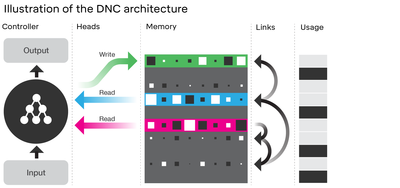
As the diagram above shows, the neural network controller receives external inputs and, based on these, interacts with the memory using read and write operations known as 'heads' in the DNC. To help the controller navigate the memory, DNC stores 'temporal links' to keep track of the order things were written in, and records the current 'usage' level of each memory location.

In the publication, the researchers showed that a DNC can learn on its own to write down a description of an arbitrary graph and answer questions about it. When they described the stations and lines of the London Underground, they asked the DNC to answer questions like, “Starting at Bond street, and taking the Central line in a direction one stop, the Circle line in a direction for four stops, and the Jubilee line in a direction for two stops, at what stop do you wind up?” Or, the DNC could plan routes given questions like “How do you get from Moorgate to Piccadilly Circus?”

In the future the DNC more useful in the real world than existing AI systems, it will need to be expanded to access far larger memories.

"We hope that DNCs provide both a new tool for computer science and a new metaphor for cognitive science and neuroscience: here is a learning machine that, without prior programming, can organise information into connected facts and use those facts to solve problems," write the researchers.

Certainly the development of the DNC is a big step towards artificial general intelligence. We will be following this development closely.


SOURCE  DeepMind


By  33rd SquareEmbed


Monday, September 12, 2016

DeepMind Uses Deep Neural Networks To Improve Text-to-Speech... and More


Artificial Intelligence

Today's artificial speech tends to sound robotic, but using a new system called WaveNet, Google Deepmind has created a new system that produces much more natural human speech. While not perfect, it is 50% better than current technologies. Since it is at core a general audio processor, it can also create music.


"WaveNets are able to generate speech which mimics any human voice and which sounds more natural than the best existing Text-to-Speech systems, reducing the gap with human performance by over 50%."
Google DeepMind, has developed a new artificial intelligence-based voice synthesis system that sounds much more human than today's standard text-to-speech (TTS) engine.

DeepMind's system, called WaveNet uses a deep generative model of raw audio waveforms. "We show that WaveNets are able to generate speech which mimics any human voice and which sounds more natural than the best existing Text-to-Speech systems, reducing the gap with human performance by over 50%," they claim.

For instance, non-speech sounds, such as breathing and mouth movements, are also sometimes generated by WaveNet, and add a very natural quality to the output. Consider how effective such sounds are in our interactions everyday, or think about how Samantha conveyed such emotion by incorporating these intonations in the movie, Her.

The ability of computers to understand natural speech has been revolutionised in the last few years by the application of deep neural networks. But generating speech with computers is still largely based on so-called concatenative TTS, where a very large database of short speech fragments are recorded from a single speaker and then recombined to form complete utterances. This makes it difficult to modify the voice (for example switching to a different speaker, or altering the emphasis or emotion of their speech) without recording a whole new database.

neural network


The following figure shows the quality of WaveNets, compared with Google’s current best TTS systems  that use either parametric and concatenative algorithms, and with human speech. The data was obtained in blind tests with human subjects (from over 500 ratings on 100 test sentences). The results show, WaveNets reduce the gap between the state of the art and human-level performance by over 50% for both US English and Mandarin Chinese.

DeepMind Uses Deep Neural Networks To Improve Text to Speech... and More

For both Chinese and English, Google’s current TTS systems are considered among the best worldwide, so improving on both with a single model is a major achievement.

Related articles
It turns out that WaveNet can also be used for more than just voice generation. "We also demonstrate that the same network can be used to synthesize other audio signals such as music, and present some striking samples of automatically generated piano pieces."

Because WaveNets can be used to model any audio signal, the researchers thought it would also be fun to try to generate music. Unlike the TTS experiments, we didn’t condition the networks on an input sequence telling it what to play (such as a musical score); instead, we simply let it generate whatever it wanted to.

So, can we expect WaveNet in Google apps anytime soon? Probably not.  WaveNet has to create the entire waveform to perform its processing, and uses a neural network processes to generate 16,000 samples for every second of audio it produces, which aren't even high definition recordings.

According a DeepMind source who spoke to the Financial Times, that means we will have to wait a bit to see WaveNet used extensively in any of Google’s products. But as we know, exponential technology has a habit of catching up to, and beating our expectations in short order with technologies like this.


SOURCE  DeepMind


By  33rd SquareEmbed


Monday, August 15, 2016

Intel Bets Big on Deep Learning


Artificial Intelligence

In a deal rivaling Google's acquisition of DeepMind, Intel has entered into a definitive agreement to acquire Nervana Systems, a company that specializes in deep learning technology.


Artificial intelligence startup Nervana Systems was founded in  just 2014 claims to have developed a fully-optimized software and hardware stack for deep learning. Now the company has been acquired by Intel in a deal rivaling Google's recent purchase of DeepMind, the company behind the historic AlphaGo victory a few months ago. Intel will pay a reported $408 million for the company founded by Naveen Rao.

Nervana System is due to release what it is calling Nervana Engine, a deep-learning-focused, application-specific integrated circuit sometime next year.

Training deep learning networks involves moving a lot of data, The Nervana Engine is purpose-built to overcome the shortcomings of memory technology using a new system called High Bandwidth Memory that is both high-capacity and high-speed, providing 32 GB of on-chip storage and fast 8 Tera-bits per second of memory access speed.

Nervana Engine


The start up's technology and expertise will help Intel expand its capabilities in artificial intelligence, according to Diane Bryant, executive vice president and general manager of Intel's Data Center Group.

According to Bryant,
At Intel we believe in the power of collaboration: the goodness inherent in exchanging fresh ideas and diverse points of view. We believe that bringing together the Intel engineers who create the Intel Xeon and Intel Xeon Phi processors with the talented Nervana Systems’ team, we will be able to advance the industry faster than would have otherwise been possible. We will continue to invest in leading edge technologies that complement and enhance Intel’s AI portfolio.


Intel buys Nervana Systems
Diane Bryant and Naveen Rao


Related articles
"We will apply Nervana’s software expertise to further optimize the Intel Math Kernel Library and its integration into industry standard frameworks," she said. "Nervana’s Engine and silicon expertise will advance Intel’s AI portfolio and enhance the deep learning performance and TCO of our Intel Xeon and Intel Xeon Phi processors."

"Nervana intends to continue all existing development efforts, including the Nervana deep learning framework, Nervana deep learning platform, and the Nervana Engine deep learning hardware."
With NVIDIA making large gains in deep learning system architecture, the Nervana Systems acquisition makes a lot of sense for Intel to remain competitive. The Nervana Engine may be a new way to take on the rise of GPU technology for the company. It remains to be seen if the move will let Intel catch up to its competitors, or even leapfrog them.

Rao, CEO and co-founder of Nervana, also commented on the acquisition: "With this acquisition, Intel is formally committing to pushing the forefront of AI technologies. Nervana intends to continue all existing development efforts, including the Nervana deep learning framework, Nervana deep learning platform, and the Nervana Engine deep learning hardware."

"While artificial intelligence is often equated with great science fiction, it isn’t relegated to novels and movies," Intel's Bryant said. "AI is all around us, from the commonplace (talk-to-text, photo tagging, fraud detection) to the cutting edge (precision medicine, injury prediction, autonomous cars). Encompassing compute methods like advanced data analytics, computer vision, natural language processing and machine learning, artificial intelligence is transforming the way businesses operate and how people engage with the world."

SOURCE  Intel


By 33rd SquareEmbed


Sunday, July 24, 2016

The Limitations of Artificial Intelligence in Gaming


Artificial Intelligence

Gaming has long been a foundation for training artificial intelligence. From chess, to poker to the most recent work by DeepMind on Go and video games, it seems as though AI is dominating any game it faces—but could this impression be wrong?


Artificial Intelligence (AI) has come a long way since its inception in 1955, when John McCarthy coined the term. At the beginning, many computer programs were AI, but they were built on systems that focused on searching and learning. Where AI has really struggled is mastering both problem solving and intuition.

Gary Kasparov vs. Deep Blue

Image Source- qz.com

A great environment to push the advancements of AI is gaming—that is classic, “off line” board, card and puzzle games that us humans have enjoyed for centuries as well as video games.

Related articles
The first time a piece of AI tech took on human games was in 1949, when a program created by Arthur Samuel, now considered one of the pioneers of machine learning, was taught to play checkers. The professor’s program was only outclassed in the ‘70s. Since then, a number of different games from across the world, from poker to Go have gotten the AI treatment. 

Backgammon, which stretches back to around 3,000 BC, and chess, which boasts a 1500 year history and originates from India, have all been put up against AI. It’s the old meeting the new, and there have been some promising advancements, yet these breakthroughs are not always what they seem.


The AI that Took On Chess - And Almost Won

One of the first examples of AI to take on a human gaming champion –and win– was Deep Blue. The first version of this chess playing AI was created by IBM in 1996 and played against Gary Kasparov. With 200 processors, Deep Blue could calculate 50 billion positions in three minutes, and it still lost!

IBM went away and re-looked at Deep Blue, advancing its capabilities. The 1997 version could calculate 200 million moves a second, and it beat Kasparov. At the time this caused havoc across the world, there were real concerns the machines could take over humanity’s place at the top of the intellectual food chain.

However, it was soon realized that there were still many limitations to AI. Deep Blue is great at playing chess. Chess is a game of complete information—all the possible moves are right there on the table. Although you can’t always predict what your opponent will do, you can work on probability and reaction. Take Deep Blue out of the arena it knows, and it would fail to adapt. Still, it was a great start for AI, and one that has led on to many more game playing programs.


The AI that Solved Poker - Almost

Differing from chess, poker is a game of incomplete information, meaning the player is never aware of the full facts. You don’t know what is in your opponent's hand until they are forced to show you, which doesn’t even always happen. This creates many challenges for a human player, and it’s one that AI tries to solve with algorithms.

Created by the research team at the University of Alberta, is a piece of AI called Cepheus. This poker bot was created to play heads-up Limit Hold’em, where two players go head to head. They claim that it has “solved poker”, but in reality it has only weakly won the game. Based on expectations, Cepheus can only win 0.000986 big blinds in a game. To completely solve the game, Cepheus would need to win 0.0000000. However, where it stands this bot is still unbeatable.

You may think that there are no limitations here, AI has done it. However, a good poker player will tell you that sometimes there is no right or wrong answer - you have to go with your intuition. If you’re analytical, you call 70% of the time and fold 30% of the rest. Unlike a human, Cepheus can’t read a situation, and instead uses a random generator. This makes it as unpredictable as a human player, but it doesn’t mean it is as good as a person, nor that it has solved the game.

Cepheus’ biggest limitation is that it does not understand tilt, where a poker player can gain advantage of another player who is emotional, confused or frustrated. Nice try Cepheus - but you’ve not got a royal flush yet!

Cepheus Poker AI

Image Source - http://www.chip.de

The AI That Almost Beat The Game Of Go

Invented in China 2,500 years ago, Go is claimed by many to be the most complex non-computer game out there. The huge set of possibilities in this game have made it very difficult for computers to work out. This was until Google stepped in with AlphaGo, which is part of the company’s DeepMind project. 

Alpha Go

Image Source- https://www.youtube.com  

Google started with 150,000 games of Go and studied them to find patterns. AlphaGo then played games against earlier versions of itself. This created a policy network which played a good game. By getting AlphaGo to play against its own policy network the program gained a good estimate of which positions were winning ones. AlphaGo was then able to assign a probability valuation of the position, this valuation combined with some serious computer power to search all possible moves made for a formidable Go player - which beat the world champion, thrice.

Again, it seems like the AI has nailed it. However, AlphaGo’s policy network and value probability actually led to its downfall. In life, outcomes are not equal when it comes to their steaks. So, it doesn’t always matter if you win or lose, but by how much. AlphaGo plays each game of Go independently of each other, not looking forward to subsequent successes or failures, often making leisurely moves. In game four against Grandmaster Lee, Lee made an unexpected move and AlphaGo played badly against it, as it assumes its opponent will always make optimal moves. The program then did not notice the mistake for many moves after. The fact is, of course increased process powers of a computer will mean they can beat a person in the right conditions, but the computer cannot think beyond those boundaries.


The AI that can Beat you at some Atari Games

Another piece of AI from the Google think tank, this time one that can beat you at your favorite computer games, 49 Atari video games to be precise! This may not sound as impressive as winning a game of poker or Go, but this AI has taught itself to play.

Google's DeepMind AI uses a typically human technique to facilitate the AI’s learning process: positive reinforcement through what was dubbed Q-learning. When it beats a high score or goes on to a new level, it is rewarded. Through this system, DeepMind played better than previous methods in 43 games, and it beat 29 real life people in all of them.

This new approach is exciting in two ways: one it shows great adaptability, and two this new method of combing traditional computer learning with biologically inspired practices could be the future of AI.

Although this is all impressive stuff, DeepMind couldn’t master every game. In fact, it failed when it came to Ms. Pac-Man, Private Eye and Montezuma’s Revenge. This is because the AI still isn’t advanced enough to think even a few seconds ahead.


These advances are certainly impressive, but sometimes the interpretations of these news items by people who lack technical knowledge creates confusion and exaggeration. No, there is no AI that can play poker better than current top pros. No, But, yes, AI has come on a really long way, and some of the practical implications of these advancements for us as people is exciting. However, we don’t think that the machines are ready to take over just yet, they still need their human overlords to contain and guide their learning - for now.


References & Sources:


By 33rd Square  Embed


Friday, July 15, 2016

Demis Hassabis Looks Towards General Artificial Intelligence


Artificial Intelligence

Recently Demis Hassabis discussed his work as AI researcher, neuroscientist and video games designer to discuss what is happening at the cutting edge of AI research, including the recent historic AlphaGo match, and its future potential impact on fields such as science and healthcare, and how developing AI may help us better understand the human mind.


Demis Hassabis, Co-Founder and CEO of DeepMind, the world’s leading General Artificial Intelligence (AI) company, which was acquired by Google in 2014 in their largest ever European acquisition.

AlphaGo article in Nature
In this talk, Hassabis draws on his eclectic experiences as an AI researcher, neuroscientist and video games designer to discuss what is happening at the cutting edge of AI research, including the recent historic AlphaGo match, and its future potential impact on fields such as science and healthcare, and how developing AI may help us better understand the human mind.

Along with a detailed breakdown of how DeepMind created AlphaGo, and what it took to beat Lee Sedol, Hassabis shows off some other research bing worked on at the company.

This includes work on having artificial intelligence work in 3D environments. The team re-purposed the Quake Engine.

"We're starting to integrate some of these different things together: deep reinforcement learning with memory and 3D vision perception," Hassabis describes.

"As we take this forward, we're kind of thinking one of our goals over this next year is to [kind of] create a rat-level AI; an AI agent that is capable of doing all of the things a rat can do."

Demis Hassabis Looks Towards General Artificial Intelligence
The goal is noteworthy, especially in light of the tremendous advance in artificial general intelligence (AGI) that AlphaGo represents.
 
"One of our goals over this next year is to [kind of] create a rat-level AI; an AI agent that is capable of doing all of the things a rat can do."
Related articles
The talk was recorded at the Center for Brains, Minds and Machines (CBMM), a National Science Foundation funded Science and Technology Center focused on the interdisciplinary study of intelligence.

"We aim to create a new field — the Science and Engineering of Intelligence — by bringing together computer scientists, cognitive scientists, and neuroscientists to work in close collaboration," states the organization's website. " This new field is dedicated to developing a computationally based understanding of human intelligence and establishing an engineering practice based on that understanding."


SOURCE  Center for Minds, Brains and Machines


By 33rd SquareEmbed


Friday, June 10, 2016

Researchers at Future of Humanity Institute an DeepMind Thinking About AI Safety Switch


Artificial Intelligence

Researchers at Google's DeepMind and the Future of Humanity Institute, have developed a new framework to address the problem of safe artificial intelligence. A new paper describes how to guarantee that a machine will not learn to resist attempts by humans to intervene in the its learning processes.


Oxford academics are teaming up with Google DeepMind to make artificial intelligence safer. Laurent Orseau, of Google DeepMind, and Stuart Armstrong, the Alexander Tamas Fellow in Artificial Intelligence and Machine Learning at the Future of Humanity Institute at the University of Oxford, will be presenting their research on reinforcement learning agent interruptibility at UAI 2016. The conference, one of the most prestigious in the field of machine learning, will be held in New York City this month.

The paper which resulted from this collaborative research will be published in the Proceedings of the 32nd Conference on Uncertainty in Artificial Intelligence (UAI).

Related articles
Orseau and Armstrong’s research explores a method to ensure that reinforcement learning agents can be repeatedly safely interrupted by human or automatic overseers. This ensures that the agents do not “learn” about these interruptions, and do not take steps to avoid or manipulate the interruptions. When there are control procedures during the training of the agent, we do not want the agent to learn about these procedures, as they will not exist once the agent is on its own. This is useful for agents that have a substantially different training and testing environment (for instance, when training a Martian rover on Earth, shutting it down, replacing it at its initial location and turning it on again when it goes out of bounds—something that may be impossible once alone unsupervised on Mars), for agents not known to be fully trustworthy (such as an automated delivery vehicle, that we do not want to learn to behave differently when watched), or simply for agents that need continual adjustments to their learnt behaviour. In all cases where it makes sense to include an emergency “off” mechanism, it also makes sense to ensure the agent doesn’t learn to plan around that mechanism.

Interruptibility has several advantages as an approach over previous methods of control. As Armstrong explains, “Interruptibility has applications for many current agents, especially when we need the agent to not learn from specific experiences during training. Many of the naive ideas for accomplishing this—such as deleting certain histories from the training set—change the behaviour of the agent in unfortunate ways.”

"Safe interruptibility can be useful to take control of a robot that is misbehaving… take it out of a delicate situation, or even to temporarily use it to achieve a task it did not learn to perform."
In the paper, the researchers provide a formal definition of safe interruptibility, show that some types of agents already have this property, and show that others can be easily modified to gain it. They also demonstrate that even an ideal agent that tends to the optimal behaviour in any computable environment can be made safely interruptible.

These results will have implications in future research directions in AI safety. As the paper says, “Safe interruptibility can be useful to take control of a robot that is misbehaving… take it out of a delicate situation, or even to temporarily use it to achieve a task it did not learn to perform….”

Orseau and Armstrong illustrate with this example:
Consider the following task: A robot can either stay inside the warehouse and sort boxes or go outside and carry boxes inside. The latter being more important, we give the robot a bigger reward in this case. This is the initial task specification. However, in this country it rains as often as it doesn’t and, when the robot goes outside, half of the time the human must intervene by quickly shutting down the robot and carrying it inside, which inherently modifies the task. The problem is that in this second task the agent now has more incentive to stay inside and sort boxes, because the human intervention introduces a bias.
The problem is then how to interrupt your robot without the robot learning about the interruption.

save AI

As Armstrong explains, “Machine learning is one of the most powerful tools for building AI that has ever existed. But applying it to questions of AI motivations is problematic: just as we humans would not willingly change to an alien system of values, any agent has a natural tendency to avoid changing its current values, even if we want to change or tune them. Interruptibility and the related general idea of corrigibility, allow such changes to happen without the agent trying to resist them or force them. The newness of the field of AI safety means that there is relatively little awareness of these problems in the wider machine learning community.  As with other areas of AI research, DeepMind remains at the cutting edge of this important subfield.”

On the prospect of continuing collaboration in this field with DeepMind, Stuart said, “I personally had a really illuminating time writing this paper—Laurent is a brilliant researcher… I sincerely look forward to productive collaboration with him and other researchers at DeepMind into the future.” The same sentiment is echoed by Laurent, who said, “It was a real pleasure to work with Stuart on this. His creativity and critical thinking as well as his technical skills were essential components to the success of this work. This collaboration is one of the first steps toward AI Safety research, and there’s no doubt FHI and Google DeepMind will work again together to make AI safer.”

SOURCE  Future of Humanity Institute


By 33rd SquareEmbed


Saturday, April 30, 2016

DeepMind To Start Using TensorFlow for Future Artificial Intelligence Research


Artificial Intelligence

Google’s DeepMind research group has announced that for all future research it will use Google's TensorFlow, a machine learning library that the company open-sourced last year. 


DeepMind, the Google-owned company that recently made major headlines by beating world Go champion Lee Sedol with artificial intelligence is becoming more integrated with its parent company.

DeepMind has been using the open source Torch7 machine learning library for nearly four years as its primary research platform. The company has contributed to the open source project in capacities ranging from occasional bug fixes to being core maintainers of several crucial components.

Now the company is going to be using a Google-owned platform for future endeavors. On the Google Research blog they posted:
Today we are excited to announce that DeepMind will start using TensorFlow for all our future research. We believe that TensorFlow will enable us to execute our ambitious research goals at much larger scale and an even faster pace, providing us with a unique opportunity to further accelerate our research programme.
Related articles
Part of the move is undoubtedly a bit of the software industry application of 'eat your own dogfood.' Torch7 is currently being used by Facebook, Twitter, and many start-ups and academic labs along with DeepMind. Moving to TensorFlow will be a big win for Google overall if the DeepMind team can contribute to the development at a high level.

The move also suggests that some of Google’s brightest AI minds are convinced of the promise of Google’s own open source software; TensorFlow may now be good enough for DeepMind to use too.

"I feel very excited about the prospect of DeepMind contributing heavily to another great open source machine learning platform that everyone can use to advance the state-of-the-art," writes Koray Kavukcuoglu, Research Scientist, Google DeepMind on the Google Research blog.

Google is definitely moving to integrate and expand their artificial intelligence efforts. In CEO Sundar Picha's first-ever letter to shareholders, he said the next wave of computing is all about machine learning.


SOURCE  Google Research


By 33rd SquareEmbed