bloc 33rd Square Business Tools - 3d scanning 33rd Square Business Tools: 3d scanning - All Post
Showing posts with label 3d scanning. Show all posts

Thursday, August 11, 2016

New System Creates Real-time Performance Capture of Challenging Scenes


3D Scanning

Microsoft is developing new real-time 3D scanning capabilities that could mean you could attend a concert or sporting event live in full 3D, or even have the ability to communicate in real-time with remotely captured people using immersive augmented reality or virtual reality displays in the future.


Researchers at Microsoft have created a system that could be the prototype for a next-generation Kinect camera. Called Fusion4D, the project, the scanning system impressively reconstructs complex 3D scenes digitally, including those with more than one person, animals and can even capture clothing being put on the actor.

The researchers have detailed their work in a paper published online.

Fusion4D is the first real-time multi-view non-rigid reconstruction system for live performance capture, claim the researchers. "We have contributed a new pipeline for live multi-view performance capture, generating high-quality reconstructions in real-time, with several unique capabilities over prior work," they conclude.

Fusion4D

Related articles

Today, most cameras and 3D scanners like the Kinect Sensor, used for motion capture still focus on static, non-moving, scenes. This is due to limitations in computational power and the demands on software to reconstruct scenes. 

For more complex scenes, with moving cameras and many elements, the computer must solve for orders of magnitude more parameters in real-time. This typically results in noisy or missing data, choppy motion and digital artifacts in the output that are not representative of what is being captured in the real world.

Fusion4D Microsoft research


"Our reconstruction algorithm enables both incremental reconstruction, improving the surface estimation over time, as well as parameterizing the nonrigid scene motion."
Microsoft's research team also dealt with the case of changing scene topology, such as person removing a jacket or scarf.

The implications of the research are vast. For instance, it could lead to new real-time experiences such as the ability to watch a remote concert or sporting event live in full 3D, or even the ability to communicate in real-time with remotely captured people using immersive augmented reality or virtual reality displays.

The applications could also extend to robotics and machine vision.

With Microsoft's HoloLens system reaching wider deployment now, this last case could lead to some very interesting possibilities.

New System Creates Real-time Performance Capture of Challenging Scenes

"As shown, our reconstruction algorithm enables both incremental reconstruction, improving the surface estimation over time, as well as parameterizing the nonrigid scene motion," write the authors."We also demonstrated how our approach robustly handles both large frame-to-frame motion and topology changes. This was achieved using a novel real-time solver, correspondence algorithm, and fusion method."

"We believe our work can enable new types of live performance capture experiences, such as broadcasting live events including sports and concerts in 3D, and also the ability to capture humans live and have them re-rendered in other geographic locations to enable high fidelity immersive telepresence."



SOURCE  Microsoft Research


By 33rd SquareEmbed


Thursday, March 31, 2016

Microsoft's Holoportation Demo Will Blow Your Socks Off


Holograms

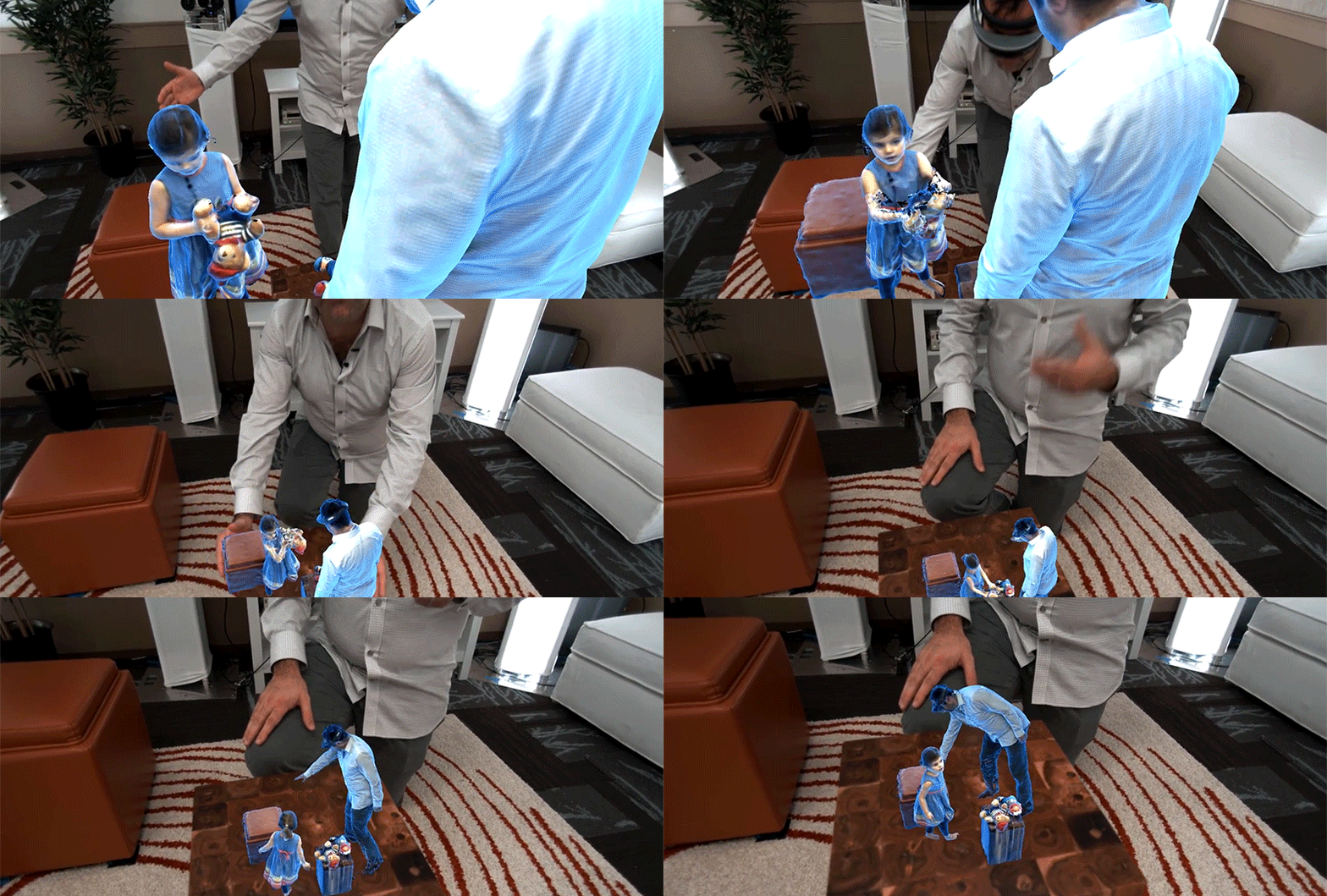
Holoportation is a new type of 3D capture technology that allows high-quality 3D models of people to be reconstructed, compressed and transmitted anywhere in the world in real time. Don't miss the video of this incredible demo from Microsoft.


Microsoft has already offered a few tantalizing glimpses at its Hololens technology, and the latest really shows off just how useful and natural the device might be for telepresence applications.

In the video below, Microsoft research manager Shahram Izadi demonstrated ‘holoportation,’ which allows him  and the people he talks with to appear as if he’s there in real-time, anywhere in the world.

Holoportation is a new type of 3D capture technology from Microsoft that allows high-quality 3D models of people to be reconstructed, compressed and transmitted anywhere in the world in real time.

Microsoft Holoportation

Used with augmented reality displays like the HoloLens, this technology allows users to see, hear, and interact with remote participants in 3D as if they are actually present in the same physical space. Communicating and interacting with remote users becomes as natural as face-to-face communication.

The sessions can even be played back previous as though “walking into a living memory,” and miniaturize the content to make it easier to consume. Perhaps even cooler is when Izadi decides to shrink himself and his daughter down with a gesture. These are the computer interactions we have only seen in movies!


Related articles
Microsoft was clever to set up the two capture facilities with the same dimensions and furniture, so that the participants interact with the virtual and the physical quite seamlessly in this demonstration. They walk around tables, not through them, and objects can be picked up and manipulated. When one participant sits down, it really looks like they have sat in the room with Izadi.

“Imagine being able to virtually teleport from one place to another,” Izadi says. Well, if you’re the owner of a HoloLens, you soon could do.

So far there is little information when the Holoportation system might be available, but it does show that "Help me Obi Wan Kenobi, your my only hope," is not far away from being yet another technology that jumps into reality from the science fiction screen.


SOURCE  Microsoft Research


By 33rd SquareEmbed


Sunday, February 21, 2016

Are 3D Scanners A Hacker's Latest Tool of Choice?


3D Scanning

The bust of Queen Nefertiti, an Egyptian artwork famously residing in Berlin has been secretly 3D scanned and the data released online as a torrent, providing completely free access under public domain to the an object in the museum’s collection that is currently off-limits to photographers. Now, anyone can download even create 3D prints of the piece.


In what they are calling an 'artistic intervention,' two German artists Nora Al-Badri and Jan Nikolai Nelles 3D scanned the head of the Neues Museum Berlin's famous Nefertiti without permission of the Museum and then released the 3D data under a Creative Commons Licence.

The original bust is a 3,300-year-old painted stucco-coated limestone sculpture of Nefertiti, the Great Royal Wife of the Egyptian Pharaoh Akhenaten. The piece is believed to have been crafted in 1345 BC by the sculptor Thutmose, because it was found in his workshop in Amarna, Egypt. It is one of the most copied works of ancient Egypt.

Partly because of the piece, Nefertiti has become one of the most famous women of the ancient world, and a symbol of feminine beauty.

A German archaeological team led by Ludwig Borchardt discovered the Nefertiti bust in 1912 in Thutmose's workshop. It has been kept at various locations in Germany since its discovery, including the cellar of a bank, a salt mine in Merkers-Kieselbach, the Dahlem museum, the Egyptian Museum in Charlottenburg and the Altes Museum. It is currently on display at the Neues Museum in Berlin, where it was originally displayed before World War II.

The Nefertiti bust has been the subject of an intense argument between Egypt and Germany over Egyptian demands for its repatriation.

Are 3D Scanners A Hacker's Latest Tool of Choice?

"From today on everybody around the world can access, study, print or remix a 3D dataset of Nefertiti's head in high resolution. This data is accessible under a public domain without any charge," claim the artists on the Nefertiti Hack website.

"With the data leak as a part of this counter narrative we want to activate the artefact, to inspire a critical re-assessment of today’s conditions and to overcome the colonial notion of possession."
The artists themselves used the 3D data to create a 3D printed, one-to-one polymer resin model they claim is the most precise replica of the bust ever made, and are permanently displaying it in the American University of Cairo.  The project called "The Other Nefertiti" serves as a stand-in for the original artwork.

The artists' 3D Print exhibited in Cairo is the most precise scan ever made public of the original head of Nefertiti. The artists' intention is to make cultural objects publicly accessible. The Neues Museum in Berlin until today does not allow any access to the head of Nefertiti nor to the data from their scan. “With the data leak as a part of this counter narrative we want to activate the artefact, to inspire a critical re-assessment of today’s conditions and to overcome the colonial notion of possession in Germany” the two artists say.

Al-Badri and Nelles leaked the information at Europe’s largest hacker conference, the annual Chaos Communication Congress. Within 24 hours, at least 1,000 people had already downloaded the torrent from the original seed, and many of them became seeders as well.

Since then, the pair has also received requests from Egyptian universities asking to use the information for academic purposes and even businesses wondering if they may use it to create souvenirs.

Nora Al-Badri and Jan Nikolai Nelles with the 3D bust in Cairo

Related articles

“The head of Nefertiti represents all the other millions of stolen and looted artifacts all over the world currently happening, for example, in Syria, Iraq, and in Egypt,” Al-Badri said. “Archaeological artifacts as a cultural memory originate for the most part from the Global South; however, a vast number of important objects can be found in Western museums and private collections. We should face the fact that the colonial structures continue to exist today and still produce their inherent symbolic struggles.”

The artists hope their actions will place pressure on not only the Neues Museum but on all museums to repatriate objects to the communities and nations from which they came. Rather than viewing such an idea as radical, they see it as pragmatic, as a logical update to cultural institutions in the digital era: especially given the technological possibilities of today, the pair believes museums who repatriate artifacts could then show copies or digital representatives of them.

Many people have already created their own Nefertitis from the released data; the 3D statue in the American University in Cairo stands as such an example of Al-Badri and Nelles’s ideals for the future of museums, in addition to being one immediate solution that may arise from individual action.

With 3D scanners shrinking in size and price, they are already common apps and modifications to smartphones and other mobile devices. More and more museums around the world can expect their artefacts to be 'liberated' like the Nefertiti has been. Other institutions are already embracing sharing such data. Should they all?


SOURCE  Hyperallergic


By 33rd SquareEmbed


Friday, November 21, 2014

Medical Technology: What We Can Expect from the Future

 Medicine
Here are some more future medical technologies coming our way. Big changes are coming our way in the next few years, helping us live longer and healthier lives.


Medical technology is an exciting and fast-developing field that promises remarkable new advancements in the not-so-distant future. Take a tour and see some of the most interesting potentialities of future medical technology.

Real-Time Tumor Scanning

A surgical knife, called the iKnife, already exists and allows surgeons to make incisions with reduced blood loss. The knife can also detect whether a biological sample contains malignant tissue. This will change the way cancer diagnosis is rendered, and can result in faster and safer biopsies.

The Next Advancement in Google Glass

Google glasses certainly have caught their share of media attention, but scientists are already working on ways to turn that technology into a contact lens. The lens can be controlled using the brain by accessing brain waves and intuiting what the wearer needs. Someday, surgeons might be able to make more precise incisions with the aid of these kinds of glasses.
Related articles


The Lawnmower Man Might be Real

If you remember the old horror movie, "The Lawnmower Man," you might be frightened by this next revolution. Ian Pearson posits that one day we might be able to create a digital version of ourselves that can continue living in digital form. We would essentially upload our minds to a computer and continue living in mind, if not in body. Maybe eternal life is possible after all.

New Drugs

The potential for 3D printing may take on a whole new level of sophistication with the ability to create drugs on demand. Printing drugs from a printer may completely change the pharmaceutical world as we know it. Instead of pharmacies contains rows of medication, they may just have several drug manufacturing machines that print and make your prescription on the spot. 3D printing has also shown capabilities of reproducing organs for transplanting. With this kind of technology on the horizon, organ donors will become a thing of the past.

With the advent of new medical technologies, there will also be large ethical and social implications that need to be hammered out. From surgeries to births, medicine and the doctors are seeing a new world of technology in their field. Maternal care specialist, Dr. Gilbert Webb says even caesarian sections are becoming safer with new advances. Those living 20 to 30 years from now may live in a drastically different world than what we are experiencing today. Look how far the personal computer has come since its introduction in the 80s, and you can get an idea for how drastically technology can change in the span of 30 years.


Information Credit: http://health.usnews.com/doctors/gilbert-webb-373659


By Brooke ChaplanEmbed

Author Bio - Brooke Chaplan is a freelance writer and an outdoor enthusiast. She lives and works in Los Lunas, NM where she enjoys writing, hiking and running as much as she can!

Thursday, January 23, 2014

3D Scanned Cell

 Imaging
A new 3D imaging technique for live cells uses a conventional microscope to capture image slices throughout the depth of the cell, then computationally renders them into one three-dimensional image. The technique uses no dyes or chemicals, allowing researchers to observe cells in their natural state.


Living cells are ready for their close-ups, thanks to a new imaging technique that needs no dyes or other chemicals, yet renders high-resolution, three-dimensional, quantitative imagery of cells and their internal structures – all with conventional microscopes and white light.

Called white-light diffraction tomography (WDT), the imaging technique opens a window into the life of a cell without disturbing it and could allow cellular biologists unprecedented insight into cellular processes, drug effects and stem cell differentiation.

The team of University of Illinois researchers, led by electrical and computer engineering and bioengineering professor Gabriel Popescu, published their results in the journal Nature Photonics.

“One main focus of imaging cells is trying to understand how they function, or how they respond to treatments, for example, during cancer therapies,” Popescu said. “If you need to add dyes or contrast agents to study them, this preparation affects the cells’ function itself. It interferes with your study. With our technique, we can see processes as they happen and we don’t obstruct their normal behavior.”

Related articles
Because it uses white light, WDT can observe cells in their natural state without exposing them to chemicals, ultraviolet radiation, or mechanical forces – the three main methods used in other microscopy techniques. White light also contains a broad spectrum of wavelengths, thus bypassing the interference issues inherent in laser light – speckles, for example.

The 3D images are a composite of many cross-sectional images, much like an MRI or CT image. The microscope shifts its focus through the depth of the cell, capturing images of various focus planes. Then the computer uses the theoretical model and compiles the images into a coherent three-dimensional rendering.

The greatest potential of WDT, according to the researchers, is the ability to study cells in three dimensions over time. Since the cells are not altered, they can be imaged repeatedly, allowing researchers a glimpse into the dynamics of a cell as it goes about its life – or as it is treated with a new drug.

“As a cell grows we can see the change in all three dimensions,” said Taewoo Kim, a graduate student and first author of the paper. “We can see the dynamics of the cell in 3-D, which hasn’t been done in a quantitative manner. For example, we could see, in the span of a minute or over a cell’s lifetime, how it grows and how the things in the cell move around.”

“With this imaging we can tell at what scale things within the cell are transported randomly and at what scale processes are actually organized and deterministic,” Popescu said. “At first glance, the dynamics looks pretty messy, but then you look at it – we stare at movies for hours and hours – and you realize it all makes sense. Everything is organized perfectly at certain scales. That’s what makes a cell alive. Randomness is just nature’s way to try new things.”

WDT uses a component that adds onto a conventional phase contrast microscope, a common piece of equipment in biology labs, without altering the microscope itself. The researchers used conventional microscopes with the intention of making these new optics principles easily accessible for biologists. The researchers hope that this will allow rapid large-scale adoption of WDT, and Popescu founded a startup company, Phi Optics, to help achieve that goal.

In addition to biological applications, the WDT technique has implications in the broader field of optics as the researchers pushed the boundaries of physics by applying scattering theory to imaging optics.

“The physics behind this technique is another thing we were fascinated about,” Kim said. “Light propagation in general is studied with approximations, but we’re using almost no approximation. In a very condensed form, we can perfectly show how the light changes as it passes through the cell.”

“We started on this problem two years ago, trying to formulate mathematically the sectioning effect observed in spatial light interference light microscopy (SLIM),” said Renjie Zhou, a graduate student and co-first author of the paper. “We came up with equations which eventually described WDT. The final equation is beautiful and the theory opens opportunities for solving other optics problems in a new theoretical language.”

Next, the researchers hope to pursue cross-disciplinary collaborations to explore applications of WDT in biology as well as expansions of the imaging optics demonstrated in WDT. For example, they are using WDT to watch stem cells as they differentiate in hopes of better understanding how they turn into different cell types. Since stem cells are so sensitive, only a chemical-free, non-invasive, white-light technique such as WDT could be used to study them without adverse effects.


SOURCE  University of Illinois at Urbana-Champaign

By 33rd SquareSubscribe to 33rd Square

Wednesday, December 11, 2013


 3D Scanning
The Structure Sensor is now available for pre-order from Occipital, the creator of the gadget.  The Structure clips onto your iPad and will be bundled with augmented reality and 3D scanning apps.


Startup Occipital has already raised over $1 million on Kickstarter, and now is in the pre-order phase for its Structure 3D sensor.

The Structure is small 3D sensor that clips onto the back of your iPad, and hooks into the Lighting Connector.  With the sensor users can scan objects for other applications or 3D printing, and for augmented reality applications.  With an independent battery, the device won't eat up your devices battery life either.

The company is now opening up its platform to developers, so no one really knows what future applications may make use of the scanner.

Structure 3D Sensor

Richard Darell at Bit Rebels says, "It’s not always that you stumble over technology that you know is going to fundamentally change the way we do things. The Structure Sensor is not only a device that will capture real life objects and create them into virtualized 3D representation of them, it is way more than that."

Related articles
The Structure Sensor has been designed from the ground up to be mobile. Occipital put a lot of thought into making the Structure Sensor work perfectly with the iPad and other mobile devices. The goal was to make a device that enabled incredible 3D scanning applications, was easy to use, had great battery life, was compact, and looked like beautiful, precision hardware.

The Structure Sensor chassis is machined out of a single piece of aluminum that serves as both an aesthetic exterior and as a thermal core that keeps the precision optics inside at an optimal temperature.  It’s also anodized for an appealing finish.  At its top, the Structure Sensor has a chemically hardened glass surface that optimizes the depth image quality, while also protecting the infrared emitter and camera inside.

Turn Your iPad into a 3D Scanner

Out of the box the Structure will come with the following functions:
1. Room Capture: Easily capture a 3D model of a room by simply spinning around with your Structure Sensor and iPad. Then, tap any two points to retrieve distances. 
2. Fetch: A virtual pet to play fetch with in the physical world around you. 
3. Ball Physics: An augmented reality demo where virtual balls interact with the dense geometry of the world. 
4. Object Scanner:  Capture models of objects and export them to CAD software or for 3D printing.  You can also upload models directly to Shapeways.com for 3D printing.
Structure 3D Scanner for iPad

Length x Width x Height 119.2mm x 27.9mm x 29mm
Weight 99.2 grams
Minimum Distance 40 centimeters
Maximum Distance 3.5+ meters
Precision 1% of measured distance (typical)
Resolution VGA (640 x 480) / QVGA (320x240)
Framerate 30 / 60 frames per second
Battery Life 3-4 hours of active sensing, 1000+ hours of standby
Illumination Infrared structured light projector, Uniform infrared LEDs
Field of View Horizontal: 58 degrees, Vertical: 45 degrees

The Structure Sensor is now available for pre-order here. The price is only $349 - much less than other 3D scanners.


By 33rd SquareSubscribe to 33rd Square

Thursday, August 22, 2013

Makerbot 3D Digitizer

 3D Scanning
3D Printing company Makerbot has released their Digitizer, a 3D scanner that will allow you to scan in real objects and use them for 3D printing or digital modification.  Priced below competitive products, the Digitizer could be a game-changer.


S ince March, the team at MakerBot have been teasing their Digitizer desktop 3D scanner. Now they’re just about ready release it.

Priced at $1,400, you too can scan all the little knick-knacks in your life and turn them into 3D schematics to print or share with others.

To use the Digitizer, you place an object on its central turntable and initiate the device.  The system uses a pair of lasers that will scan the object’s surface geometry and turn that cloud of data points into a 3D model.

MakerBot says the whole process takes about 12 minutes, after which you’re able to recreate the item a 3D printer or modify the data using software such as Pixologic's ZBrush.

3d scanning workflow

Related articles
MakerBot is easily one of the best known proponents of the 3D printing movement, and a device like Digitizer may just be what the movement needs to make 3D printing more mainstream.

CEO Bre Pettis referred to the Digitizer as a “game changer” for the 3D printing movement and it’s not hard to see why. For the past two years now, MakerBot’s efforts have largely been about making the process of 3D printing as accessible as possible. 3D printing novices can get a feel for turning the contents of pre-produced files into actual physical objects.

The turntable can only support objects that are 3kg (or about 6.5lbs) or lighter, and you should ideally use the thing a very well-lit room. The Digitizer promises to be fast and easy, and at $1,400 it is priced well below competitive products such as the NextEngine 3D scanner or the new high resolution FROGScan system from Streamline Automation.

According to Makerbot, the Digitizer captures enough points to create about 200,000 triangles for each new 3D model. It can capture details as small as 0.5 mm, and surface depth as shallow as 0.5 mm. The dimensional accuracy of the MakerBot Digitizer’s is ± 2 mm, meaning that when you scan an object, the dimensions of your 3D model will be within 2 mm of your original object.


SOURCE  Makerbot, TechCrunch

By 33rd SquareSubscribe to 33rd Square

Monday, July 8, 2013


Digital Avatars
Researchers using photographed samples of skin from people's chins, cheeks and foreheads at a resolution of about 10 micrometers, have created super-realistic simulated CGI skin with detail such that each skin cell spreads across only three pixels.


New research could further CGI graphics with simulated skin that is faithful down to the level of individual cells.

Creating realistic faces is one of the biggest challenges for CGI, in large part because skin's appearance is the sum of a complex interplay of tiny features and flaws. Get any of those factors wrong, and the CGI face comes out looking eerily wrong. "The renderings can only be as real as the input data," says Abhijeet Ghosh at Imperial College London. "And that's where we come in."

Uncanny Valley Getting Closer With Cell-Level Simulated Skin

Related articles
Ghosh and Paul Debevec of the University of Southern California (USC) and their colleagues had already developed a way to simulate light reflecting off human skin. It involves splitting the light into four rays: one that bounces off the epidermis and three that penetrate the skin to varying depths, scattering before being reflected.

The team have now massively cranked up the level of detail. Using a specially developed lighting system and camera, they photographed samples of skin from people's chins, cheeks and foreheads at a resolution of about 10 micrometres, so that each skin cell was spread across roughly three pixels. They then used the images to create a 3D model of skin and applied their light reflection technique to it. The result was CGI skin complete with minute structures like pores and microscopic wrinkles. Finally, they fed the CGI images to an algorithm that extended them to fill in an entire CGI face.

Usually, CGI uses a standard set of values for skin structure, says Ghosh. But for big-budget films, digital effects companies like Weta Digital – which used some of Ghosh and Debevec's techniques in the movie Avatar, for example – prefer to tailor skin textures to individuals. To create the blue-skinned Na'vi, for example, artists took surface details like moles and wrinkles and added them to the characters by hand. "In movies they zoom in to show that stuff off," says Ghosh, but the work is a slow process. Ghosh and Debevec's system, which Ghosh presented at the Games and Media Event at Imperial College London in May, could automate this level of customization.

CGI face

It's not only the entertainment industry that is eyeing this technology. In 2010, the cosmetics company Avon gave Ghosh funding to explore whether his digital skin could be used to simulate the application of different kinds of make-up. Other cosmetics firms have also showed interest in the idea. Ghosh thinks that one day we will have an app that offers a virtual try-before-you-buy service for make-up. "You would arrive at a kiosk and have your face scanned," he says. The software would then show you exactly what your skin would look like with, for example, a certain foundation applied, he says.

Next, he team at USC is working with games publisher Activision to try to find a way to bring these sort of high quality faces to games as soon as possible.


SOURCE  New Scientist

By 33rd SquareSubscribe to 33rd Square

Friday, January 18, 2013

3d printing


 3D Printing
At the inaugural 3D Printshow last year, the exhibits spoke to the broad range of markets and industries that have been touched by 3D printing: software, hardware, services, art, fashion, music, business, design, architecture, medicine, and home decor. 
The future is made of plastic, metal and glass and is being gradually and increasingly coming out of a 3D printer. Late last year, for the first time, a tradeshow dedicated to the new technology got its start in London. 3D Printshow is dedicated solely to this new, strange world and is a sign that the 3D printing industry has made it’s way to the wider consumer market.

The diversity of the exhibits spoke to the broad sampling of markets that have been reached by 3D printing: software, hardware, services, art, fashion, music, business, design, architecture, medicine, and home decor. It seems there are no areas of industry, art and design that are not affected by 3D printing.

3d printed shoes

In the show's gallery, the selected works came from a range of disciplines including sculpture, jewellery design, animation and interactive art. Each work explored the ideas and concepts generated by this new artistic movement and are realized through 3D printing.
According to the organizers, the exhibition marks a meeting point between established design convention and the potential provided by unprecedented advances in technology.

3d printed music
Artists jam on 3D printed instruments at 3D Printshow 2012

Even music will be affected by the technology as is shown in the image above, and by Ray Kurzweil's familiar anecdote of 3D printing a Stradavarius violin anywhere on demand.  Kurweil also predicts that 3D printers will eventually be able to self-replicate by printing the parts to build other 3D printers. A team at Kurzweil’s Singularity University is working on the concept of 3D-printable buildings. Scientists hope to be able to print human tissue and organs as well as bones.

For the show's visitors, the exhibits allowed them to explore the extraordinary possibilities of 3D printing and encouraged a deeper understanding and enjoyment of cutting edge art and design.

In the video below,CNET's Luke Westaway took to the floor of London's 3D printer show to examine trinkets, musical instruments, a house, and even replica cat skeletons scanned from mummified remains.


SOURCE  CNET

By 33rd SquareSubscribe to 33rd Square


Tuesday, August 14, 2012

Disney Face Cloning

 Animatronics
Researchers at Disney Research, and Walt Disney Imagineering R&D have developed a new computational design process for cloning human faces that could greatly simplify the creation of synthetic skin for animatronic characters.
The team at Disney Research has developed a complete process for designing, simulating, and fabricating synthetic skin for an animatronics character that mimics the face of a given subject and its expressions.

The technique could be applied to more advanced avatar, or surrogate robots in the future. As the video below shows, the technique creates life-like duplication of human facial features and motions that could potentially bridge the uncanny valley.

Animatronics technology is used for creating physical robots that move and look like real humans. Many impressive characters have been created in this spirit, like those in the Hall of Presidents attraction at Walt Disney World.

Until now, creating animatronic copies of real human individuals is a difficult and labor-intensive process requiring the manual work of skilled animators, material designers and mechanical engineers. Researchers at Disney Research, Zürich, ETH Zürich, and Walt Disney Imagineering R&D have developed a new computational design process for cloning human faces that could greatly simplify the creation of synthetic skin for animatronic characters.

Due to its expressive power, replicating the human face presents huge challenges. To deliver compelling and realistic performances, an animatronic character must produce a vast range of facial expressions, each having different deformations and wrinkles. Manually designing the shape and material properties of a single skin that is able to achieve all of these targets is a formidable task. The Zürich researchers, however, invented a computational method for automatically designing synthetic skin to match real individuals.

The process starts by 3D scanning facial expressions from a human subject. Then, a novel optimization scheme determines the shape of the synthetic skin as well as control parameters for the robotic head that provide the best match to the human subject. This processing increases the realism of the resulting character, resulting in an animatronic face that closely resembles the human subject.

"With our method, we can simply create a robotic clone of a real person," said Dr. Bernd Bickel, researcher at Disney Research, Zürich. "The custom digitally designed skin can be fabricated using injection molding and modern rapid prototyping technology. We 3D print a mold and use elastic silicon with properties similar to human skin as base material". Their findings were presented at ACM SIGGRAPH 2012, the International Conference on Computer Graphics and Interactive Techniques.

"Our research focuses on the creation of the silicone skin," explained Dr. Peter Kaufmann, researcher at Disney Research, Zürich. "We use computation to carefully modify the thickness of the skin across the face, leading to deformations that closely match those of the real human."


SOURCE  Disney Research

By 33rd SquareSubscribe to 33rd Square