bloc 33rd Square Business Tools - robots 33rd Square Business Tools: robots - All Post
Showing posts with label robots. Show all posts

Sunday, June 18, 2017

Qbo One Robot Looks to Impact the Classroom


Robotics  

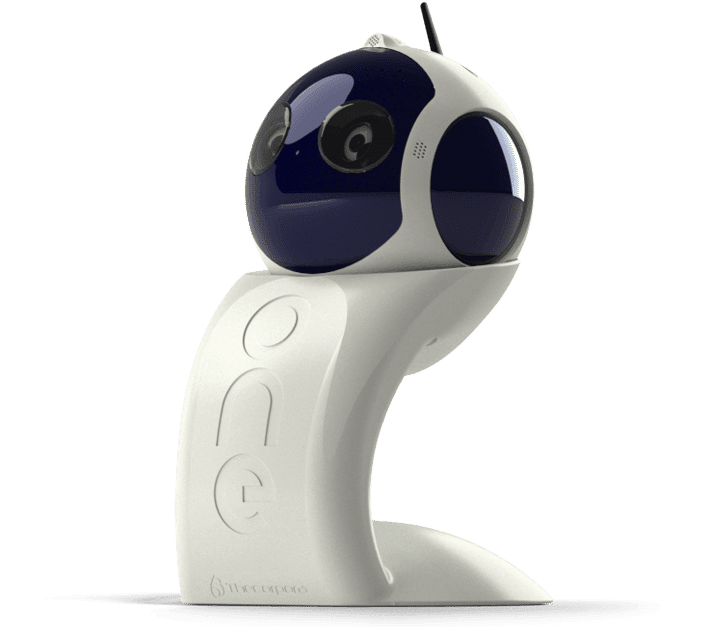
The Qbo robot has been around for a few years, and now it is about to have a little brother. The Qbo One may not be mobile, but it has many of the same features as the original Qbo robot. Look for this cute bot soon on Indigogo.


In 2011, the original Qbo robot turned a few heads in the robotics community, especially when it appeared to recognize itself in a mirror. Soon The Corpora, makers of the cute little robot, will release the next generation Qbo robot, appropriately named the Qbo One. Presented as a much lower cost and more widely available bot, Qbo One doesn't have any mobility features; instead, it’s meant to sit atop your desk and interact with you from there.


Qbo One Robot


The robot has a very attractive curved shape with a round capacitive touch head, eyelids, and a mouth made of LEDs that allows it to express emotions.

Unlike Qbo, Qbo One is designed to be a desktop  interactive robot closely aligned as a product for everyday users.  It is easy to use and understand and could be ideal for educational implementation.

According to The Corpora, Qbo One is a very good platform for schools because the robot can reach out to kids as young as eight years old and teach them robotics and programming using the robot. Kids can learn about various sensors and make them work with simple programming language like Scratch.
Qbo One Robot

Qbo One is based on Raspberry Pi 3 and Arduino. Both boards are attractive embedded platforms among hobbyists from several reasons including their low price, easy way to interface different sensors and actuators and a large community that share information and resources.

Qbo robot
Qbo has seen many updates over the years. The distinctive round head remains on the new model.
Related articles
With the two cameras in its eyes, the Qbo One robot can see, recognize and track faces, capture photos, and enable immersive video calling. Three microphones and natural language processing let you talk to Qbo One from anywhere in the room.

The robot's mouth made of LEDs and a speaker connected to a sound card so he can do sophisticated sound manipulations and the head comes with two digital servos that control up and down movements along with right and left movements.

Q.bo One is fitted with a capacitive sensor on the top of his head that is divided into three sections which lets him react appropriately to touch.

An Indiegogo campaign will begin this month to secure funding for Qbo One. 


SOURCE  The Corpora


By  33rd SquareEmbed


Saturday, January 21, 2017

Get Up Close and Personal with Boston Dynamics' Robots - In VR


Robotics  

Go face-to-face with the world’s most advanced robots and get a rare look inside Boston Dynamics’ top secret lab, never before open to the public...until now. 


For years now, the robot creations of Boston Dynamics have been seen by huge numbers of people on YouTube. Now, thanks to virtual reality and the team at Within, you can get close to being beside ATLAS, Alpha Dog and Spot Mini without buying a plane ticket.

"The dream is building machines that can go anywhere a person or animal can go."
In "Hello, Robot," director David Gelb presents, the premiere episode of the new  VR series, "The Possible," taking you inside the never before seen labs of Boston Dynamics. The Possible, is a new virtual reality series that explores groundbreaking technology.

Within Hello Robot

Related articles
Along with excellent 360 video footage of the robots, "Hello, Robot," also features Boston Dynamics founder Marc Raibert discussing his journey in creating the company. "The dream is building machines that can go anywhere a person or animal can go," explains Raibert. "That's how I see the future."

"We like to think that we can change people's ideas of what robots can do," he says. Viewing the biologically inspired Boston Dynamics robots in VR may open your eyes too.

Download the Within app here to watch Hello, Robot for yourself. Within supports all major headsets, including Oculus Rift, Samsung Gear VR, HTC Vive, Sony Playstation VR, and Google Daydream. To get started experiencing our ever-growing roster of content, just download the app for iPhone or Android today.


SOURCE  With.in


By  33rd SquareEmbed


Tuesday, December 6, 2016

Difficult Terrain Now Presents No Challenge to ATLAS Humanoid Robot


Humanoid Robots  

Four-legged Boston Dynamics robots are well known for their ability to maintain balance in uneven terrain. Now, the same feat has been achieved by researchers using the humanoid robot, ATLAS. Check out the astonishing video!


The Institute for Human and Machine Cognition (IHMC) Robotics Lab in Pensacola, Florida has developed a system by which a Boston Dynamics ATLAS robot can navigate across a series of different surfaces of different sizes and geometries.

As the video below shows, even masonry blocks that have been turned on their sides and placed at various angles in a course present little challenge to ATLAS.

"It vastly extends the set of environments a robot can traverse."
"After a step is taken, the robot explores the new contact surface by attempting to shift the center of pressure around the foot," the researchers stated in a paper that details the walking technique. "The available foothold is inferred by the way in which the foot rotates about contact edges and/or by the achieved center of pressure locations on the foot during exploration."

ATLAS walking on difficult terrain


Related articles
The robot has has no prior knowledge of the terrain laid out in front of it. ATLAS tests the surface one foot at a time, shifting its weight around in the process and finally applying it to the supported foothold. The process is supported by angular momentum provided by the robot’s upper body as the humanoid robot executes some of the more difficult steps.

The project is one of a series of bipedal walking projects being undertaken by the institute.

"The ability to walk on unexpected partial footholds greatly increases the robustness of a robot when employed in cluttered environments," state the researchers. "In addition it vastly extends the set of environments a robot can traverse...In the future, we hope to improve the balancing capabilities of our robot by improving our control algorithms and state estimation and by applying the algorithms to robots with higher joint velocity limits."


SOURCE  DRCihmcRobotics


By  33rd SquareEmbed


Friday, October 28, 2016


Artificial Intelligence  

There has a growing amount of buzz since D-Wave founder Geordie Rose's latest company emerged from stealth with an audacious patent application. Kindred Systems is working with artificial intelligence and robotics to replicate human intelligence in machines.


A secretive Canadian artificial intelligence company emerging from stealth is rocking the technology world with its list of star-power investors, staff and advisors, and its audacious goal of no less than building machines with human-like intelligence.

According to Kindred's website, "Since its founding in 2014, Kindred has been exploring and engineering systems that enable robots to understand and participate in our world, with the ultimate goal of enabling a future where intelligent machines work together with people to create abundance shared by all."

The vision of Kindred Systems founders Suzanne Gildert and Geordie Rose began at another of Rose's cutting-edge ventures, D-Wave Systems, the quantum computer company. While trying to establish a methodology for training robots, Gildert, who was a physicist at D-Wave came up with the concept of using human control as the basis for the system.

Gildert and Rose quietly left D-Wave in 2014 to found Kindred. “Quantum mechanics is cool, but humanlike intelligence in robots is cooler,” she is reported as saying.

"The opportunity here to build general-purpose machines that have the plethora of capabilities that humans have is unprecedented."
Machine learning has been applied to areas such as image and speech recognition, but machines still struggle to handle basic physical tasks such as picking up and manipulating objects. By improving a robots' physical dexterity with actual human input, Kindred engineers and scientists believe they can dramatically improve robotic performance.

"The light bulb moment was, 'well, a human could supply that training data by moving the robot and if you want good training data you need an immersive situation,"' Gildert told the Chicago Tribune.

Kindred’s central thesis is that human-like intelligence requires a human-like body. This is known in the artificial intelligence field as embodiment.

Kindred recently filed a U.S. patent application in August this year outlining a system in which an operator wearing a head-mounted display, similar to an Occulus Rift and a robotic exo-suit. Data from the suit and from other external sensors is then analyzed by computers and used to control distant robots.

"Humans and AIs working together to control robots are always better than either by themselves," said Rose,


The patent application goes into some detail about the operator interface, a wearable robotic exo-suit that includes head motion sensors, devices to capture arm movements, and haptic gloves. The operator can also use foot pedals to control the robot’s movement and a virtual reality headset to experience what the robot is seeing.

The suit may even use chemical and biometric sensors, as well as EEGs and MRI devices to capture brain waves.

The surrogate robot is conceived of as a 1.2-meter-tall humanoid, possibly covered with synthetic tactile skin, with two (or more) arms ending in hands or grippers, and wheeled treads for locomotion.

Kindred glove
Operator's haptic glove from Kindred's patent application

Cameras on its head would stream high-definition video to its simian operator, while other sensors might include infrared and ultraviolet imaging, GPS, touch, proximity, and strain sensors, and even a radiation detector.


Kindred Robot

Related articles
This may sound like just another teleoperation robot, but Kindred's goals are bigger. According to the patent application, “Although a wealth of information included in human brains for performing various human executable tasks is available, robotic-related devices used to execute these tasks have historically not utilized this information or not made good use of it.”

Eventually the system will be able to learn from its operators, and ultimately carry out tasks without a person in the loop. “Device control instructions and environment sensor information generated over…multiple runs may…be used to derive autonomous control information which may be used to facilitate autonomous behavior in an autonomous device,” says the patent application.

Important to note in the patent application and the advisory board members, is the addition of deep learning. The applicaton suggests that Kindred will manage this using “deep hierarchical learning algorithms” such as a conditional deep belief network (CDBN) or a conditional restricted Boltzmann machine (CRBM), a type of powerful recurrent neural network. Artificial intelligence researchers Yoshua Bengio, Rich Sutton, and Graham Taylor are also on the company's advisory board.

In the future, Kindred plans to publish its findings in academic journals or present them at conferences, a common practice AI researchers use to validate their breakthroughs and invite others to build on them. Rose and Gildert spoke this week at the Machine Learning and the Market for Intelligence conference at the University of Toronto, and are increasingly opening the shutters of Kindred's operations and goals.

Kindred is now focusing on bringing its work into the real world through partnerships with industrial robotics companies, Rose told Bloomberg, who declined to discuss specific discussions or agreements. "We saw an opportunity to use that existing base of robots that will be out there in the world in their hundreds of thousands," Gildert said.

Eventually, the company's technology could be used to help make multi-purpose robots that can learn any task, simply by watching how humans do those things.

"The opportunity here to build general-purpose machines that have the plethora of capabilities that humans have is unprecedented," Rose said.

SOURCES  Chicago Tribune, IEEE Spectrum, Bloomberg


By  33rd SquareEmbed


Wednesday, October 26, 2016

Harvard’s New Robot Teaches Kids To Code

Education  

Root is the latest educational robot to hit the scene. Invented by an experienced team from Harvard robotics area, Root can climb up whiteboards and draw on paper.  For kids, Root makes learning to code interactive, and lots of fun.


"It turns paper or whiteboards into an intuitive and interactive coding experience."
Invented by the bright minds at Scansorial (a startup emerging from Harvard University's Wyss Institute), Root is a fun, easy-to-use robot which teaches coding to anyone ages four to 99. The project recently launched on Kickstarter with the aim to secure enough funding for wider distribution to homes and schools.

Root Robot drawing

Related articles
With over 50 sensors and actuators with which it can draw, erase, play music, explore its world, and even defy gravity by using magnetism to drive on wall mounted whiteboards, Root makes learning to code interactive, applicable to many different subjects, and tons of fun.

As coding skills improve, Root’s multi-level app translates programs written in one level to the next, helping growing programmers take each step.

"Root is more than just a robot that drives on walls. It turns paper or whiteboards into an intuitive and interactive coding experience," says Zee Dubrovsky, CEO of Scansorial.

The Scansorial team team has over 50 years of collective experience in launching and building consumer products (iRobot, Sonos, Apple) and software/education services (Microsoft, Disney, PLTW, Harvard, MIT). This includes launching four coding robots (Create, Kilobot, AERobot, Multiplo), launching two graphical coding environments (MIT App Inventor, Minibloq), and launching three consumer robots (Roomba, Scooba, Looj).

From now until November 30, Root will be available for pre-order exclusively through Kickstarter. It's only three days into the campaign and Root has already been picked as a "Project We Love" by Kickstarter staff and today it was honored with the title "Project of the Day".


Coding with Root is a dynamic and creative experience according to the developers. Root reacts to things in the environment, kids react to Root and the interplay is orchestrated with code. 

Kids can program Root to move, turn, draw, erase, scan colors, play music, light up, sense touches, feel bumps, detect magnetic surfaces, perceive light, and respond to sensors in your phone or tablet.


Harvard’s New Robot Teaches Kids To Code


Research has shown that early, positive experiences with computing raise students’ interest in technical subjects later on. "Root will reach students as early as kindergarten, and grow with them as a familiar and consistent platform as they advance, opening doors that otherwise would have been invisible," claim the developers. 


By  33rd SquareEmbed


Wednesday, October 12, 2016

Meet The Russian Humanoid Robot, Fedor


Robots  

Fedor is a new humanoid robot developed in Russia for the space program. Although the robot is being designed for space, the list of tasks it impressively performs in a recently released video makes it look like a late entry audition tape for the DARPA Robotics Challenge.


Our readers are familiar with the American and Japanese humanoid robots that competed in the DARPA robotics competition, like ATLAS, and how Valkyrie is being readied for missions in space by NASA. Now meed Russia's entry into the ranks of impressive bot - Fedor (Final Experimental Demonstration Object Research).

Fedor robot

Related articles
Fedor is a humanoid robot developed to help astronauts on their missions. As the video below demonstrates, the robot can manipulate tools, pick up objects, and even drive a car. If we didn't know any better, it looks like the developers were following the DRC handbook for task programming.

The video also shows that like the leader of the Russian republic, Fedor likes to keep in shape, lifting weights and doing a few sets of  push-ups.

According to Sputnik, Fedor will be adapted to a new manned spacecraft to undergo testing by 2021.


SOURCE  Робот Фёдор - помощник космонавта


By  33rd SquareEmbed


Saturday, October 8, 2016


Robotics  

A few months ago Sophia, Hanson Robotics’s latest humanoid robot, and the company's chief scientist, Dr. Ben Goertzel, were interviewed at the Converge tech conference in Hong Kong. 


Earlier this year, The Wall Street Journal’s Geoffrey Fowler and Joanna Stern interviewed Sophia, Hanson Robotics’s latest creation, and the company's chief scientist, Dr. Ben Goertzel, at the Converge tech conference in Hong Kong.

"I can emulate pretty much all human expressions."
Sophia is a lifelike robot built of complex motors, software and Hanson's patented Frubber skin material. "I can emulate pretty much all human expressions," states the robot in the video below.

Related articles
Why do we need such humanlike robots?

According to Goertzel, Sophia is being built for a market niches where "people want someone that it is something to interact with. For education, for teaching your kids or adults for for elder care unit for being a ... greeter into the store... you really want something that will bond with you emotionally and socially rather than just a computer interface"

What does the future hold for Sophia?

"As she gets more more intelligent I think she can be more more rational and more wise and compassionate that than humans are now," states Goertzel.


SOURCE  Wall Street Journal


By  33rd SquareEmbed


Thursday, September 15, 2016


Robotics  


Boston Dynamics founder and CEO Marc Raibert got interviewed by TechCrunch’s Brian Heater at the Disrupt conference recently. The two of them spent some time commenting on a video of the company’s various robots over the years.


“We want to make our robots friendly,” Boston Dynamics founder and CEO Mark Raibert told the audience at Disrupt. “Our 250-pound robots — nobody wants to get near them.”

Related articles
The company's SpotMini robot can walk around interior spaces and is being programmed for more domestic tasks, compared with its more military-inspired big brothers. Raibert mentions that this is part of Boston Dynamics being acquired by Google.

"It is true that we have wound down the government work over the course of about a year and a half or so, since we were acquired by Google," Raibert explains. Now he says, "We are more open to the broad range of possible applications."

When asked about the rumors that Google is looking to sell Boston Dynamics, Raibert didn’t really answer. “I’ve heard the rumors, that’s about all I can say,” he said. He does say that his company's progress since the acquisition has been incredible.

"Mobility, dexterity and perception are the key ingredients, and when they are mature, I think robots will be incredibly useful," states Raibert. 


SOURCE  Tech Crunch


By  33rd SquareEmbed


Sunday, September 11, 2016

ATLAS Just Keeps on Learning


Humanoid Robots  

Boston Dynamics' ATLAS robot continues to challenge robot developers. In a new example, researchers from Florida's IHMC have managed to train the humanoid robot to balance on one foot on a very narrow piece of wood. 


Our readers will probably remember the DARPA Robotics Challenge last year with a smile, recalling the often humorous falls and fails of the humanoid robots in the competition, at even the seemingly simplest of tasks.

Related articles
Well, researchers at The Florida Institute for Human & Machine Cognition (IHMC) Robotics Lab seem to want to learn from that experience, and prevent it from happening to their robot in the future. They have taught their Boston Dynamics' ATLAS robot, a new skill: balancing on one foot on a narrow piece of plywood for almost a full thirty seconds.

ATLAS is a pretty proficient balancer it would seem, but probably more interesting is the humanlike way it tries to regain its balance at the end of the video. In a fraction of a second, the robot leans its weight to the side, rotates its torso, and shifts its foot placement—just as you or I might do in the same situation.

According to the researchers, "This video was recorded during a lucky run, usually the robot is not able to maintain balance for this long."

This is a level of coordination is impressive considering ATLAS was only learning how to stand up a few months ago.


SOURCE  IHMC


By  33rd SquareEmbed


Tuesday, September 6, 2016

Fluidly Moving Disney Robot Shows What the Future of Our Interaction with Machines Might Be


Robotics  

A new robot, developed at Disney has been demonstrated, and shows a precise and fluid movement, nearly perfectly echoing the gestures of a remote operator. 'Jimmy,' as the robot is called, suggests applications such as telepresence and education, but the overall impression could have much broader implications in light of how closely we will be working with robots in the future.


Disney Research roboticists have developed hybrid hydrostatic transmission systems for a human-safe haptic telepresence robot prototype called 'Jimmy.'

fluid motion robot
According to the researchers, Jimmy's mechanical system uses a hybrid air-water configuration, analogous to N+1 cable-tendon transmissions, using N hydraulic lines and 1 pneumatic line for a system with N degrees of freedom (DOFs).

The common air-filled line preloads all DOFs in the system, allowing bidirectional operation of every joint. This configuration achieves the high stiffness of a water-filled transmission with half the number of bulky hydraulic lines.

Related articles
Unlike motors or servos, Jimmy's systems don't have to place complex motor assemblies inside the robot’s arms. This means the overall system can be smaller and lighter, which also means it will generally be safer for close human contact..

The new actuators were used to build a humanoid robot with two 4-DOF arms, connected via the hydrostatic transmission to an identical master.

Stereo cameras mounted on a 2-DOF servo-controlled neck stream live video to the operator’s head-mounted display, which in turn sends the real-time attitude of the operator’s head to the neck servos in the robot.

"The ability to be swift yet delicate . . . enabled by an ultralight and ultralow friction robot arm will allow for manipulation strategies that embrace contact with the environment, rather than a traditional vision-only approach."
The operator is visually immersed in the robot’s physical workspace, and through the bilateral coupling of the low-impedance hydrostatic transmission, directly feels interaction forces between the robot and external environment. "We qualitatively assessed the performance of this system for remote object manipulation and use as a platform to safely study physical human-robot interaction," state the researchers.

As the video below shows, the hydraulic robot offers incredibly smooth and fast motion, while maintaining backdrivability and bidirectional force reflection, allowing safe interaction with people, and the handling of delicate objects.

John P. Whitney, who led the development of the robot told IEEE Spectrum, "The ability to be swift yet delicate, and the natural sense of environmental “proprioception” enabled by an ultralight and ultralow friction robot arm will allow for manipulation strategies that embrace contact with the environment, rather than a traditional vision-only approach that must carefully avoid any unintended contacts."

As robots move out of factories, and into our homes and offices, this level of compliance and haptics will be essential.


SOURCE  Disney Research, IEEE Spectrum


By 33rd SquareEmbed


Monday, July 11, 2016

Researchers Create Skeletal Robot Powered by Artificial Muscles


Robotics  

Japanese researchers have developed a musculoskeletal robot driven by artificial multifilament muscles. The robot, constructed from a replica human skeleton has the same number of muscles in its legs as a person, and can even perform a basic walking task.


Working with a professional manufacturer, a team of researchers has succeeded in stable mass production of artificial muscle of small diameter. By knitting the small-diameter artificial muscle, and applying it to a musculoskeletal robot, the researchers at the Suzumori Endo Robotics Laboratory at the Tokyo Institute of Technology, were able to create motion characteristics very similar to a human being, including an elementary assisted walking gait.

artificial muscle skeleton robot


Related articles
The team used the McKibben type of pneumatic powered artificial muscle for the project. McKibben air muscles were invented for orthotics in the 1950s. They have the advantages of being lightweight, easy to fabricate, are self limiting (have a maximum contraction) and have load-length curves similar to human muscle.

"We expect the technology to be the key to the "creature-ish" robot we've realized and then expanded into new robotics areas, such as "move fabric" for power suits."
The researchers started with an artificial human skeleton that was then covered in bundles of multifilament artificial muscles. As with real human muscles, the multifilament bundles contract and expand when an electrical current is applied, and by controlling different groups of these muscles at different times via a computer, the skeleton’s arms, legs, and head can all be made to move similar to actual human motion.

The robot’s legs even contain the same number of muscles that a real human being’s legs use to walk. The motion and mechanics are far from natural, but the creation does look like a first generation prototype of the systems imagined for Sonny and the other NS-5 robots in the movie,I, Robot.

artificial muscle power suit


The application for artificial muscle may extend well beyond creating humanoid robots. "Beyond the traditional "such as machine" robot, we expect the technology to be the key to the "creature-ish" robot we've realized and then expanded into new robotics areas, such as "move fabric" for power suits," write the researchers [translated].

With the aging population of Japan, a big research emphasis revolves around developing assistive robotics technologies like exosuits. The team's work may lead to softer versions of such suits using artificial muscles.

The technology has also been spun off into a commercial venture, S-muscle (Esumasuru).


SOURCE  Suzumori Endo Robotics Laboratory


By 33rd SquareEmbed


New Report Points to Future of Massive Technological Unemployment in Asia


Technological Unemployment  

Millions of jobs in Southeast Asia, especially in the textiles industry may be lost to automation in next two decades, according to a new report from the International Labour Organization. About 137 million workers or 56 percent of the salaried workforce from five key countries, fall under the high-risk category, the study showed.


Potentially more than half of workers in five Southeast Asian countries are at high risk of losing their jobs to automation in the next two decades, an International Labour Organisation (ILO) study found. New technology will make those in the garments industry particularly vulnerable.

the International Labour Organization (ILO) conducted more than 330  interviews,  4,000  enterprise  surveys  and  2,700  student  surveys across  Asia,  as  well  as  extensive  secondary  research  to  better  understand  how  disruptive technologies may reshape the landscape of labour in the region.

"Robots are becoming better at assembly, cheaper and increasingly able to collaborate with people."
Fifty six percent of the salaried workforce from Cambodia, Indonesia, the Philippines, Thailand and Vietnam—about 137 million workers—fall under the high-risk category, the study showed.

"Countries that compete on low-wage labour need to reposition themselves. Price advantage is no longer enough," said Deborah France-Massin, director for the ILO's bureau for employers' activities. The report said workers have to be trained to work effectively alongside computers and robots.


Southeast Asia is home to more than 630 million people and is a hub for several manufacturing sectors, including textiles, vehicles and hard disk drives.

Of the nine million people working in the region's textiles, clothing and footwear industry, 64 per cent of Indonesian workers are at high risk of losing their jobs to automation, 86 per cent in Vietnam, and 88 per cent in Cambodia.

Garment manufacturers in Cambodia, who take orders from retailers such as Adidas, Marks and Spencer and Walmart Stores Inc, employ about 600,000 people.

Related articles
Vietnam is also witnessing record investment in its footwear and textiles industries, due to new free-trade pacts with major markets, including the US-led Trans-Pacific Partnership. It is the second-largest garment supplier behind China to the United States.

The United Nations agency said technologies including 3D printing, wearable technology, nanotechnology and robotic automation could disrupt the sector. "Robots are becoming better at assembly, cheaper and increasingly able to collaborate with people," the ILO said.

The textiles, clothing and footwear (TCF) sector is at the highest risk of automation out of five industries analyzed in the study, including automotive and auto parts, electrical and electronics, business process outsourcing and retail.

In the automotive and auto parts industry, more than 60 per cent of salaried workers in Indonesia, and over 70 per cent of those in Thailand face the risk of their jobs being displaced.

Southeast Asia's automotive sector, the seventh-largest producer of vehicles in 2015 globally, employs more than 800,000 workers, the report said.

Thailand, known as the "Detroit of Southeast Asia",  is a regional production and export hub for the world's top car makers. The auto sector accounts for around 10 per cent of Thai GDP and employs a 10th of its workers in manufacturing.

The report concludes:

Across  all  the  sectors  examined  in  this  paper,  technological advancements  and  innovations are challenging the existing order. Jobs – particularly in low-skilled, labour-intensive sectors – will be  displaced  by  technology  and  global  supply  chains  may  start  experiencing  a  period  of  flux as production relocates closer to purchasing markets. We are also witnessing the emergence of  new markets, new jobs and even new sectors that mostly require higher levels of skills.


SOURCE  The Straights Times


By 33rd SquareEmbed


Sunday, July 10, 2016

Robotic Recreation of Mudskippers Sheds New Light on Evolution


Robotics  

A new study of African mudskipper, including development of a robotic model inspired by the animal has found the animals needed to use their tails to propel themselves forward. Shedding new light on the evolution of the first terrestrial animals, the work shows that the powerful tails the animals used as fish may have been more important than scientists previously realized. 


A new study could help designers create amphibious robots able to move across granular surfaces more efficiently and with less likelihood of getting stuck in the mud.

The project, published recently in the journal Science involved a multidisciplinary team of physicists, biologists and roboticists from the Georgia Institute of Technology, Clemson University and Carnegie Mellon University. Following a detailed study of the mudskipper, the team developed of a robot model that used the animal’s locomotion techniques. The study also examined flow and drag conditions in representative granular materials, and applied a mathematical model incorporating new physics based on the drag research.

Related articles
“Most robots have trouble moving on terrain that includes sandy slopes,” said Dan Goldman, an associate professor in the Georgia Tech School of Physics. “We noted that not only did the mudskippers use their limbs to propel themselves in a kind of crutching motion on sand and sandy slopes, but that when the going got tough, they used their tails in concert with limb propulsion to ascend a slope. Our robot model was only able to climb sandy slopes when it similarly used its tail in coordination with its appendages.”

Using fossil records, scientists have long studied how early land animals may have gotten around, and the new study suggests their tails – which played a key role in swimming as fish – may have helped supplement the work of fins, especially on sloping granular surfaces such as beaches and mudflats.

robot mudskipper


"We were interested in examining one of the most important evolutionary events in our history as animals: the transition from living in water to living on land."
“We were interested in examining one of the most important evolutionary events in our history as animals: the transition from living in water to living on land,” said Richard Blob, alumni distinguished professor of biological sciences at Clemson University. “Because of the focus on limbs, the role of the tail may not have been considered very strongly in the past. In some ways, it was hiding in plain sight. Some of the features that the animals used were new, such as limbs, but some of them were existing features that they simply co-opted to allow them to move into a new habitat.”

The research team recorded how the mudskippers (Periopthalmus barbaratus) moved on a variety of loose surfaces, providing data and video to Goldman’s laboratory. The small fish, which uses its front fins and tail to move on land, lives in tidal areas near shore, spending time in the water and on sandy and muddy surfaces.

The team then applied the principles to a robot model known as MuddyBot that has two limbs and a powerful tail, with motion provided by electric motors. Information from both the mudskipper and robotic studies were also factored into a mathematical model provided by researchers at Carnegie Mellon University.

The Carnegie Mellon University researchers, who have worked with Goldman on relating the locomotion of other animals to robots, demonstrated that theoretical models developed to describe the complex motion of robots can also be used to understand locomotion in the natural world.

“Our computer modeling tools allow us to visualize, and therefore better understand, how the mudskipper incorporates its tail and flipper motions to locomote,” said Howie Choset, a professor in the Robotics Institute at Carnegie Mellon University. “This work also will advance robotics in those cases where a robot needs to surmount challenging terrains with various inclinations.”

Information from the study could help in the design of robots that may need to move on surfaces such as sand that flows around limbs, said Goldman. Such flow of the substrate can impede motion, depending on the shape of the appendage entering the sand and the type of motion.

But the study’s most significant impact may be to provide new insights into how vertebrates made the transition from water to land.

“We want to ultimately know how natural selection can act to modify structures already present in organisms to allow for locomotion in a fundamentally different environment,” Goldman said. “Swimming and walking on land are fundamentally different, yet these early animals had to make the transition.”


SOURCE  Georgia Tech


By 33rd SquareEmbed