bloc 33rd Square Business Tools - materials 33rd Square Business Tools: materials - All Post
Showing posts with label materials. Show all posts

Monday, March 6, 2017

Building Tech: How Technology is Changing Construction


Construction


Technology is revolutionizing the way professionals in the construction industry complete and manage projects. Additionally, it is having a noticeable impact on the planning and building processes. Contractors and companies willing to embrace this new technology will have the edge in bidding wars thanks to reduced costs and time to complete projects.

Here are four examples of technologies changing the construction industry.

Prefabrication of Materials and Designs

Prefabrication of materials and designs is an affordable technology and technique, and it requires very little maintenance. The advantage to using a prefabrication like Prefab Technology Pty Ltd is spending less time on the building site. It is a more economical way to build whole buildings like houses and their extensions.

Related articles

3D Printing

3D printing is a miracle for the construction industry. It can potentially reduce the time it takes to create complex and simple building forms. It is also being used by prefabrication firms to create and install components like plumbing and mechanical equipment. It can even be used to carry out drywall detailing. The tech is advancing, and it will eventually be able to build entire homes. Although there are flaws, according to the Mirror, the very first home was printed in China in 45 days.

3d printing for construction


Software for Faster Energy Modeling

Energy modeling has always consumed a lot of time, but new software tools in ways to allow full analysis during the conceptual design stage. It replaces models that take weeks to design and run like airflow and daylighting models. With new energy modeling software tools, construction designers can run an analysis in hours on performance data, and they can alter their designs far more quickly if needed.

Drones

Drones have become important technological tools in the construction industry. When they are equipped with advanced software and hi-res cameras, they cut down on the time it takes to survey and the hassle. Also, subcontractors are able to make better informed decisions concerning design and architectural elements of a structure using the drone's aerial analysis.

These four examples help to demonstrate how technology is changing construction. They are changing the way construction is done from design all the way to actual completion. There are many other forms of technology contributing to construction revolution too. With all of the breakthroughs, contractors will be able to finish projects faster, and at the same time, the projects will be of better quality. Finally, they save on the cost for the construction firms and the people hiring them. This technology, among others, is a win-win for all parties involved.


By  Lizzie WeakleyEmbed

About the Author: Lizzie Weakley is a freelance writer from Columbus, Ohio. She went to college at The Ohio State University where she studied communications. In her free time, she enjoys the outdoors and long walks in the park with her 3-year-old husky Snowball. If you are looking at getting a STEM related education, Lizzie suggests that you consider an electrical engineering master’s degree from the University of Ohio.


Monday, January 2, 2017

Transparent, Self-Healing, Conducting Artificial Muscle Could Power Robots of the Future


Artificial Muscle

Researchers have created a self-healing, transparent, highly stretchable material that can be electrically activated and used to improve batteries, electronic devices, and robotics.


Researchers have developed a transparent, self-healing, highly stretchable conductive material that can be electrically activated to power artificial muscles and could be used to improve batteries, electronic devices, and robots. The development could also hold promise for revolutionary bionic devices and implants.

The findings, recently published in the journal Advanced Materials, represent the first time scientists have created an ionic conductor—a material that ions can flow through—that is transparent, mechanically stretchable, and self-healing.

"Creating a material with all these properties has been a puzzle for years. We did that and now are just beginning to explore the applications."
The potential applications of the material are vast, from allowing robots to self-heal after mechanical failure to extending the lifetime of lithium ion batteries used in electronics and electric cars to improving biosensors used in the medical field and environmental monitoring.

“Creating a material with all these properties has been a puzzle for years,” said Chao Wang, an adjunct assistant professor of chemistry who is one of the authors of the paper. “We did that and now are just beginning to explore the applications.”

The research team was inspired by wound healing in nature. They know the potential for self-healing materials is huge. Moreover, Wang developed an interest in self-healing materials because of his lifelong love of Wolverine, the comic book character who has the ability to self-heal.

self-healing artificial muscle

Wang helped solve the problem of self-healing by using a mechanism called ion-dipole interactions, which are forces between charged ions and polar molecules that are highly stable under electrochemical conditions. He combined a polar, stretchable polymer with a mobile, high-ionic-strength salt to create the material with the properties the researchers were seeking.

Related articles
The low-cost, easy to produce soft rubber-like material can stretch 50 times its original length. After being cut, it can completely re-attach, or heal, in 24 hours at room temperature. In fact, after only five minutes of healing the material can be stretched two times its original length.

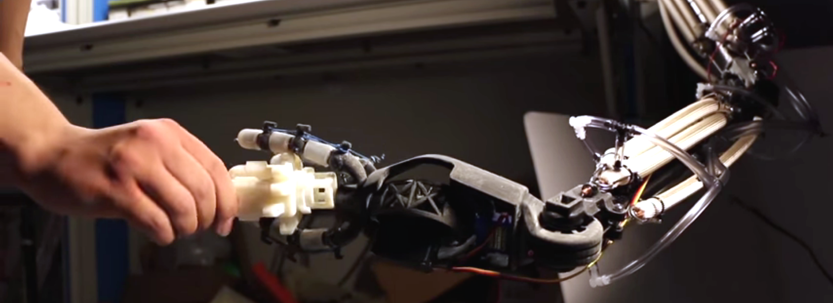
Two graduate students, Timothy Morrissey and Eric Acome, working with another author of the paper, Christoph Keplinger, demonstrated that the material could be used to power artificial muscle, also called dielectric elastomer actuator. Artificial muscle is a generic term used for materials or devices that can reversibly contract, expand, or rotate due to an external stimulus such as voltage, current, pressure or temperature.

The researchers used electrical signals to get the artificial muscle to move. They were also able to demonstrate that the ability of the new material to self-heal can be used to mimic a preeminent survival feature of nature: wound-healing. After parts of the artificial muscle were cut into two separate pieces, the material healed without relying on external stimuli, and the artificial muscle returned to the same level of performance as before being cut.


SOURCE  University of California Riverside


By  33rd SquareEmbed


Wednesday, December 14, 2016

5 Innovations that will Change Construction Forever

Architecture

Technology is changing construction in a way that builders had never thought of before. Construction companies are now able to work safely and more efficiently when equipped with the right technology, from materials to new fabrication techniques. 


The five technologies below are useful for builders, and many forward-thinking constructors are already using them.


Prefabricated Building Materials

This technology allows constructors to create ingenious interlocking designs that they can assemble relatively easily on-site. Prefabricated building materials save time, natural resources, and manpower. The construction requires less time and less water and concrete because close to 90 percent of the obstruction takes place in the factory. Under the direction of Sheikh Saqr al Qasimi, RAK Ceramics used this method to produce some of the most celebrated hospitality projects in the United Arabs Emirates. RAK Ceramics is one of the construction companies that supplied construction materials for the Burj Dubai.


Various Forms of Hands-Free Technology

Hands-free technology is very popular because it represents the wave of the future. For example, Google Glass allows the construction crew to record, received, transmit and evaluate data without wasting time. With these devices, crews do not have to pause whatever they are doing to pick up cameras or send messages to their colleagues.

Clearly, hands-free technology promotes both efficiency and accuracy and improves safety. Construction crews can focus on the job at hand instead of ancillary tasks, and this consequently decreases the potential for accidents such as falls.

Related articles

Tablets

Tablets and other smart devices make digital communication easier than ever. These devices make it possible for construction crews to communicate with each other and have access to work orders online. Additionally, screws can also use these computing devices to capture images and show them to their clients and check on the status of relevant documents such as permits conveniently.

Professional construction devices provide every member of their crew with at least a tablet to enable them to track and manage their work more efficiently. Tablets also help these crews to stay in contact whenever they are working in different locations. While the construction industry still holds some habits from decades ago, these high-tech gadgets are evolving and will become indispensable construction devices of the future.

3D printing buildings


3D Printing

3D printing technology holds a significant potential for the construction industry as constructors can apply it on whole range of construction materials. Many companies have used this technology to create shelters for victims of natural disasters using water, sand, and clay, and this shows it is here to stay.

3D printing comes with other benefits as well. By allowing construction crews to hand over the actual construction process to a printer, it eliminates the possibility of human error. This ensures complex geometrical designs are not the sole preserve of the wealthy alone.

Drones

Drones are literally changing the construction landscape when it comes to surveying potential construction sites and monitoring them. While it continues to evolve, many companies are currently hiring drone pilots to survey construction sites in both remote and heavily populated locations. Furthermore, construction site foremen are also using this innovation to monitor actively how their crews are working. Drones make it easy to monitor workers and promptly survey the progress of certain areas on construction sites.

Drones for construction

Additionally, this technology will also play some roles that are indirectly related to the construction of the home of the future. Given the pace of innovation in the construction industry, individual ownership of drones will be commonplace in the very near future. Construction companies will be able to send their own drones to companies that supply construction materials such to be loaded with these materials and bring them the construction site.

From prefabricated building materials to drones and everything in between, it is clear why construction companies across the world are focusing on technology. These innovations offer efficiency, safety, and cost-effectiveness.


By  Rachael MurpheyEmbed


Friday, July 24, 2015

Softer Materials Could Lead to More Human Robots


Robotics


Robots made entirely out of soft materials could be real game-changers. They could integrate more easily with human activities ranging from the ordinary to the exceptional. A group of engineers at Carnegie Mellon University is working to make such soft robots a hard reality.


SOURCE  NOVA PBS


By 33rd SquareEmbed


Tuesday, February 17, 2015

Aluminum Everywhere: Why this Material is So Popular for Everything from Cars to Technology

 Materials
Have you ever wondered why aluminum is such a popular material for so many applications? Consider these facts about this abundant, versatile material.


I

n today's industrialized, mechanized world, the watchwords for manufacturers are "faster, stronger,” and “lighter". Millions of dollars are spent every year in developing materials that can help achieve these goals. However, one of the most popular and useful materials has already been around for a long time. Between the buzz surrounding Ford’s new aluminum trucks, and other uses including new technology and devices, you might wonder why aluminum is everywhere these days.

Availability

Aluminum is perhaps most remarkable for its sheer abundance: it's the third most common element on Earth. It is difficult to obtain, however, since it requires comparatively complex methods to smelt. These factors combine to make it both valuable and virtually unlimited in supply.

Aluminum on Washington Monument
The top of the Washington Monument is capped in aluminum, once one of the most precious metals on the planet.

It is Valuable

Related articles
Since value is determined by need, where does aluminum's value come from? The answer isn't simple. Aluminum has been used in many industries for decades, but it's in the few decades that it has become really popular. The industries which are most likely responsible for this are packaging, construction, and transportation.

Packaging

According to one source, packaging accounts for around a 33% of aluminum use world-wide. While this sounds unlikely, it actually makes sense when the uptick in pre-prepared and bottled foods is factored in. Aluminum packaging can be found in practically every home in the US. Since the metal is soft, tough, and highly resistant to corrosion, it's not surprising that it has found use for long-term and short-term storage.

Construction

The lightness and corrosion resistance of aluminum makes it excellent for construction. Alloying it with other metals can change its properties drastically. The type of alloy used depends on the planned use. High-rigidity alloys might be used for structural components, while soft, pliable alloys could find use as flashing or skirting. In addition, the metal is often used in insulation. Certain types of aluminum cladding are much more effective than traditional materials, such as brick and stone.

Transportation

Another recent increase in aluminum demand comes from the transportation industry. Transportation has involved aluminum for decades, especially in aircraft. This is logical, since aeronautics requires high-strength, low-flexibility materials at with minimal weight. However, it's only in recent years that the automotive industry has started looking at aluminum as a replacement for steel. An example: Ford just redesigned their most popular truck, the F-150, with an aluminum body. This is a huge step forward for aluminum use in cars.

After considering even a few facts of modern aluminum use, it's easy to see why aluminum is becoming more popular. It even helps explain why the world's biggest aluminum producer, China, is confident that future aluminum demand will remain high.


By Dixie SomersEmbed

Author Bio - Dixie is a freelance writer who loves to write about business, finance and automotive technology. She lives in Arizona with her husband and three beautiful daughters. The information for this article was provided by the professionals of Advantage Manufacturing Ltd., who specialize in aluminum fabrication in Calgary.

Friday, February 6, 2015

New Low-Cost Steel Is As Strong As Titanium

 Materials
Steel is still the predominate choice for many structural applications, however the material suffers from relatively low strength-to-weight ratios. Adding aluminum to steel typically makes it lighter, but extremely brittle. Now researchers have developed a new alloy that allows for the addition of aluminum, without the brittleness.


Hank Reardon, one of the pivotal characters in Ayn Rand's Atlas Shrugged invents a new allow of steel that is stronger, lighter, and cheaper than steel.  Now, researchers in Korea have developed  new form of steel that has the potential to revolutionize the world; although this time, it’s not fiction.

For innumerable uses, steel is still the workhorse material. The researchers at Pohang University of Science and Technology in South Korea have reported what they're calling one of the greatest steel leaps forward of the last few decades: flexible, ultra-strong, lightweight steel.

This new metal has a strength to-weight ratio that matches even our best titanium alloys, however at one tenth the price, and can be made on a small scale with the tools already in place to produce automotive grade steel.

The new material "is 13 percent less dense compared with typical steel, and has almost the same strength-to-weight ratio compared to titanium alloys."


According to Hansoo Kim, the researcher that led the team, "Because of its lightness, our steel may find many applications in automotive and aircraft manufacturing."

The development has been published in Nature.

The key to creating this new super-steel was overcoming a challenge that had hampered materials scientists for years. In the 1970's, researchers discovered that adding aluminum to the mix when creating steel can make an incredibly strong and lightweight metal, but this new steel was unavoidably brittle. You'd have to exert lots of force to reach the limit of its strength, but once you did, the steel would break rather than bend.

B2 crystals

Related articles
When making the aluminum-steel alloy, they were periodically melding atoms of aluminum and iron together to form a strong, crystalline structure called B2. These veins and pieces of B2 were solid but brittle.

"My original idea was that if I could somehow induce the formation of these B2 crystals, I might be able to disperse them in the steel," he says. The researchers ascertained that if little B2 crystals were forced to separate from each other, then the surrounding composite would protect them from chipping.

Kim and partners invested years formulating and adjusting a technique for high temperature treating and rolling the steel to control when and where B2 crystals formed. The group additionally found that including a small amount of nickel offered much more control over B2 arrangement, as nickel impeded the crystal structure until much higher temperatures.

Kim's group has produced the new metal on a small scale. At the same time before it can be mass-delivered, specialists must stand up to a precarious generation issue.

Presently, steelmakers utilize a silicate layer to cover and ensure large batch steel production runs from oxidation with the air and other contamination in a foundry. This type of silicate can't be used for Kim's steel on the grounds that it tends to react with the cooling aluminum.

For now a few more technical hurdles remain before the team's new steel can reach its full potential. The effort will be justified though: the new material "is 13 percent less dense compared with typical steel, and has almost the same strength-to-weight ratio compared to titanium alloys," according to Kim.

The researchers have already teamed with POSCO, one of the biggest steel makers in the world to see if the new kind of steel can be mass produced.


SOURCE  Popular Mechanics

By 33rd SquareEmbed

Wednesday, December 3, 2014

Synchrontron X-ray scanning tunneling microscopy

 Microscopy
By combining STM with the spectroscopic versatility of synchrotron x-rays, researchers have achieved chemical fingerprinting of individual nickel clusters on a copper surface at a resolution of 2 nm, creating a powerful and versatile nanoscale imaging tool with exciting promise and potential for the materials and biological sciences. 


Researchers from the U.S. Department of Energy's Argonne National Laboratory and Ohio University have devised a powerful technique that simultaneously resolves the chemical characterization and topography of nanoscale materials down to the height of a single atom.

"We have demonstrated a world record in the spatial resolution of chemical imaging using synchrotron x-ray scanning tunneling microscopy."


Working at the Center for Nanoscale Materials (CNM)/X-ray Science Division 26-ID beamline of the U.S. Department of Energy’s Advanced Photon Source, the researchers took advantage of some new technological innovations in the work.

The technique combines synchrotron X-rays (SX) and scanning tunneling microscopy (STM). In experiments, the researchers used SX as a probe and a nanofabricated smart tip of a STM as a detector.

Using this technique, researchers detected the chemical fingerprint of individual nickel clusters on a copper surface at a two-nanometer (nm) lateral resolution, and at the ultimate single atom height sensitivity. By varying the photon energy, the researchers used the difference in photoabsorption cross sections for nickel and the copper substrate to chemically image a single-nickel nanocluster - thus opening the door to new opportunities for chemical imaging of nanoscale materials. Until now, a spatial limit of about only 10-nm was attainable, and the researchers would simultaneously sample a large sample area.  The researchers have improved the spatial resolution to 2 nm.

Researchers Combine Techniques for Unparalleled View of Nanomaterials

Related articles
The work is published in the journal Nanoletters. “We have demonstrated a world record in the spatial resolution of chemical imaging using synchrotron x-ray scanning tunneling microscopy,” said Saw-Wai Hla, a co-author of the study.

“Imaging with direct chemical sensitivity has been a long-standing goal since scanning tunneling microscopes were developed during the 1980s,” said Volker Rose, a physicist in the X-ray Science Division. “It was very exciting when we obtained elemental contrast of a material at just one atomic layer height”.

"This is a marriage between two of the most powerful instruments of materials science," said Saw-Wai Hla, electronic and magnetic materials and devices group leader in Argonne's Nanoscience & Technology Division. "We now have an instrument that can perform the functions of STM and X-rays in a single setting, and therefore it has a great potential to revolutionize the materials characterization."

To conduct the experiment, researchers used the Center for Nanoscale Materials’ (CNM) beamline 26-ID at the Advanced Photon Source (APS), which is equipped with two collinear undulator devices that serve as the X-ray source and a double-crystal monochromater that selects the photon energy. The X-rays were passed through a beam chopper to quickly turn the beam on and off and then illuminate the tip/sample junction in the SX-STM. This enabled the very sensitive lock-in detection of the X-ray induced currents.

The experiment was conducted at room temperature, which is well suited for the needs of most physical, chemical, biological and nanomaterial applications. The team anticipates that even higher spatial resolution may become possible with a new instrument currently under development.

“The next step will be to extend the new technique to low temperatures,” notes Rose. “Our measurements indicate that atomic resolution may be achievable at 5 K (about negative 450 F).”


SOURCE  Argonne National Laboratory

By 33rd SquareEmbed

Tuesday, October 28, 2014


 Materials
A new way to calculate the electrical properties of individual components of composite materials could open a path toward more energy-efficient medical refrigerators, air-conditioned car seats and more.


If you’ve ever gone for a spin in a luxury car and felt your back being warmed or cooled by a seat-based climate control system, then you’ve likely experienced the benefits of a class of materials called thermoelectrics.

Thermoelectric materials convert heat into electricity, and vice versa, and they have many advantages over more traditional heating and cooling systems.

Recently, researchers have observed that the performance of some thermoelectric materials can be improved by combining different solid phases -- more than one material intermixed like the clumps of fat and meat in a slice of salami. The observations offer the tantalizing prospect of significantly boosting thermoelectrics’ energy efficiency, but scientists still lack the tools to fully understand how the bulk properties arise out of combinations of solid phases.

“Reverse Engineering” Materials for More Efficient Heating and Cooling

"Effective medium theory is pretty old. What’s new about what we did is we took a composite, and then backed-out the properties of each constituent phase."


Now a research team based at the California Institute of Technology (Caltech) has developed a new way to analyze the electrical properties of thermoelectrics that have two or more solid phases. The new technique could help researchers better understand multi-phase thermoelectric properties – and offer pointers on how to design new materials to get the best properties.

The team describes their new technique in a paper published in the journal Applied Physics Letters.

Because it’s sometimes difficult to separately manufacture the pure components that make up multi-phase materials, researchers can’t always measure the pure phase properties directly. The Caltech team overcame this challenge by developing a way to calculate the electrical properties of individual phases while only experimenting directly with the composite.

“It’s like you’ve made chocolate chip cookies, and you want to know what the chocolate chips and the batter taste like by themselves, but you can’t, because every bite you take has both chocolate chips and batter,” said Jeff Snyder, a researcher at Caltech who specializes in thermoelectric materials and devices.

To separate the "chips" and "batter" without un-baking the cookie, Snyder and his colleagues turned to a decades old theory, called effective medium theory, and they gave it a new twist.

Related articles
“Effective medium theory is pretty old,” said Tristan Day, a graduate student in Snyder’s Caltech laboratory and first author on the APL paper. The theory is traditionally used to predict the properties of a bulk composite based on the properties of the individual phases. “What’s new about what we did is we took a composite, and then backed-out the properties of each constituent phase,” said Day.

The key to making the reversal work lies in the different way that each part of a composite thermoelectric material responds to a magnetic field. By measuring certain electrical properties over a range of different magnetic field strengths, the researchers were able to tease apart the influence of the two different phases.

The team tested their method on the widely studied thermoelectric Cu1.97Ag0.03Se, which consists of a main crystal structure of Cu2Se and an impurity phase with the crystal structure of CuAgSe.

Thermoelectric materials are currently used in many niche applications, including air-conditioned car seats, wine coolers, and medical refrigerators used to store temperature-sensitive medicines.
“The definite benefits of using thermoelectrics are that there are no moving parts in the cooling mechanism, and you don’t have to have the same temperature fluctuations typical of a compressor-based refrigerator that turns on every half hour, rattles a bit and then turns off,” said Snyder.

One of the drawbacks of the thermoelectric cooling systems, however, is their energy consumption.
If used in the same manner as a compressor-based cooling system, most commercial thermoelectrics would require approximately 3 times more energy to deliver the same cooling power. Theoretical analysis suggests the energy efficiency of thermoelectrics could be significantly improved if the right material combinations and structures were found, and this is one area where Synder and his colleagues’ new calculation methods may help.

Many of the performance benefits of multi-phase thermoelectrics may come from quantum effects generated by micro- and nano-scale structures. The Caltech researchers’ calculations make classical assumptions, but Snyder notes that discrepancies between the calculations and observed properties could confirm nanoscale effects.

Snyder also points out that while thermoelectrics may be less energy efficient than compressors, their small size and versatility mean they could be used in smarter ways to cut energy consumption. For example, thermoelectric-based heaters or coolers could be placed in strategic areas around a car, such as the seat and steering wheel. The thermoelectric systems would create the feeling of warmth or coolness for the driver without consuming the energy to change the temperature of the entire cabin.

“I don’t know about you, but when I’m uncomfortable in a car it’s because I’m sitting on a hot seat and my backside is hot,” said Snyder. “In principle, 100 watts of cooling on a car seat could replace 1000 watts in the cabin.”

Ultimately, the team would like to use their new knowledge of thermoelectrics to custom design ‘smart’ materials with the right properties for any particular application.

“We have a lot of fun because we think of ourselves as material engineers with the periodic table and microstructures as our playgrounds,” Snyder said.


SOURCE  American Institute of Physics via Newswise

By 33rd SquareEmbed

Tuesday, August 5, 2014

Plastic Recycling: The Process, Advantages and Disadvantages

 Recycling
When plastics are recycled, there are short-term advantages for the environment, but the long-term results may not be so pretty. Have a look at how plastic is recycled, the advantages and disadvantages of the process.


Plastic is one of the most versatile materials of our modern age. And yet the popularity of plastic is the problem. We use 20 times more plastic now than we did 50 years ago and masses of this material is finding its way into landfill to spend hundreds of years taking up space. By recycling plastic, the amount produced and wasted can be reduced but whereas the process has short-term advantages for the environment, the long-term results aren't so pretty. Learn more as we look at how plastic is recycled, the advantages and disadvantages of the process.

What is the Process of Recycling Plastic?

With countries all over the world under pressure to create a more sustainable future and populations more aware of the need to reduce and reuse, plastic recycling is carried out on a larger scale than ever before. The process involves the following:
Related articles

1. Recyclable materials are collected from homes and businesses by recycling schemes or from recycling facilities.
2. Plastics are sorted from other recyclable materials by highly advanced machines.
3. The plastic recyclables are sorted into their different types.
4. Any plastic types that cannot be recycled are disposed of in landfill.
5. The plastic is squashed into bales to be sent to a plastic recycling plant.
6. At the recycling plant, the plastic is cleaned of any impurities such as food waste, ink and labels.
7. The plastic is ground into flakes or chippings which then go through the process of washing and sorting once again.
8. The flakes and chippings are either purified with a chemical solution or melted down to form plastic beads.
9. The flakes and beads are sent to a plastic manufacturing plant to be melted down again for processing into new products.

Which Plastic Products can be Produced from Recycled Plastic?

Recycled plastic can be processed into a wide range of new plastic products, such as:
• Bin liners and carrier bags
• Window frames and flooring
• Plastic bottles
• CD cases
• Fencing and garden furniture
• Fiber filling for duvets
• Water butts and composters
• Drainage pipes

Plastic Recycling

What are the Advantages of Recycling Plastic?

Recycling plastic can mean good news for our environment and the future of our planet:

• Recycling plastic conserves the natural resources and energy that would be required to produce plastic from scratch.
• When plastic is recycled, less plastic is sent to landfill and thus, less of this material takes up room in our environment for hundreds of years. In fact, recycling one ton of plastic can save 7.4 cubic yards of landfill space.
• Plastics are becoming increasingly easy to recycle. Besides the invention of new plastic recycling technology, governments all over the world have plastic collection schemes in place.

Two useful technologies to work from anywhere – hosted Cloud Desktop and SharePoint hosting service from CloudDesktopOnline, with full support from one of the best Daas provider – Apps4Rent.

What are the Disadvantages of Recycling Plastic?

And yet, recycling plastic does have its disadvantages...
• The process of recycling plastic can be particularly harmful to the environment. When the material is melted down, VOCs (volatile organic compounds) are released into the atmosphere. These are harmful to nearby plant and animal life.
• As heat is required to melt plastic, the process generates carbon emissions. These greenhouse gases contribute to global warming and are already taking an effect on our planet’s climate.
• While the VOCs released from recycling can harm the environment, they also present health risks to people who use recycled plastic. Plastic resin is manufactured from petroleum and this substance can leech into the foods that are stored in recycled plastic containers. This isn't cited as a major threat but plastic manufacturers are careful to use only a small amount of recycled plastic in food packaging.
• As plastic carries potential health threats, much of recycled plastic finds its new home as a less useful product - this is referred to as downcyling. For example, a plastic bottle might become plastic furniture and in turn there is still a demand to produce new plastic for plastic bottles.
• After plastic has been recycled once, it’s very rarely suitable for a second round of recycling. This means that the material will eventually end up in waste despite its secondary, prolonged use. If plastic recycling continues in this way then manufacturers will always have the same demand for new material.

This guest article was written by Hannah Richards on behalf of www.ensinger.co.uk.


By Hannah Richards Embed

Wednesday, July 9, 2014

Researchers Create Graphene Substitute from Plastic

 Nanotechnology
A team researchers in Korea has synthesized carbon nanosheets similar to graphene, using a plastic. The new material is free of the defects and complexity involved in producing graphene, and can substitute for graphene as transparent electrodes for organic solar cells and in semiconductor chips, they say.


Graphene has been dubbed a “wonder material,” and has potential for numerous applications because of the material's great conductivity, flexibility and durability. However, graphene is hard to come by due to the fact that its manufacturing process is complicated and mass production not yet fully achievable.

Now, a Korean research team has developed a carbon material without artificial defects commonly found during the production process of graphene while maintaining thea material's original characteristics. The newly developed material can be used as a substitute for graphene in solar cells and semiconductor chips. Further, the developed process is based on the continuous and mass-produced process of carbon fiber, making it much easier for full-scale commercialization.

The carbon nanosheet can be mass-produced in a simpler process while having high quality since the new process bypasses the steps that are prone to formation of defects such as elimination of the metal substrate or transfer of graphene to another board. The final product is as effective as graphene.


In recognition of the innovative approach, the research was introduced on the cover of Nanoscale, a high impacting peer-reviewed journal in the field of nano science.

The research team led by Dr. Han-Ik Joh at the Korea Institute of Science and Technolgy (KIST) along with Dr. Seok-In Na at Chonbuk National University and Dr. Byoung Gak Kim at KRICT synthesized carbon nanosheets similar to graphene using polymer, and directly used the transparent electrodes for organic solar cells.

Related articles
To manufacture high quality graphene in large volume, the CVD (chemical vapor deposition) method is widely used. The technique for manufacturing graphene on the board of metal film that serves as a catalyst. It manufactures the material by blowing out gas called the source gas onto the board. After it is done the metal has to be removed and graphene has to be transported to another board. However, this method requires intensive post-processing (transfer process) as it has to remove used metal after the manufacturing process and move the manufactured graphene to another board such as a solar cell substrate. In this process the quality quickly degrades as it is prone to wrinkles or cracks.

The research team developed “carbon nanosheet” in a two-step process, which consists of coating the substrate with a polymer solution and heating. Considering that the existing process consists of eight steps to manufacture graphene, the new method makes it much simpler. In addition, the new method can be directly used as solar cell without any additional process.

carbon nanosheet process

The research team synthesized a polymer with a rigid ladder structure, namely PIM-1(Polymer of intrinsic microporosity-1) to form the CNS through the simpole process, which is spin-coated on the quarts substrates using PIM-1 solution with light green color and then heat-treated at 1,200 °C, leading to transparent and conductive CNS.

The carbon nanosheet can be mass-produced in a simpler process while having high quality since the new process bypasses the steps that are prone to formation of defects such as elimination of the metal substrate or transfer of graphene to another board. The final product is as effective as graphene.

Dr. Han Ik Joh at KIST said, “It is expected to be applied for commercialization of transparent and conductive 2D carbon materials without difficulty since this process is based on the continuous and mass-produced process of carbon fiber.”

This is a follow-up research from the team that recently released its findings on the carbon nanosheet manufacturing based on polyacrylonitrile. The new findings are even more meaningful as it offers deeper understanding on the growth mechanism of carbon nanosheet and much simpler manufacturing process.


SOURCE  KIST

By 33rd SquareEmbed

Thursday, May 1, 2014


 Graphene
Researchers have developed a new material that is similar to graphene and may be applied to solar cells with the ability to capture different wavelengths of light could be matched to the solar spectrum, or to improved supercapacitors, which can store electrical energy until it’s needed. 


Researchers around the world have been working to harness the unusual properties of graphene, a two-dimensional sheet of carbon atoms. But graphene lacks one important characteristic that would make it even more useful: a property called a bandgap, which is essential for making devices such as computer chips and solar cells.

Now, researchers at MIT and Harvard University have found a two-dimensional material whose properties are very similar to graphene, but with some distinct advantages — including the fact that this material naturally has a usable bandgap.

The research, published online in the Journal of the American Chemical Society, was carried out by MIT assistant professor of chemistry Mircea Dincă and seven co-authors.

"They’re in the same class of materials that have been predicted to have exotic new electronic states. These would be the first examples of these effects in materials made out of organic molecules. People are excited about that."


Related articles
The new material, a combination of nickel and an organic compound called HITP, also has the advantage of self-assembly: Its constituents naturally assemble themselves, a “bottom-up” approach that could lend itself to easier manufacturing and tuning of desired properties by adjusting relative amounts of the ingredients.

Research on such two-dimensional materials, which often possess extraordinary properties, is “all the rage these days, and for good reason,” Dincă says. Graphene, for example, has extremely good electrical and thermal conductivity, as well as great strength. But its lack of a bandgap forces researchers to modify it for certain uses — such as by adding other molecules that attach themselves to its structure — measures that tend to degrade the properties that made the material desirable in the first place.

The new compound, Ni3(HITP)2, shares graphene’s perfectly hexagonal honeycomb structure. Additionally, multiple layers of the material naturally form perfectly aligned stacks, with the openings at the centers of the hexagons all of precisely the same size, about 2 nanometers (billionths of a meter) across.

In these initial experiments, the researchers studied the material in bulk form, rather than as flat sheets; Dincă says that makes the current results — including excellent electrical conductivity — even more impressive, since these properties should be better yet in a 2D version of the material. “There’s every reason to believe that the properties of the particles are worse than those of a sheet,” he says, “but they’re still impressive.”

This is just the first of what could be a diverse family of similar materials built from different metals or organic compounds. “Now we have an entire arsenal of organic synthesis and inorganic synthesis,” Dincă says, that could be harnessed to “tune the properties, with atom-like precision and virtually infinite tunability.”

Such materials, Dincă says, might ultimately lend themselves to solar cells whose ability to capture different wavelengths of light could be matched to the solar spectrum, or to improved supercapacitors, which can store electrical energy until it’s needed.

In addition, the new material could lend itself to use in basic research on the properties of matter, or to the creation of exotic materials such as magnetic topological insulators, or materials that exhibit quantum Hall effects. “They’re in the same class of materials that have been predicted to have exotic new electronic states,” Dincă says. “These would be the first examples of these effects in materials made out of organic molecules. People are excited about that.”


SOURCE  MIT

By 33rd SquareEmbed

Tuesday, April 15, 2014

Researchers Create Strong and Lightweight Nanostructures Inspired by Nature

 Nanomaterials
Structural nanomaterials have been developed by researchers using 3D laser lithography to create lightweight, high-strength material inspired by the the structure of bones, wood and bees' honeycombs. 


Researchers have developed new bio-inspired lightweight microstructured materials with very high stability. Although the density of these materials is below that of water, their stability relative to their weight exceeds that of massive materials, such as high-performance steel or aluminum.

Natural lightweight materials, such as bone, are cellular solids with optimized architecture. They are structured hierarchically and actually consist of nanometer-size building blocks, providing a benefit from mechanical size effects.

"The novel lightweight construction materials resemble the framework structure of a half-timbered house with horizontal, vertical, and diagonal struts. Our beams, however, are only 10 µm in size."


The researchers demonstrated that materials with a designed micro-architecture, providing both structural advantages and size-dependent strengthening effects, can be fabricated. Using 3D laser lithography, they produced micro-truss and -shell structures from ceramic–polymer composites that exceed the strength-to-weight ratio of all engineering materials.

The lightweight construction materials are inspired by the framework structure of bones and the shell structure of the bees’ honeycombs. The results have been published in the journal PNAS.

Related articles
“The novel lightweight construction materials resemble the framework structure of a half-timbered house with horizontal, vertical, and diagonal struts,” says Jens Bauer, Karlsruhe Institute of Technology (KIT). “Our beams, however, are only 10 µm in size.” In total, the lightweight construction elements are about 50 µm long, wide, and high.

Microstructured materials are often used for insulation or as shock absorbers. Open-pore materials may be applied as filters in chemical industry.

“Nature also uses open-pore, non-massive structures for carrying loads,” Oliver Kraft, KIT, explains. Examples are wood and bones. At the same density, however, the novel material produced in the laboratory can carry a much higher load. A very high stability was reached by a shell structure similar to the structure of honeycombs. It failed at a pressure of 28 kg/mm2 only and had a density of 810 kg/m3. This exceeds the stability / density ratio of bones, massive steel, or aluminum. The shell structure produced resembles a honeycomb with slightly curved walls to prevent buckling.

To produce the lightweight construction materials, 3D laser lithography was applied. In the procedure laser beams harden the desired microstructure in a photoresist. Then, this structure is coated with a ceramic material by gas deposition. The structures produced were subjected to compression via a die to test their stability.


SOURCE  KIT

By 33rd SquareEmbed