bloc 33rd Square Business Tools - humanoid robot 33rd Square Business Tools: humanoid robot - All Post
Showing posts with label humanoid robot. Show all posts

Thursday, November 3, 2016

Is This The Most Life-Like Robot Ever Built?


Androids

Bloomberg recently traveled to Osaka University to see Professor Hiroshi Ishiguro’s latest creation, an android named Erica that's designed to work, one day, as a receptionist or personal assistant. 


The latest android created by Professor Hiroshi Ishiguro, has lifelike skin and facial gestures and uses artificial intelligence software to listen to and respond to requests. Check out the video from Bloomberg below.

Is Erica creepy? To Vance she is, but not to Ishiguro, who considers her nearly indistinguishable from a human.

Ishiguro a professor at Osaka University’s Intelligent Robotics Laboratory, famously known as the the man who "made a copy of himself" as an android, and his team claim that Erica can also recognize the speech patterns and non-verbal cues of the person it's speaking with.

"Without intention and desire, the android cannot be emotional," says Ishiguro.

Erica android

Related articles
"We are developing total technology to enable Erica to have natural interaction with persons by integrating various technologies such as voice recognition, human tracking, and natural motion generation," states the research project's website.

By giving the android, which was first previewed to the public last year, improved speech and communication body language, further erasing the "uncanny valley" effect of speaking to a robot.

Although she is unable to walk independently, Erica's non-verbal actions, including blinks, emotive facial movements and head leaning, all seemed to enhance the android's Japanese-style communication.


SOURCE  Bloomberg


By  33rd SquareEmbed


Wednesday, October 12, 2016

Meet The Russian Humanoid Robot, Fedor


Robots

Fedor is a new humanoid robot developed in Russia for the space program. Although the robot is being designed for space, the list of tasks it impressively performs in a recently released video makes it look like a late entry audition tape for the DARPA Robotics Challenge.


Our readers are familiar with the American and Japanese humanoid robots that competed in the DARPA robotics competition, like ATLAS, and how Valkyrie is being readied for missions in space by NASA. Now meed Russia's entry into the ranks of impressive bot - Fedor (Final Experimental Demonstration Object Research).

Fedor robot

Related articles
Fedor is a humanoid robot developed to help astronauts on their missions. As the video below demonstrates, the robot can manipulate tools, pick up objects, and even drive a car. If we didn't know any better, it looks like the developers were following the DRC handbook for task programming.

The video also shows that like the leader of the Russian republic, Fedor likes to keep in shape, lifting weights and doing a few sets of  push-ups.

According to Sputnik, Fedor will be adapted to a new manned spacecraft to undergo testing by 2021.


SOURCE  Робот Фёдор - помощник космонавта


By  33rd SquareEmbed


Wednesday, June 29, 2016

Uncanny Humanoid Robot Greets Visitors in China


Robotics

Visitors to the World Economic Forum of in Tianjin, China this year were greeted by Jia Jia, a "beauty" humanoid robot that has attracted a lot of attention.

Jia Jia, a humanoid robot showcased at this year's Summer Davos conference in Tianjin, China has been nicknamed the "Robot Goddess," a nod to her good looks and apparent intelligence.

When addressed in Mandarin, Jia Jia is able to respond, with a moving mouth, and can display minute facial expressions. Jia Jia can also guess people's ages and gender.

Uncanny Humanoid Robot Greets Visitors in China

Related articles
Created in 2014 by scientists at the University of Science and Technology of China (UST), she's the third-generation of humanoid robots produced by the university.

Jia Jia is connected to the university's cloud computing platform so her ability to process human emotions and interact are enhanced every time the team uploads fresh data, according to a UST spokesperson.

Tianjin Robot


The robot previously worked as a museum guide, a shopping mall salesperson and a talk show host.

Industrial robot sales rose 17 percent in China last year, according to the International Federation of Robotics, but that was significantly lower than 2014's 56 percent increase. Despite the slowdown, the nation still accounted for more than a quarter of the 248,000 industrial robots sold globally.

"We hope Jia Jia will become part of the world soon," said the UST spokesperson. "In the future, once we create more robots, she will be able to share knowledge with others, creating a robot social network. Eventually, these robots will be able to talk to each other."

humanoid robot

SOURCE  Focus


By 33rd SquareEmbed


Monday, January 18, 2016

ATLAS is Ready to Clean Your House—Almost


Robotics

Since Team IHMC's second place in last year's DARPA Robotics Challenge, they have been busy training their ATLAS robot to do something we all want a robot to do—the chores!  


IEEE Spectrum recently shared video (see below) of what many of us really want to see humanoid robots practicing—household chores. The video was prepared by the Florida Institute for Human & Machine Cognition (IHMC) team. Performing rescue and disaster operations at sites like Fukishima is a noble pursuit, but let's face it, who else is tired of waiting for our robot butlers and maids?

John Carff, ATLAS robot operator at IHMC, told IEEE about what it took to have the bot perform the functions shown in the this video. (To burst your bubble a little, the video is sped up 20x normal speed).

Unfortunately the robot is not being prepped to enter our homes soon and take care of the drudgery. The work is part of a maintenance routine intended to keep the Google-owned ATLAS running often to verify code updates and regression tests.  Running the same tasks like the routines set up for the  DRC, were getting boring for the team, so IHMC just came up with a bunch of fun ideas, and tried to get ATLAS to do them.

"In the future, I can see a lot of what was done in this video moving more to the autonomous side."
Related articles
"Most of the stuff in this video is controlled by me, but in a co-active way. I’m not simply sitting there with a joystick teleoperating the robot: I tell the robot through the UI that I want to grab a bottle off the table by clicking the bottle and making sure that the resulting hand is in the correct place," says Carff. "Then, the robot tells me how it’s going to move its entire body to reach that location, through a preview in the UI. If I’m okay with the plan the robot has come up with, I tell it to execute that motion. In the future, I can see a lot of what was done in this video moving more to the autonomous side, but I always see there being a human in the loop.”

Carff says that the hardest task was using the pallet jack because it is on rollers, ATLAS couldn’t jack it up from the back, as the jack just rolls back and forth. Carff’s solution was to move the robot off to the side, and then use its foot to pin the jack down as ATLAS pumps the handle.

While a Roomba still can probably do a better job for a fraction of the cost, our conviction in the Law of Accelerating Returns has us eagerly anticipating the availability of our own robot servant in the not-to-distant future.


SOURCE  IEEE Spectrum


By 33rd SquareEmbed


Tuesday, April 21, 2015

Hanson Robotics Shows Off 'Han'

Robotics
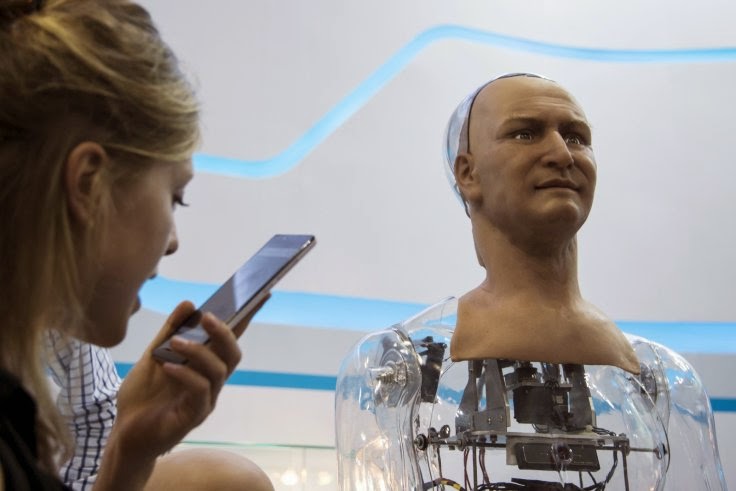
David Hanson's new ultra-realistic humanoid robot called 'Han' recognizes and interprets people's facial expressions and can hold simple conversations. Han could one day be used in the hospitality and health care industries where face-to-face communication is considered essential.


David Hanson's newest humanoid robot, 'Han' made his debut at the Global Sources Electronics Fair in Hong Kong recently.

Related articles
Mounted onto a clear plastic body which definitely keeps Han on the machine-like spectrum of the uncanny valley, the robot's face interacts with people directly. Han is programmed with pattern recognition software that, paired with a variety of cameras in its eyes and chest, allow the robot to recognize and interact with people.

The robot can identify a person's eyes and maintain eye contact. It can also identify human facial expressions and respond to them with an impressive array of facial expressions of its own, controlled by 40 motors behind its trademark Hanson Robotics' frubber skin that make subtle movements to smoothly adjust the robot's face.

human-robot interaction

Voice recognition software also allows Han to hold simple conversations with people, although the programming is quite basic at this time.

The concept of a human-like interface for certain situations such as for hotel reception desks, or acting as a museum tour guide. Robots such as Han could also be useful for education applications, aged care, or even medical training applications, Hanson Robotics claimed.

Reuters reported that, Hanson Robotics will be commercializing its systems in female robot Eva, rather than Han, which will be going into production later this year.


SOURCE  Reuters

By 33rd SquareEmbed

Friday, June 20, 2014


 Robotics
Aldebaran Robotics has announced the launch of NAO Evolution, the new generation of its NAO robot, equipped with the NAOqi 2.0™ operating system.    


French robot maker Aldebaran has announced the launch of NAO Evolution, the new generation of the popular NAO robot, equipped with the NAOqi 2.0™ operating system.
    
NAO Evolution is the fifth and latest generation of the interactive, autonomous, and fully programmable robot. NAO is already being used for specific research and education purposes. Over 5000 robots are currently operating in 70 countries.

According to the company's press release, NAO Evolution is the next big step for the development of innovative applications for a broad range of companies and content publishers.

The new robot has the the most up-to-date operating system, NAOqi 2.0, now being used by all of the company's robots, including the new emotional robot Pepper. Designed for easy natural voice interaction, the NAOqi environment includes a dialogue engine, an emotional engine, and Autonomous Life.

Related articles
All robots designed by Aldebaran share the same technologies and operating system, enabling the transfer applications from one robot to another with a minimum amount of adaptation. This includes the larger Aldebaran robot, Romeo, which is also proceeding with development. In this sense, Aldebaran has succeeded in the challenge of creating a unique "platform" available in several humanoid forms and benefiting from the same advanced software.

NAO Evolution also has improved functionality for easy interaction between humans and the robot and allowing developers to program complex sequences themselves:


  • Improved shape and facial detection and recognition using new algorithms 
  • Improved sound source location using 4 directional microphones 
  • Refined obstacle detection and distance estimation with a detection range from 1 cm (0.39 inches) to 3 m (9.8 feet) using new sonar telemeters 
  • More powerful battery: 48.6 watt-hours, giving NAO Evolution about 1 h 30 min of battery life in operational mode, i.e. 30% more than the previous generation. 
  • Although NAO Evolution is the same size as before (height: 58 cm, 1.9 feet), it is now:
  • Stronger, with metal gears in the neck, hips, legs, and ankles. 
  • Quieter, with soles that dampen the noise and friction of its footsteps. 
  • More skillful, grasping objects more easily using finger grips. 


"Apart from schools and universities, we would like companies and the developer community to get hold of our robots and create applications that will ensure the success of NAO in the future."


"This new phase is fully in line with our vision of eventually offering the greatest possible number of humanoid robots for a variety of purposes" says Bruno Maisonnier, founder and CEO of Aldebaran. "Apart from schools and universities, we would like companies and the developer community to get hold of our robots and create applications that will ensure the success of NAO in the future."

Now available, NAO Evolution will be marketed with package per region.


SOURCE  Aldebaran Robotics

By 33rd SquareEmbed

Tuesday, June 17, 2014

ASRA C1 Robot

 Robotics
SoftBank, fresh of the announcement of Pepper earlier this month, has also shared the work of it's subsidiary, Asratec.  Their humanoid robot ASRA C1 has been developed to help advance the robotic software platform, V-Sido.


Earlier this month, Japanese telecom giant SoftBank, along with French robot maker Aldebaran surprised everyone by unveiling an interactive personal robot called Pepper. Now there is news that Pepper is not the only robot SoftBank had in development.
SoftBank's subsidiary, Asratec, announced last week that they've built a prototype bipedal humanoid called the ASRA C1.

Asratec was founded in July 2013, and its goal is developing robotics products to help advance humanoid technology. Its flagship product is called V-Sido, which consists of a software package and a hardware module.

Related articles

ASRA C1 is 1.2 meters tall, weighs 13.5 kilograms, and has 35 degrees of freedom, according to specs released by the company. Its limbs are powered by Futaba servos, and it has a gyro, accelerometer, camera, and other sensors. Much of the robot is covered with soft padding, making it safer for interaction.

Asratec, based in Tokyo, posted a series of videos showing its humanoid standing up and moving its head and arms. Currently the robot isn't walking, but its creators seem to be putting significant efforts to improve its self-balancing capabilities. The robot can absorb shocks and automatically adjusts its posture to avoid falling over.

SoftBank Has Another Humanoid Robot in Development

The videos on Asratec's site also show how you can control the robot by using a joystick or clicking and dragging on the limbs of a 3D virtual model. Another option is standing in front of a Kinect sensor, with the robot copying your movements.

The software package, V-Sido OS, can be used for controlling a variety of commercial robot kits and servo motors. Thanks to inverse kinematics, users can generate motions in real-time using its software interface or other controllers. Asratec has just released an alpha version of V-Sido OS.

The hardware module is called V-Sido Connect. It's an ARM-based board that can control serial servo motors in combination with V-Sido OS.

It looks like Asratec built the ASRA C1 humanoid to test and demonstrate the versatility of its V-Sido systems. It's not clear if the company plans to commercialize the robot, though SoftBank CEO Masayoshi Son appears determined to bring robot helpers into people's lives.

The company designed ASRA C1 in collaboration with two other Japanese companies, RT Corporation and GK Dynamics.

One unusual thing about the robot is an extra pair of appendages attached to its torso. These are meant to be grabbed and manipulated directly by a user, driving the robot's arms in a master-slave fashion. The idea, we assume, is that you could use the robot to grab objects for you, or perhaps teach it how to perform manipulation tasks.


SOURCE  IEEE Spectrum

By 33rd SquareEmbed

Thursday, April 17, 2014

Humanoid Robot

 Robotics
After the success of it's NAO, small humanoid robot, Aldbaran Robotics has engaged a new challenge: the production of a larger robot called Romeo that will allow for interaction more effectively in everyday human environments.


Romeo is a humanoid robot from Aldebaran Robotics, known as the makers of the popular NAO robot.  Romeo is currently a development project that aims to create a real robotic personal assistant and companion; a test-bed for a larger NAO.

NAO was a worldwide success, with nearly 5,000 copies sold or rented since its launch in 2008. Initially restricted to researchers in robotics, it is has since been open to the world of education, and more. Aldebaran has also developed software to engage children with autism.

Having developed NAO, the company noted the new challenge: the production of a larger robot that would allow the robot to interact more effectively in everyday environments such as opening a door or take objects on a table.

Having developed NAO, the company noted the new challenge: the production of a larger robot that would allow the robot to interact more effectively in everyday environments such as opening a door or take objects on a table.


Related articles
Today, this research platform serves both to validate the use of assistance that will be enabled by a larger robot Nao and secondly to test new technologies that can be integrated on future products for the company. These innovations are derived from Aldebaran Robotics own but also the work of academic and industrial partners conducted within the framework of collaborative projects such as the PSPC project.

Among the items being tested with Romeo include: human robot interaction, mobile eyes and the vestibular system (balance), and force control.

Already four European laboratories have acquired early prototype versions of Romeo. There have been two versions, as planned when writing the project specifications. Between the two versions, the design of the spinal column changed, the final electronics were incorporated into the head, the shells of the upper body were made using more solid material, electronic wiring in the legs was improved, and the batteries were integrated, among other advances.

The robot has the size of a child of eight years (1.40 m) and weighs a little more (40 kilos). To be as light as possible, its body is made of carbon fiber and rubber, and was designed to avoid the risk of injury to the person that will attend. Today, Romeo can walk, see the three-dimensional environment, hear and speak, much like NAO.

Aldebaran Romeo
One potential use of larger humanoid robots like Romeo is as caregivers.
Romeo was made only four copies, all purchased by European research organizations should receive in the coming months. The timeline for testing the robot in real-world conditions is projected for 2016, with the final objective of being able to use it in a retirement home in the 2017 or 2019.

Funded in part by the French government and the European Commission, the Romeo project budget totals 37 million Euros over the period from 2009-2016.


SOURCE  Project Romeo

By 33rd SquareEmbed

Sunday, February 23, 2014

Medical Tech Innovations That Can Change Our World

 Medicine
Medical technology saves countless lives every single day, yet it normally does not receive the same amount of attention and glamour as other electronics. Here is a closer look at five of the most amazing innovations that are revolutionizing healthcare today.


Medical tech innovations are changing the world that we live in for the better. The innovations in health care are astounding. They are allowing doctors to deliver more efficient healthcare and treat a wider variety of symptoms. Knowing that we are advancing, here are five medical tech innovations that have and can change the world that we live in today.

MelaFind Optical Scanner

There's a new FDA-approved way to help with diagnosis of cancer. The hand held tool is used to analyze the tissue captured from the biopsy. The reason it's so popular is because it reduces the number of scars left from biopsy procedures. MelaFind technology originated from the Department of Defenses' missile navigation technology. The suspected lesions are scanned with 10 electromagnetic wavelengths and compared against a registry of 10,000 digital images to determine if it's cancerous or not.

Electronic Aspirin

People who suffer from migraines, sphenopalatine ganglion (SPG), or other types of headaches should try a nerve stimulating device to alleviate the pain. The device can be placed in the upper gum and on the side of the head affected by the headache. The signals will stimulate the SPG nerves, which will alleviate the pain. Stimulation usually blocks the neurotransmitters that cause the pain.

Five Medical Tech Innovations That Can Change Our World

Robotic Check-Ups with RP-VITA

Related articles
Health reform is designed to help people improve their health in a cost-effective way. Telemedicine and robotic check-ups are the new way to make rounds. In some places, medical robots will patrol the hospital hallways and make routine rounds without direct contact with the patients. RP-VITA Remote Presence Robot is offered by iRobot Corporation and InTouch Health. The device has a two-way video screen and also medical monitoring equipment to help make the assessment easier.

Echo Therapeutics' Needle-Free Diabetes Care

Diabetes self-care is moving in the pain-free direction. A transdermal biosensor from Echo Theraputics will read the blood's analytes through the skin. Thus, there's no need to prick the skin. The device resembles a toothbrush and will remove the top layer of skin to register the patient's blood chemistry. The data will be sent wirelessly to a remote monitoring location. When the levels venture outside of the patient's optimal range, audible alarms will be delivered.

Sapien's Transcatheter Aortic Valve

This device from Edwards is offered to patients who need a new heart valve but cannot endure surgery. The new valve can be guided via a catheter through the femoral artery. This procedure is conducted via a small incision near the rib cage. This surgery yields shorter hospitalizations and can revolutionize heart surgery as we know it.

Brain-Machine Interfaces Help Prosthetics Move With Thoughts

Just the thought of any prosthetic limbs, like those provided by Lubbock Artificial Limb & Brace, is remarkable. Bio-engineers have developed a new type of prostheticthat can be connected to the nerves of the area and can be controlled with thought. They speculate that this could mean amputees being able to control computers and other machinery with their thoughts and hope that home trials will be available in about 5 years.

With new technology comes dramatic and diverse changes in everyday life. The future holds many more advances that will help further the medical industry and better our lives.

By Meghan BelnapSubscribe to 33rd Square

Friday, December 20, 2013

DARPA Robotics Challenge Live Feed

 DARPA Robotics Challege
The DARPA Robotics Challenge (DRC) Trials are now on and live streaming.


It is on!  The DARPA Robotics Challenge Trials are underway. There are camera crews who will be live streaming almost every event.
Related articles

When DARPA talks about "Red" teams and "Blue" teams, they're differentiating between teams that brought their own robots for Track A and D ("Red") and teams using ATLAS for Track B and C ("Blue"). To simplify logistics, there are separate competition areas for Red and Blue, so there are several competitions going on at once.


SOURCE  DARPA

By 33rd SquareSubscribe to 33rd Square

Tuesday, December 10, 2013


 DARPA Robotics Challenge
With the DARPA Robotics Challenge trials just days away, NASA has introduced the world to its entry, called Valkyrie.  The impressive looking humanoid robot is based on the space agency's Robonaut work, and looks to be ready for competition.


L ooking very much like a proper robot, NASA has unveiled its entry for the DARPA Robotics Challenge (DRC), and it is named Valkyrie. Aesthetically Valkyrie is a cross between a Japanese Gundham, Ironman and a little bit of ATLAS thrown in.

Unmistakably a cousin to Robonaut 2, who works in the International Space Station, Valkyrie will be competing in less than two weeks alongside the other robot competitors at the DRC.

Officially Valkyrie is known as 'R5' at NASA.  Presumably R's 3-4 were shelved in the development process(?)

NASA's Valkyrie Robot Ready for the DRC
Related articles
NASA's Johnson Space Center (JSC), which only previously released concept art for their entry in the competition has since the contest announcement been quite secretive about their robot.

IEEE Spectrum got the first look at the robot recently and shared the details.  Valkyrie is 1.9 meters tall, 125 kilograms, and has 44 degrees of freedom.  The battery-powered humanoid robot was built by NASA's Johnson Space Center team in Houston, in partnership with the University of Texas and Texas A&M.

Valkyrie is equipped with a large amount of sensors: cameras and LIDAR in the head, more cameras and sonar in the abdomen, and even more cameras in the forearms, knees, and feet. All of these data won't be transmitted back to Valkyrie's operators all at once, but being able to take advantage of whatever sensor is most relevant to the robot's current task should help Valkyrie be fast and efficient, whether it's being teleoperated or functioning more autonomously.

NASA Valkyrie Robot

Certainly compared to most of the other DRC competitors, Valkyrie appears to be ready to safetly work alongside peple.  It is covered in foam and tailored upholstery, including stylish details.  "Our robot is soft," NASA JSC team leader Nicolaus Radford told IEEE Summit. "If you brush against it while you're working, you don't want to feel this cold, hard metal. You want it to feel natural, like you're working next to another human being. The soft goods, the clothes we put on the robot, give it that feel, that appearance of being more comfortable to be near."

The future plans for Valkyrie extend beyond the DRC.  Radford explains: "in the same way that Valkyrie has benefited from the 15 years of robotics development in the Robonaut program and NASA's exoskeleton, we'll continue the development cycle, with technologies that we've developed for Valkyrie feeding back into Robonaut, making our space-faring robots even better than they are now."


SOURCE  IEEE Spectrum

By 33rd SquareSubscribe to 33rd Square

Enhanced by Zemanta

Thursday, November 14, 2013


 Robotics
PAL Robotics of Spain recently introduced the latest version of their REEM humanoid robot series, the REEM-C. In a promotional video, the robot deliberately walks through an office showing that human-sized robots may be appropriate for some research applications.


Spanish-based PAL Robotics recently unveiled the latest version of their REEM Robot, the REEM-C.

REEM-C is designed as a research platform for robotics work in walking, grasping, navigation, vision, speech recognition and multiple language text to speech.

REEM-C Humanoid Robot

Standing at 165 cm (5.4 feet) tall and weighing 70 kg (154.3 Lbs), the REEM-C has 44 degrees of freedom  (6 x leg, 7 x arm, 7 x hand, 2 in torso (waist), 2 in head (neck)).
Related articles
Unlike other humanoid robots, PAL has designed the REEM-C to be human-sized, to fit into the environment.

So standing side-by-side the REEM-C would tower over other robots like Honda's ASIMO or Aldebaran's NAO.  The REEM-C does not look robust and ready to tackle other robotics challenges like the DRC yet though.

REEM-C Robot

Certainly not the speediest humanoid robot available, REEM-C has a maximum walking speed of 0.28 m/s (.92 ft/sec).  That said, the gait and walking of the robot seems very natural and efficient in the video above.

The Linux-based robot uses a Intel Core i7-2710QE processor and has 60 GB of onboard storage.

SOURCE  PAL Robotics

By 33rd SquareSubscribe to 33rd Square

Thursday, July 11, 2013


 DARPA Robotics Challenge
DARPA recently provided more information on their Robotics Challenge competition including a full breakdown of the course and tasks the robots must accomplish. Also, Boston Robotics, makers of the ATLAS robot that will be used by many of the qualifying teams have released a video featuring the latest in humanoid robots.


The the video above, introduces ATLAS, one of the most advanced humanoid robots in the world made for DARPA by Boston Dynamics.

ATLAS was developed for use by teams in the  DARPA Robotics Challenges. Software-focused teams from Tracks B and C of the DARPA Robotics Challenge (DRC) will get to use the physical robot to compete in the first physical competition of the Challenge in December 2013 at the Homestead-Miami Speedway.

ATLAS Humanoid Robot


Incorporating  lessons learned from the PETMAN humanoid robot, Boston Dynamics has enabled wtih ATLAS features for greater mobility, and more sensing.  

Related articles
ATLAS is a high mobility, humanoid robot designed to negotiate outdoor, rough terrain. The robot can walk bipedally leaving the upper limbs free to lift, carry, and manipulate the environment. In extremely challenging terrain, ATLAS is strong and coordinated enough to climb using hands and feet, to pick its way through congested spaces.

Articulated, sensing hands will enable Atlas to use tools designed for human use. Atlas includes 28 hydraulically-actuated degrees of freedom, two hands, arms, legs, feet and a torso.

An articulated sensor head includes stereo cameras and a laser range finder. This version of ATLAS is powered from an off-board, electric power supply via a flexible tether. Which will be allowed for in the competition, but will eventually need to be dealt with for the robot to operate independently in actual emergency situations.

ATLAS Humanoid Robot

More DRC Information Announced

The date and location of this part of the competition was recently announced.  A full breakdown of the tasks and obstacles the robots will face has also been made public.  It will be incredibly impressive if any of the competitors can complete the course.

DARPA Robotics Challenge Terrain
ATLAS and the other robots will have to navigate obstacles like this during the DRC.  Image Source: DARPA
Basing the competition on real-world scenarios, the competition organizers have included very challenging rubble and even a staircase based on one in the Fukishima-Daichi plant that was found to be a major obstacle that could not be negotiated by any of the robots sent to that disaster zone.

Fukishima-Daichi staircase

The qualifying competitors have won their way to this part of the competition by effectively operating a computer simulated version of ATLAS.

The stated goal of the DRC is to generate groundbreaking research and development so that future robotics can perform the most hazardous activities in future disaster response operations, in tandem with their human counterparts, in order to reduce casualties, avoid further destruction, and save lives.


SOURCE  DARPA

By 33rd SquareSubscribe to 33rd Square

Thursday, June 27, 2013


 DARPA Robotics Challenge
From June 17-21, 2013, teams in DARPA's Virtual Robotics Challenge tested software designs to control a simulated ATLAS robot in a three-dimensional, virtual environment through a series of tasks modeled on what activities might be required in a real disaster response situation. After Several Mergers, Seven Teams to Receive DARPA Support to Compete with an ATLAS Robot in 2013 DARPA Robotic Challenge Trials.


The DARPA Robotics Challenge (DRC) was created with a clear vision: spur development of advanced robots that can assist humans in mitigating and recovering from future natural and man-made disasters.

Disasters evoke powerful, physical images of destruction, yet the first event of the DRC was a software competition carried out in a virtual environment that looked like an obstacle course set in a suburban area. That setting was the first proving ground for testing software that might control successful disaster response robots, and it was the world’s first view into the DARPA Robotics Challenge Simulator, an open-source platform that could revolutionize robotics development.


Disaster response robots require multiple layers of software to explore and interact with their environments, use tools, maintain balance and communicate with human operators. In the Virtual Robotics Challenge (VRC), competing teams applied software of their own design to a simulated robot in an attempt to complete a series of tasks that are prerequisites for more complex activities.

Twenty-six teams from eight countries qualified to compete in the VRC, which ran from June 17-21, 2013. DARPA had allocated resources for the six teams that did best, but in an interesting twist, good sportsmanship and generosity will allow members of the top nine teams, listed below, to move forward:

1. Team IHMC, Institute for Human and Machine Cognition, Pensacola, Fla. (52 points)
2. WPI Robotics Engineering C Squad (WRECS), Worcester Polytechnic Institute, Worcester, Mass. (39 points)
3. MIT, Massachusetts Institute of Technology, Cambridge, Mass. (34 points)
4. Team TRACLabs, TRACLabs, Inc., Webster, Texas (30 points)
5. JPL / UCSB / Caltech, Jet Propulsion Laboratory, Pasadena, Calif. (29 points)
6. TORC, TORC / TU Darmstadt / Virginia Tech, Blacksburg, Va. (27 points)
7. Team K, Japan (25 points)
8. TROOPER, Lockheed Martin, Cherry Hill, N.J. (24 points)
9. Case Western University, Cleveland, Ohio (23 points)

Related articles
The top six teams earned funding and a Boston Dynamics-built ATLAS robot from DARPA to compete in the DRC Trials in December 2013 (DARPA is also funding several other “Track A” teams to construct their own robot and compete in the Trials). The Trials are the second of three DRC events, and the first physical competition.

In a demonstration of good sportsmanship, Jet Propulsion Laboratory, which also has a DARPA-funded Track A effort with its own robot, decided to merge its two efforts and offer the bulk of the resources it earned in the VRC to other teams. DARPA split the freed resources between the next two teams:

The robot associated with the JPL win and some funding now goes to TROOPER (Lockheed Martin).
Additional funds are being allocated to a newly formed team of Team K and Case Western. That team, now known as HKU, will use an ATLAS robot generously donated to it by Hong Kong University to participate in the DRC Trials in December.

Thus, in total, seven teams with ATLAS robots and DARPA support will be going to the DRC Trials, where they will compete with other teams with their own robots.

VRC teams were evaluated based on task completion and effective operator control of the robots in five simulated runs for each of three tasks (15 total timed runs) that addressed robot perception, manipulation and locomotion.

The tasks included: entering, driving and exiting a utility vehicle; walking across muddy, uneven and rubble-strewn terrain; and attaching a hose connector to a spigot, then turning a nearby valve. To simulate communications limitations in a disaster zone, the VRC imposed a round trip latency of 500 milliseconds on data transmission, and varied the total number of communications bits available in each run, from a high of 900 megabits down to 60 megabits.


To conduct the VRC, DARPA funded the Open Source Robotics Foundation to develop a cloud-based simulator that calculates and displays the physical and sensory behaviors of robots in a three-dimensional virtual space, in real time. The simulator allowed teams to send commands and receive data over the Internet to and from a simulated ATLAS robot—information very similar to what would be sent between a physical robot and its operator in the real world.

“The VRC and the DARPA Simulator allowed us to open the field for the DARPA Robotics Challenge beyond hardware to include experts in robotic software. Integrating both skill sets is vital to the long-term feasibility of robots for disaster response,” said Gill Pratt, DRC program manager. “The Virtual Robotics Challenge itself was also a great technical accomplishment, as we have now tested and provided an open-source simulation platform that has the potential to catalyze the robotics and electro-mechanical systems industries by lowering costs to create low-volume, highly complex systems.”


SOURCE  DARPA

By 33rd SquareSubscribe to 33rd Square

Enhanced by Zemanta