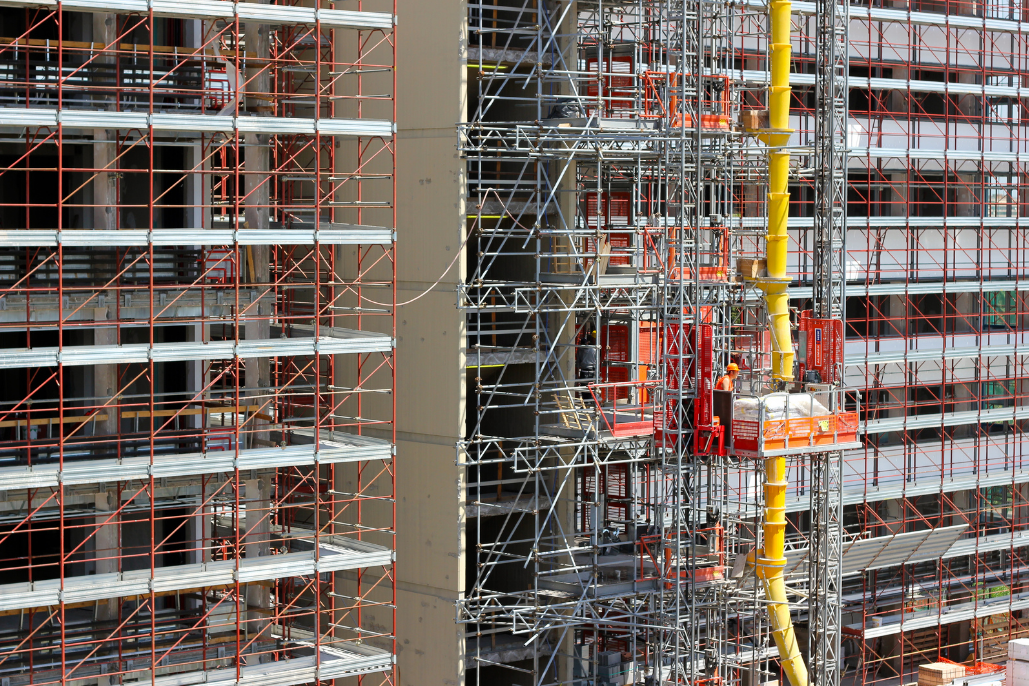
The construction business is on a boom. Recent studies ranked the residential building construction industry as the fastest-growing sector. The surge is attributed to increased demand for housing, real estate value, and lending activities. Research also found that the fastest-growing companies in the world are either owned or co-owned by architects, real estate agents, and contractors. The commercial construction industry has not been left behind. In the next five years, the industry will experience robust growth.
Showing posts with label construction. Show all posts
Monday, June 11, 2018
Thursday, January 4, 2018
Starting up a construction company can be a very profitable business, but it takes a lot of time, money, and effort. If you’re looking to start up your own company, there are quite a few things to do beforehand, such as reaching safety standards, legalizing your business, and meeting certain requirements.
Tuesday, April 25, 2017
Sustainability
The construction industry is becoming greener and more sustainable, and that is good news for the planet. If you are thinking about buying a home or hiring a builder, it is important to look at their sustainability ratings and make your choice accordingly.
You might not think of the construction industry as a particularly green one, but things are changing. Today, more and more construction companies and individual contractors are looking for ways to make their building processes more sustainable, and that is good news for home buyers, the environment, and for society as a whole.
Local Environment
One of ways the building industry has become more sustainable is through looking at the local environment. Taking the lay of the land into account can help with everything from sustainable forms of energy production, to lower construction costs. A lot set up on a hill, for instance, might be a prime candidate for a home windmill and wind power. A home with a sloping lot and a south-facing roof would be perfect for solar power. By taking the entire area into account, construction companies can build a greener and more sustainable future. They can also build in a way the benefits the homeowner more and makes buildings last longer.Related articles
Incorporating Sustainable Forms of Energy
Sustainable energy is the future, and the construction industry is embracing energy in a big way. Experienced contractors understand that incorporating wind, solar, geothermal, and other sustainable forms of energy into the homes they build will be good for the people who buy those homes and for the environment as a whole. They also understand that developing a reputation for sustainability and low energy costs will be good for their businesses and their brands, thus creating a win-win situation for everyone involved.This focus on sustainable forms of energy is likely to accelerate in the future, but the gains have already been quite impressive. From solar panels, to water conservation in plumbing, there are many new ways this is being done. Far from being a drain on the environment, the construction industry is becoming one of the greenest industries around. These can also make living in a home cheaper. By saving on energy costs, home buyers can get more for their construction loans and have a house that costs less over time.
Proper Disposal
From building contractors to the asphalt contractors who lay down roads and driveways, responsible operators throughout the construction industry care a great deal about where their excess materials end up. Proper disposal has always been an important part of the construction industry, but it has taken on a new significance in recent years.Individual contractors and construction companies have found a number of unique solutions to the disposal of excess construction materials, and many of those solutions are changing the way people live. Some construction professionals have donated their unused materials to charity, giving community organizations the ability to build homes for the homeless. Others have donated their excess materials to charity-run stores, allowing those organizations to raise the funds they need. No matter how they are used, these innovations keep excess construction materials out of local landfills, and that is good news for everyone.
Monday, March 6, 2017
Construction
Technology is revolutionizing the way professionals in the construction industry complete and manage projects. Additionally, it is having a noticeable impact on the planning and building processes. Contractors and companies willing to embrace this new technology will have the edge in bidding wars thanks to reduced costs and time to complete projects.
Here are four examples of technologies changing the construction industry.
Prefabrication of Materials and Designs
Prefabrication of materials and designs is an affordable technology and technique, and it requires very little maintenance. The advantage to using a prefabrication like Prefab Technology Pty Ltd is spending less time on the building site. It is a more economical way to build whole buildings like houses and their extensions.Related articles
3D Printing
3D printing is a miracle for the construction industry. It can potentially reduce the time it takes to create complex and simple building forms. It is also being used by prefabrication firms to create and install components like plumbing and mechanical equipment. It can even be used to carry out drywall detailing. The tech is advancing, and it will eventually be able to build entire homes. Although there are flaws, according to the Mirror, the very first home was printed in China in 45 days.Software for Faster Energy Modeling
Energy modeling has always consumed a lot of time, but new software tools in ways to allow full analysis during the conceptual design stage. It replaces models that take weeks to design and run like airflow and daylighting models. With new energy modeling software tools, construction designers can run an analysis in hours on performance data, and they can alter their designs far more quickly if needed.Drones
Drones have become important technological tools in the construction industry. When they are equipped with advanced software and hi-res cameras, they cut down on the time it takes to survey and the hassle. Also, subcontractors are able to make better informed decisions concerning design and architectural elements of a structure using the drone's aerial analysis.These four examples help to demonstrate how technology is changing construction. They are changing the way construction is done from design all the way to actual completion. There are many other forms of technology contributing to construction revolution too. With all of the breakthroughs, contractors will be able to finish projects faster, and at the same time, the projects will be of better quality. Finally, they save on the cost for the construction firms and the people hiring them. This technology, among others, is a win-win for all parties involved.
| By | Embed |
About the Author: Lizzie Weakley is a freelance writer from Columbus, Ohio. She went to college at The Ohio State University where she studied communications. In her free time, she enjoys the outdoors and long walks in the park with her 3-year-old husky Snowball. If you are looking at getting a STEM related education, Lizzie suggests that you consider an electrical engineering master’s degree from the University of Ohio. | |
Wednesday, December 14, 2016
Architecture
Technology is changing construction in a way that builders had never thought of before. Construction companies are now able to work safely and more efficiently when equipped with the right technology, from materials to new fabrication techniques.
The five technologies below are useful for builders, and many forward-thinking constructors are already using them.
Prefabricated Building Materials
This technology allows constructors to create ingenious interlocking designs that they can assemble relatively easily on-site. Prefabricated building materials save time, natural resources, and manpower. The construction requires less time and less water and concrete because close to 90 percent of the obstruction takes place in the factory. Under the direction of Sheikh Saqr al Qasimi, RAK Ceramics used this method to produce some of the most celebrated hospitality projects in the United Arabs Emirates. RAK Ceramics is one of the construction companies that supplied construction materials for the Burj Dubai.
Various Forms of Hands-Free Technology
Hands-free technology is very popular because it represents the wave of the future. For example, Google Glass allows the construction crew to record, received, transmit and evaluate data without wasting time. With these devices, crews do not have to pause whatever they are doing to pick up cameras or send messages to their colleagues.Clearly, hands-free technology promotes both efficiency and accuracy and improves safety. Construction crews can focus on the job at hand instead of ancillary tasks, and this consequently decreases the potential for accidents such as falls.
Related articles
Tablets
Tablets and other smart devices make digital communication easier than ever. These devices make it possible for construction crews to communicate with each other and have access to work orders online. Additionally, screws can also use these computing devices to capture images and show them to their clients and check on the status of relevant documents such as permits conveniently.Professional construction devices provide every member of their crew with at least a tablet to enable them to track and manage their work more efficiently. Tablets also help these crews to stay in contact whenever they are working in different locations. While the construction industry still holds some habits from decades ago, these high-tech gadgets are evolving and will become indispensable construction devices of the future.
3D Printing
3D printing technology holds a significant potential for the construction industry as constructors can apply it on whole range of construction materials. Many companies have used this technology to create shelters for victims of natural disasters using water, sand, and clay, and this shows it is here to stay.3D printing comes with other benefits as well. By allowing construction crews to hand over the actual construction process to a printer, it eliminates the possibility of human error. This ensures complex geometrical designs are not the sole preserve of the wealthy alone.
Drones
DronesFrom prefabricated building materials to drones and everything in between, it is clear why construction companies across the world are focusing on technology. These innovations offer efficiency, safety, and cost-effectiveness.
Monday, June 16, 2014
Disruptive Technologies
| A research group at the Institute for Advanced Architecture of Catalonia, based in Barcelona set on a goal of re-imagining 3D printing techniques so as to overcome existing limitations of using the technology for constructing buildings. |
Researchers from the Institute for Advanced Architecture of Catalonia, Spain have taken a 3D printing/additive manufacturing approach to architecture and have developed scale prototypes demonstrating their concept.
"Within the construction industry we haven't seen any disruptive technologies being introduced for almost a century," states the narrator of the team's film (below). "We believe that robotics and additive manufacturing will play a key role in the construction industry of the future."
| Related articles |
Minibuilders uses a family of small-scale construction robots which are mobile and capable of constructing objects far larger than the robot itself. Moreover, each of the robots developed performs a separate task, linked to the different phases of construction, finally working together as a family towards the implementation of a single building structure.
"We believe that robotics and additive manufacturing will play a key role in the construction industry of the future." |
Minibuilders is a project of IAAC, Institute for Advanced Architecture of Catalonia, http://www.iaac.net developed during Open Thesis Fabrication in 2013 by:
Researchers: Shihui Jin, Stuart Maggs, Dori Sadan and Cristina Nan
Faculty: Saša Jokić and Petr Novikov
Sponsored by: SD Ventures
SOURCE Minibuilders
| By 33rd Square | Embed |